

On This Day in AI: January 24, 2019
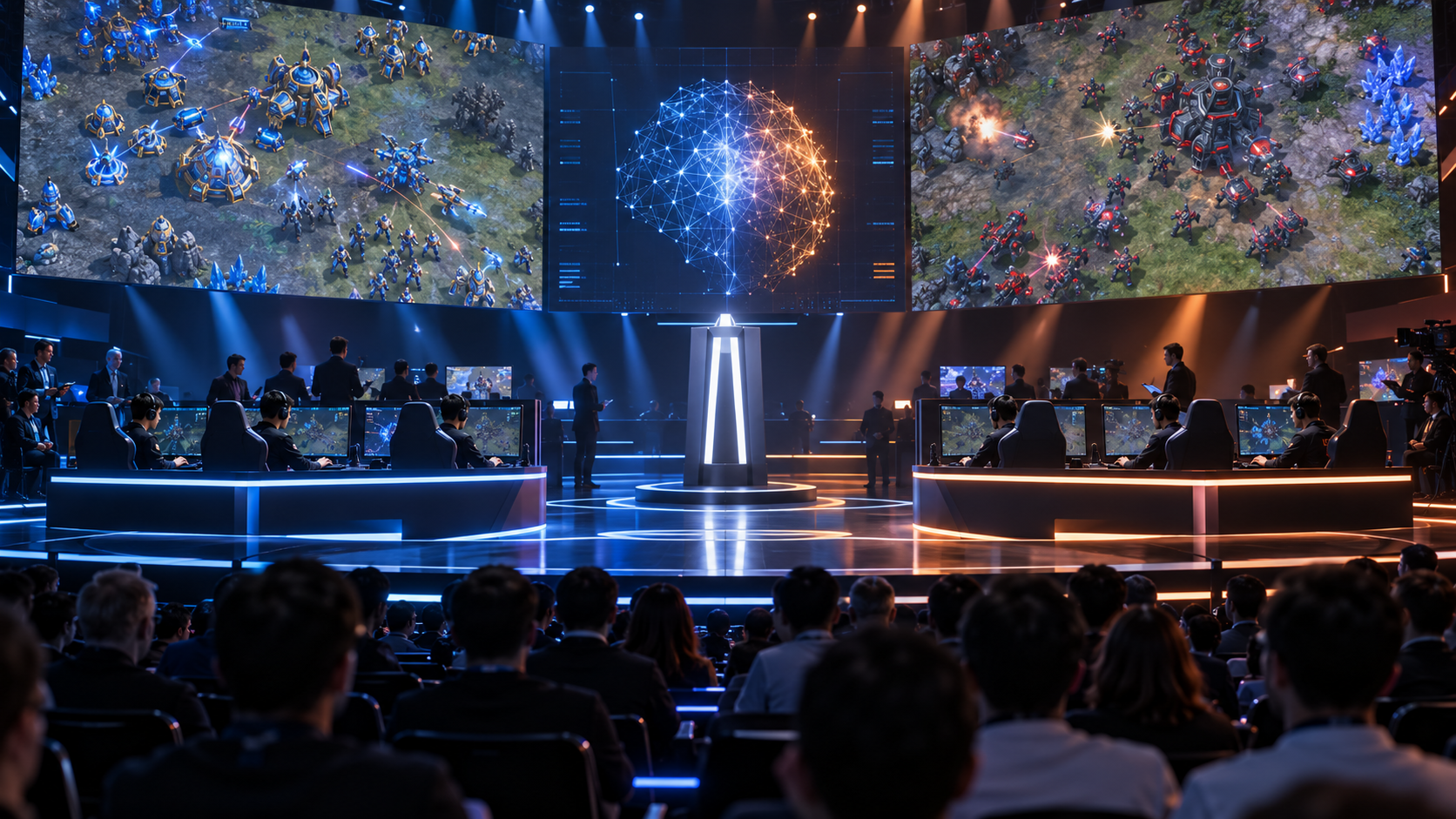
On January 24, 2019, DeepMind publicly revealed AlphaStar, an artificial intelligence system that had defeated professional players at StarCraft II. In matches recorded the previous December, versions of AlphaStar beat Team Liquid players Dario Wunsch, known as TLO, and Grzegorz Komincz, known as MaNa, by five games to zero each. During the live presentation, MaNa won a demonstration rematch against a later version operating under different camera constraints. The London-based research team developed AlphaStar with Blizzard Entertainment, using the Protoss faction on a single map. The results marked a major advance in applying reinforcement learning to a complex real-time strategy environment.
StarCraft II posed different problems from chess or Go. Players had to gather resources, build units, scout hidden territory, infer an opponent’s plans, and issue actions continuously while information remained incomplete. DeepMind trained a league of agents that played against one another, allowing different strategies and counterstrategies to emerge. Neural networks processed the game state, while imitation learning from human replays gave training a useful starting point. The published matches included restrictions intended to keep action rates within human ranges, though critics noted that the original interface allowed the system to view more of the map at once than a human normally could.
The January 24 presentation did not mean StarCraft II was solved. The system was limited to one faction, one map, and a defined match setting, and the camera issue showed how sensitive comparisons could be to interface design. DeepMind later improved the method, and a 2019 Nature paper reported a version reaching grandmaster level across all three factions. AlphaStar mattered because success required long-term planning, rapid control, adaptation, and decision-making under uncertainty within one environment. Those qualities made it a richer research test than a turn-based board game, even though game skill does not automatically transfer to the physical world. The project influenced work on multi-agent learning, automated curricula, and evaluation. It also reinforced an important caution: impressive AI performance depends on the rules, observations, and resources supplied to the system, so fair human comparisons require careful experimental design.
The exhibition also changed how audiences understood reinforcement learning. Instead of watching an agent master a simple score-based game, viewers could recognize scouting, feints, timing, and strategic adaptation similar to human play. That made the achievement intuitive without making it general. The difference mattered: a compelling match can demonstrate a research method while still hiding how much training, simulation, and task-specific engineering produced the performance. AlphaStar’s value was greatest when both sides of that story remained visible.
Players act in real time, manage an economy, control many units, and make plans while much of the map and the opponent's strategy remain hidden.
The combination demands short-term control and long-term judgment rather than a search through a small set of alternating moves.
Human replays provided initial examples, then a league of agents played one another so that strategies, weaknesses, and counterstrategies could evolve.
The public results were limited to a particular faction, map, and interface, making the match conditions essential to interpreting performance.
Later work reached grandmaster level across all three factions and was described in Nature, extending the research beyond the initial demonstration.
AlphaStar influenced reinforcement learning and evaluation while reminding researchers that excellence in a game is not the same as general intelligence.
Explore more of "On This Day ..."
Discover more events from the same date across news, politics, technology, sports, and other fields. Each link highlights significant moments that shaped history on different fronts.