

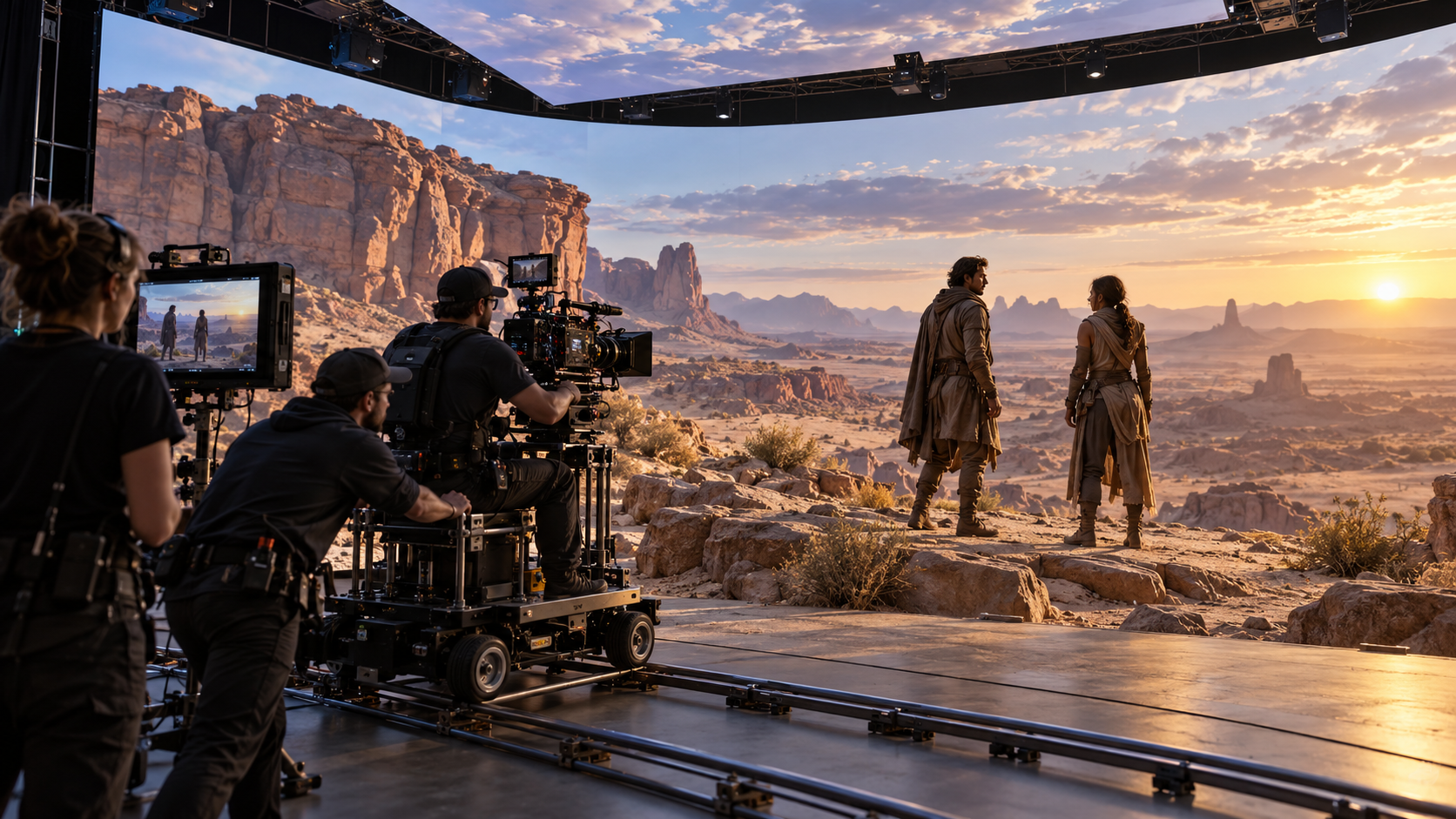
Virtual Production Explainer
Virtual production is a broad group of computer-assisted filmmaking methods that let physical and digital elements interact earlier and more directly. It includes previs, virtual scouting, performance capture, virtual cameras, real-time rendering, and in-camera visual effects on LED stages. Epic Games' field guide describes the approach as a spectrum rather than one piece of equipment. A production can use virtual production without an LED wall, and a shot made on an LED stage can still require conventional sets, lighting, compositing, and post-production.
Previsualization creates rough scenes before photography so filmmakers can explore staging, lenses, camera moves, and editing. Virtual scouting lets departments enter a digital environment and choose views or set changes. During a shoot, camera tracking sends position and lens information to a real-time engine, which updates perspective on surrounding displays. Physical foreground pieces blend with the digital background, while the screens provide interactive light and reflections. The camera records much of that combination in the original photography.
Preparation moves forward because digital environments and decisions must be ready before the shoot instead of being postponed to post-production. Directors, cinematographers, production designers, visual-effects teams, art departments, and technicians collaborate on assets, color, tracking, playback, and camera tests. This can improve shared understanding and reduce some location or compositing problems. It can also make late conceptual changes expensive because the virtual world is now part of the set that performers and cameras depend on.
LED stages have physical limits. Pixel pitch, viewing angle, refresh behavior, brightness, color, moiré, focus, and camera movement affect what can be photographed convincingly. The stage may not fit wide shots or overhead angles, and a digital background does not automatically provide correct lighting for every face or reflective object. Teams use practical lights, ceiling panels, partial sets, depth of field, and careful calibration. Some backgrounds are captured in camera; others are replaced or extended later. The value of virtual production is control and iteration, not a claim that every location should become a screen. Real travel may provide scale, texture, and spontaneity that a volume cannot reproduce economically. Traditional green screen may be better when the environment needs major changes after filming. The method works when selected for the story and planned across departments. It blurs the old linear division among preproduction, production, and post by making digital choices visible and adjustable while the camera is present. A practical way to read or discuss Virtual Production is to separate the basic definition from the choices made in a particular example. Virtual production includes real-time visualization and computer-assisted planning, not only final photography inside an LED volume. Then identify who sets the relevant rules, which parts are creative decisions, and which parts follow from law, contracts, technology, or production limits. Examples that look similar on the surface can operate differently because their purpose, audience, timing, and surrounding agreements are different. Assets, color pipelines, lens data, playback, tracking, and stage geometry require coordinated tests before principal photography. It is also useful to check whether a source is describing a formal industry category, an informal critical label, or one organization's current practice. Those distinctions prevent a memorable anecdote from becoming a false universal rule. The date and market matter too: tools, distribution systems, and standard agreements change, while older examples can preserve assumptions that no longer apply everywhere. When a claim sounds absolute, compare it with a second type of source and look for the conditions under which it is actually true. Finally, compare the visible result with the less visible work that produced it. The approach shifts decisions earlier and supports iteration, but traditional locations, sets, green screen, and later compositing remain valuable alternatives. That approach keeps the explanation grounded while leaving room for reasonable disagreement about borderline cases.
Virtual production includes real-time visualization and computer-assisted planning, not only final photography inside an LED volume.
Camera tracking keeps a rendered environment's perspective aligned with the physical camera, creating parallax as the viewpoint moves.
LED displays can supply backgrounds, reflections, and interactive light, while real foreground pieces give performers and cameras physical reference.
Assets, color pipelines, lens data, playback, tracking, and stage geometry require coordinated tests before principal photography.
Moiré, pixel structure, viewing angle, brightness, focus, stage size, and render performance limit which shots work in camera.
The approach shifts decisions earlier and supports iteration, but traditional locations, sets, green screen, and later compositing remain valuable alternatives.
Explore more "Explainers"
Discover additional explainers across politics, science, business, technology, and other fields. Each explainer breaks down a complex idea into clear, everyday language—helping you better understand how major concepts, systems, and debates shape the world around us.