

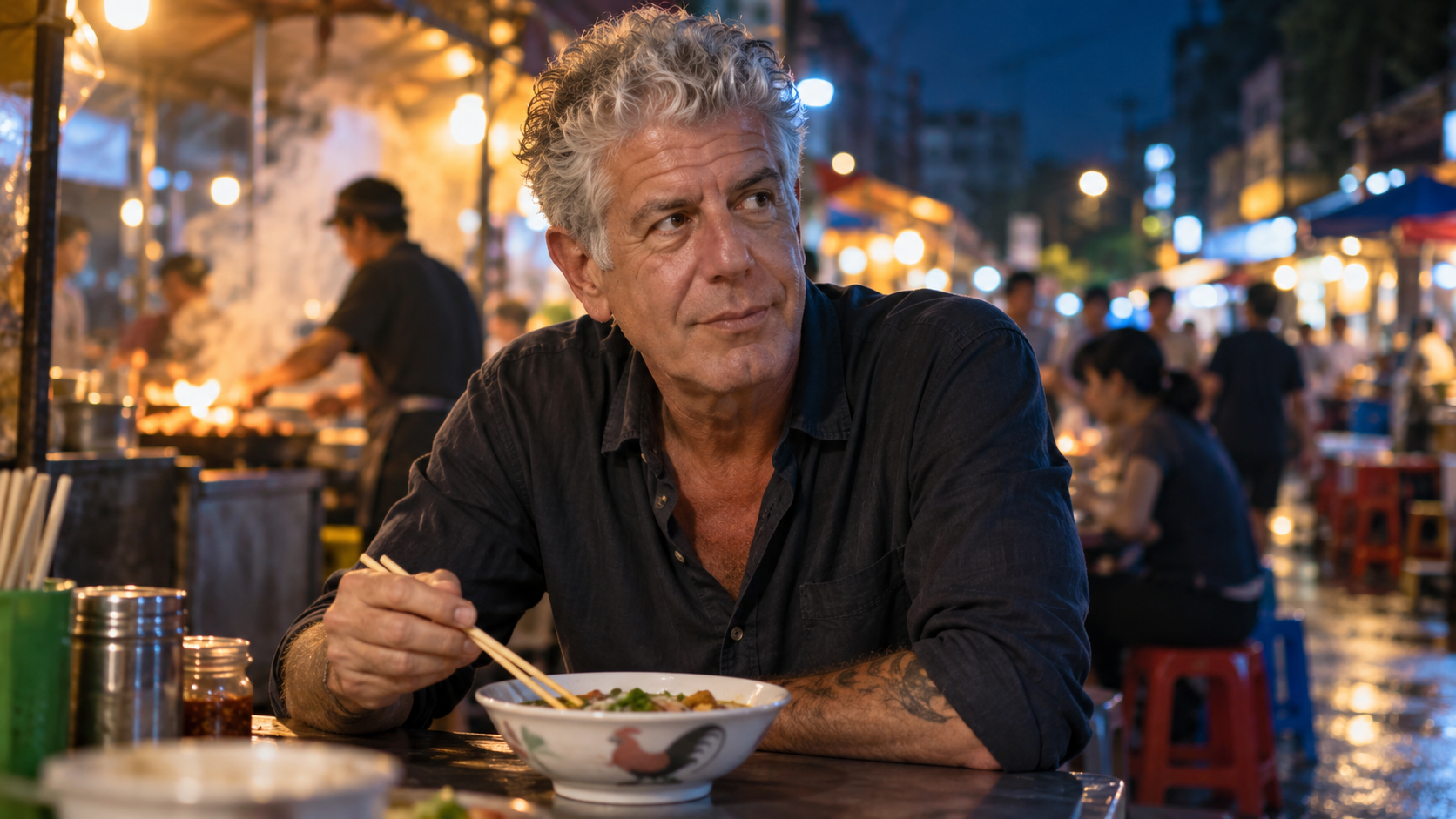
“If I’m an advocate for anything, it’s to move.”
Anthony Bourdain wrote, “If I’m an advocate for anything, it’s to move,” in No Reservations: Around the World on an Empty Stomach, published in 2007. The sentence introduces a longer appeal to cross distance, walk in another person’s shoes, and eat their food. It distilled the method of his travel television: leave the controlled set, enter a place through meals and conversation, and let the encounter complicate the story prepared in advance. Movement was geographical, but its intended result was mental—a loosening of certainty about people previously known only through headlines or stereotype.
Food made that method accessible. A shared table can reveal labor, family, class, migration, ritual, pleasure, and conflict without pretending that a meal explains an entire society. Bourdain’s strongest episodes allowed expertise to remain local. Cooks, guides, artists, workers, and friends shaped the route and sometimes corrected the host’s assumptions on camera. The value of moving, then, was not collecting destinations as proof of sophistication. It was accepting the risk that a real place would resist the visitor’s preferred narrative.
Travel does not automatically produce understanding. Money and passports determine who can move freely, tourism can extract from communities, and a charismatic visitor may still turn another person’s life into scenery. Brief contact is not the same as knowledge. Bourdain’s own work is best read as an invitation to humility rather than a claim of mastery. Movement becomes meaningful when it includes listening, fair exchange, accurate context, and awareness of the power held by the person with the camera and the ability to leave.
The quote remains valuable even when long-distance travel is impossible. Movement can mean crossing a neighborhood boundary, reading work translated from another language, eating somewhere without ordering the familiar dish, or asking a colleague to explain a tradition rather than performing expertise about it. The practice is to enter with a question and leave with a more complicated one. Document less than you observe; verify the story before repeating it; credit the person who changed your understanding. Bourdain’s advocacy was not for motion as consumption. It was for exposure to difference strong enough to disturb a sealed worldview and make the next judgment less automatic. A responsible traveler returns with fewer claims of mastery and more precise gratitude for the people who made the encounter possible, including the essential local labor that tourism usually leaves outside the camera’s most carefully chosen narrative frame.
Bourdain wrote the line in his 2007 book No Reservations: Around the World on an Empty Stomach. It summarized the approach of his travel work: cross distance, share food, and allow encounters with local people to challenge assumptions carried from home.
Movement is not the same as understanding. Travel is shaped by money, passports, extraction, and the camera’s power. The quote is strongest as an ethic of humility: listen, exchange fairly, verify context, and resist treating another community as scenery.
Choose one nearby boundary of habit—neighborhood, cuisine, language, or social circle—and cross it without pretending expertise. Ask a genuine question, observe more than you document, and credit the person whose knowledge complicates your first interpretation.
Explore more "Quotes of The Day"
Discover more notable quotes from influential voices across politics, science, business, technology, sports, and culture. Each quote offers insight into how ideas, beliefs, and decisions shape the world around us.