

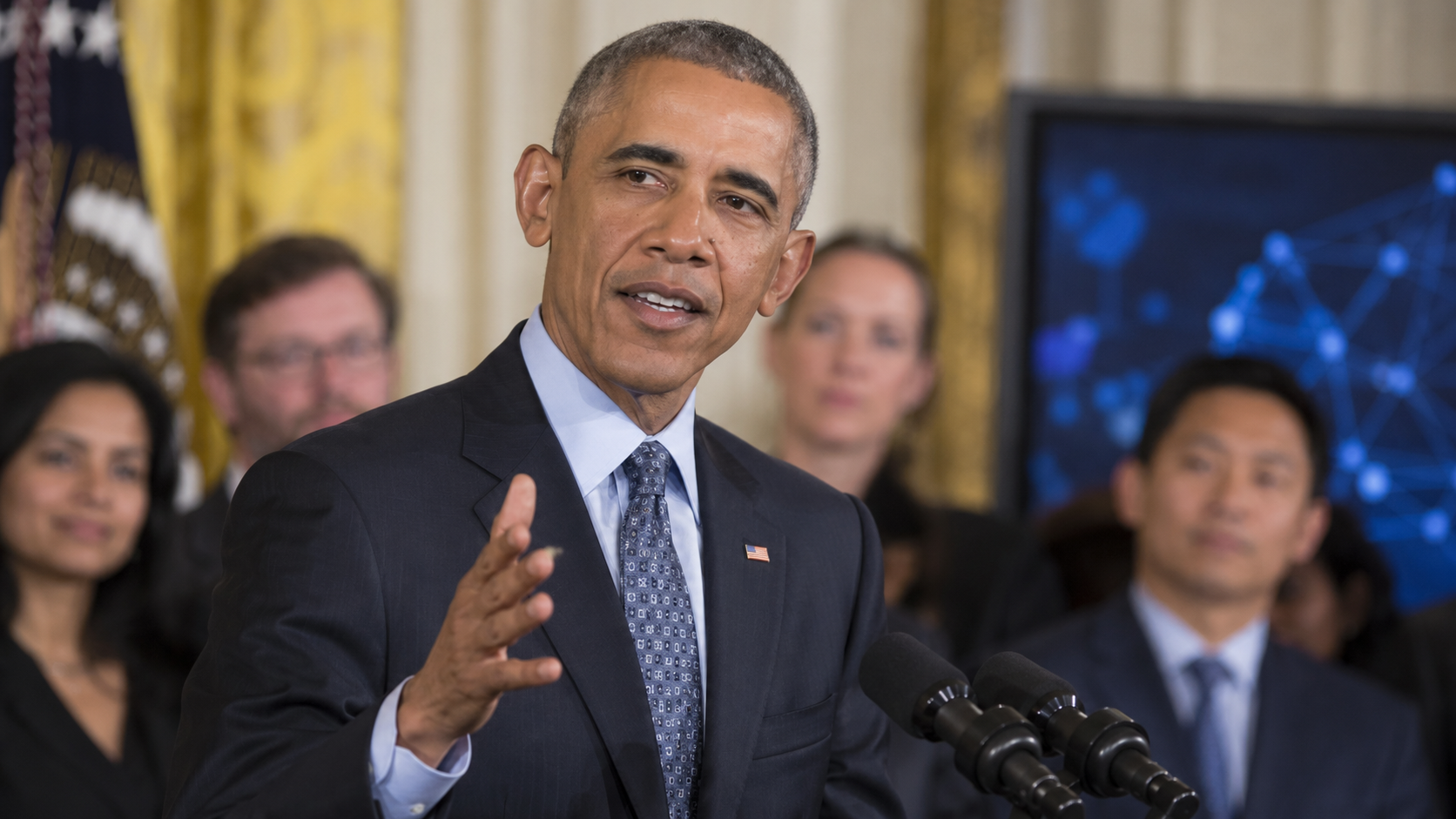
“You’re harnessing the power of artificial intelligence—big data, robotics, automation—for the good of all of us.”
President Barack Obama made this remark at a 2016 White House Frontiers Conference devoted to science, technology, and innovation. He was addressing researchers, entrepreneurs, students, and civic leaders working on problems from health to transportation. The statement treats artificial intelligence, data, robotics, and automation as tools with a public purpose. Technical progress becomes meaningful when it improves collective life, not simply when it creates a more capable machine or a profitable product. The phrase “all of us” supplies the demanding part of the standard.
Innovation often produces benefits unevenly. Automation may lower costs and improve services while also eliminating tasks, changing wages, or concentrating returns among owners of data and infrastructure. A medical model may perform well but remain unavailable to communities that lack clinicians or reliable internet access. A city may optimize traffic while expanding surveillance. Aggregate growth cannot show whether particular groups receive opportunity or bear risk. Public benefit must therefore be examined across workers, consumers, neighborhoods, generations, and people with different abilities.
Government has several roles in shaping that distribution. It can fund basic research whose value is too broad or uncertain for a single company to capture. It can modernize education and worker support, enforce competition and civil-rights law, protect privacy, and make public data available responsibly. Procurement can require evidence, security, accessibility, and appeal rights from vendors. Regulation should respond to the stakes and use of a system rather than to the glamour of the AI label. Public institutions also need technical expertise so they can test claims instead of outsourcing judgment.
The quote captures a choice that remains current. AI can help scientists search large spaces, make services easier to navigate, and give individuals new creative and analytical tools. It can also scale manipulation, exclusion, and control. The technology does not decide which path wins. Business models, labor practices, public investment, and enforceable rules channel capability toward particular ends. Democratic participation matters because the people affected by automation should have a voice in defining progress. A future built for everyone requires more than wide access to a product; it requires shared authority over the systems changing public life. “For the good of all” is not a prediction; it is a political standard. It asks leaders to judge technology by the distribution of power, opportunity, security, and voice that follows from its adoption. Progress should remain visible in people’s lives, not only in investment totals or technical leaderboards.
Obama spoke at a White House gathering focused on applying science and technology to major public challenges.
His remarks connected innovation with civic responsibility, opportunity, education, and preparation for economic change.
Lower costs or higher productivity do not reveal who gains income, access, security, time, or decision-making power.
Evaluation should examine effects across workers, communities, consumers, generations, and people with different abilities.
Research funding, competition policy, civil-rights enforcement, education, procurement, and privacy rules all influence AI’s direction.
Technical capacity inside government is essential for testing claims and protecting the public interest.
Explore more "Quotes of The Day"
Continue exploring how writers, thinkers, artists, and advocates have described the choices that shape an everyday life.