

Sound Mixing Explainer
Sound mixing is the craft of balancing, shaping, and placing the many audio elements that form a film or television soundtrack. The phrase can refer to production mixing on set, where dialogue and atmosphere are recorded during photography, and to rerecording mixing in post-production, where dialogue, sound effects, ambience, Foley, and music are combined into final versions. In both stages, the objective is clarity and storytelling, not simply loudness. The audience should understand what matters while feeling that the sound belongs to the pictured space.
On set, the production sound mixer leads the team responsible for capturing usable dialogue, often with a boom microphone, hidden radio microphones, and a multitrack recorder. The mixer monitors levels, interference, clothing noise, reflections, traffic, machinery, and other problems that may be hard to remove later. Individual microphones can be recorded separately while a working mix helps editorial and playback. Good production sound preserves performance and natural interaction, but the camera, lighting, costume, location, and schedule all create practical compromises.
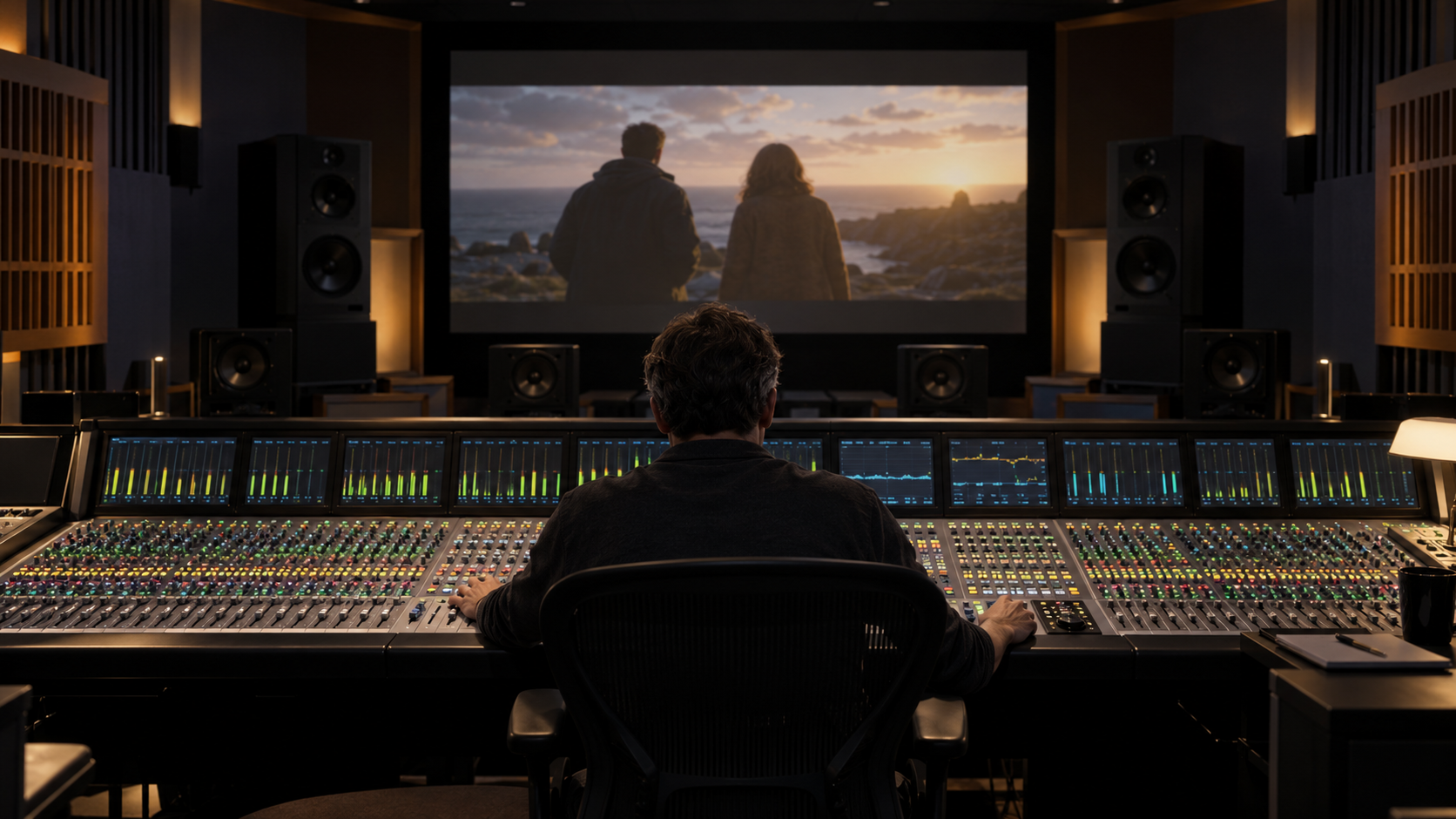
Post-production expands the soundtrack. Dialogue editors select and clean recordings; actors may replace unusable lines through automated dialogue replacement; Foley supplies synchronized human-scale movement; effects editors build events and environments; and composers deliver music. Rerecording mixers bring these components together on a mixing stage. They adjust level, equalization, dynamics, reverberation, panning, and perspective so a close voice, distant vehicle, enclosed room, and musical cue occupy a believable hierarchy rather than competing at full intensity.
A final mix is shaped for delivery formats. A cinema auditorium, television, headphones, phone, and accessibility track do not reproduce sound in the same way. Productions may create several mixes or controlled downmixes, check dialogue intelligibility at realistic listening levels, and maintain specifications for loudness and peaks. Surround and immersive formats can place sound around or above the audience, but more channels do not guarantee better storytelling. Spatial movement must support attention and remain coherent when the work is heard through fewer speakers. Mixing also involves restraint. Silence, reduced ambience, or a temporarily narrow sound field can be more expressive than constant impact. A mixer may let dialogue dominate, allow music to carry a transition, or use an off-screen sound to redirect the viewer before the image changes. The work depends on collaboration with directors, editors, supervising sound editors, composers, and producers. To listen critically, notice what remains understandable in a dense scene, how distance changes a sound's character, and when the balance guides attention without calling attention to the machinery behind it. A practical way to read or discuss Sound Mixing is to begin with the basic definition and then identify the choices made in a particular example. Production mixing records dialogue and location sound during photography; rerecording mixing combines and finishes the soundtrack during post-production. Next, ask who sets the relevant rules, who performs the work, and which results follow from creative judgment, law, contracts, technology, budget, or production limits. Similar-looking examples can operate differently because their audience, market, format, timing, and agreements are different. Level is only one control: equalization, dynamics, reverberation, panning, automation, and editing create intelligibility, scale, and acoustic perspective. It also helps to distinguish a formal industry category from an informal critical label or one organization's current practice. That separation keeps a memorable anecdote from becoming a false universal rule. Dates and territories matter: tools, distribution systems, audience behavior, and standard agreements change, while older examples can preserve assumptions that no longer apply everywhere. When a claim sounds absolute, compare it with a second kind of source and look for the conditions under which the claim is true. Then trace the process from the visible result back through the less visible decisions, handoffs, and quality checks that produced it. Effective mixing creates hierarchy; not every element should be equally prominent, and silence or reduced density can be an intentional part of the design. Finally, compare the example with a contrasting case and note which part of the definition still holds. This method keeps the explanation grounded, highlights the people and systems behind the outcome, and leaves room for reasonable disagreement about hybrid or borderline cases.
Production mixing records dialogue and location sound during photography; rerecording mixing combines and finishes the soundtrack during post-production.
Boom and radio microphones provide different perspectives, and isolated tracks preserve options even when a temporary mix is recorded for editorial use.
Dialogue, ADR, Foley, designed effects, ambience, and music are prepared by specialist teams before they reach the final mixing stage.
Level is only one control: equalization, dynamics, reverberation, panning, automation, and editing create intelligibility, scale, and acoustic perspective.
Cinema, broadcast, streaming, headphone, stereo, surround, and accessibility deliveries may require distinct checks or versions rather than one universal playback result.
Effective mixing creates hierarchy; not every element should be equally prominent, and silence or reduced density can be an intentional part of the design.
Explore more "Explainers"
Discover additional explainers across politics, science, business, technology, and other fields. Each explainer breaks down a complex idea into clear, everyday language—helping you better understand how major concepts, systems, and debates shape the world around us.