

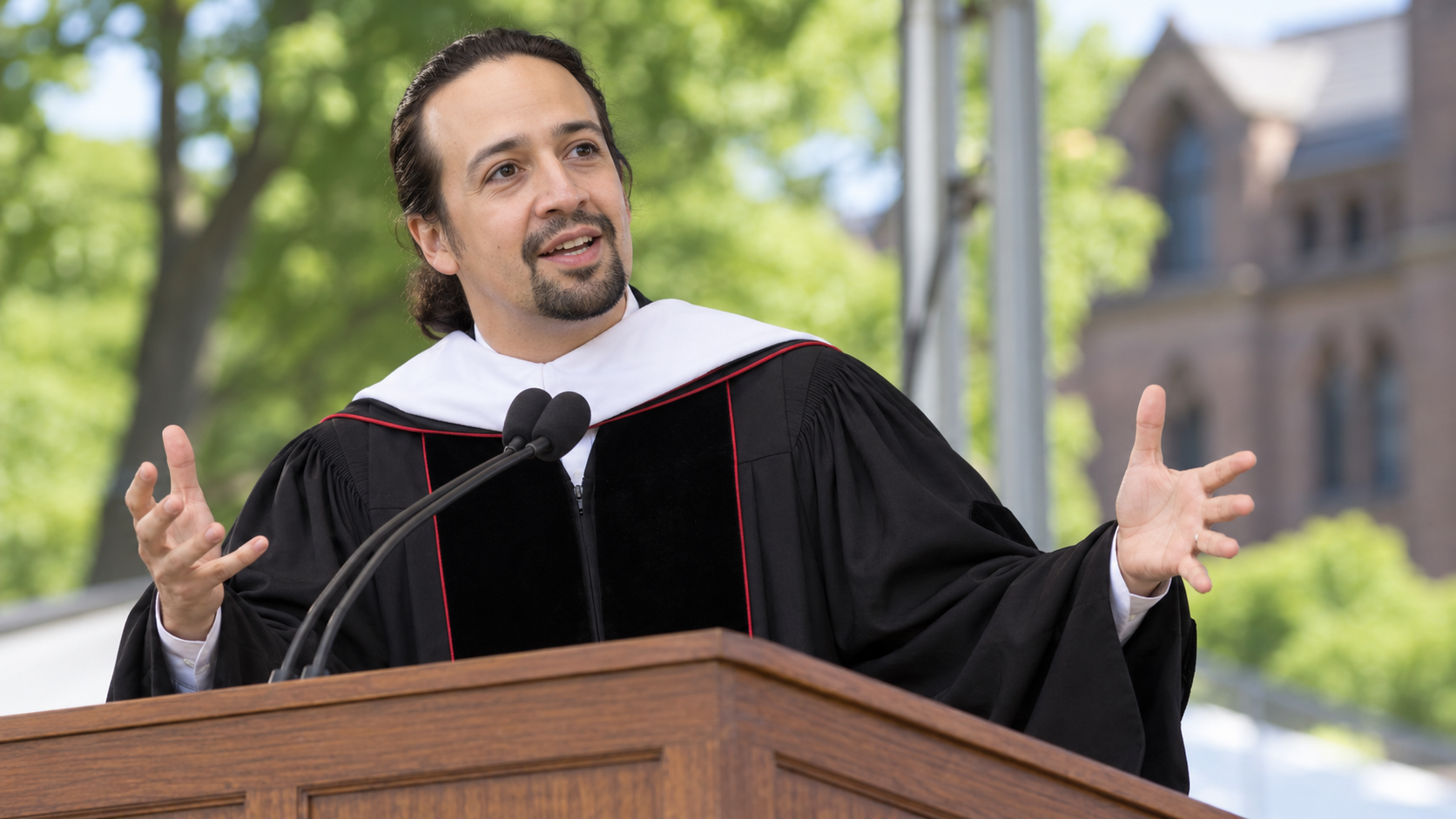
“That clock you hear is the sound of your own heart. Sink your teeth into this life, and don’t let go.”
Lin-Manuel Miranda said, “That clock you hear is the sound of your own heart. Sink your teeth into this life, and don’t let go.” in 2015. Miranda closed Wesleyan’s 2015 commencement after describing two clocks: the fast clock of college ending and the slower, heavier clock of mortality. He used characters from Hamilton to contrast rushing toward a goal with waiting for the right moment. His conclusion refused to choose one rhythm; life requires acting and waiting while time continues through both. Read in full, the line belongs to a specific public moment rather than a floating piece of motivational language. That setting matters because it shows what problem the speaker was naming and which audience was being asked to respond.
The quotation’s force lies in the way it compresses a larger creative argument. Urgency is often reduced to speed, but the sentence asks for presence. To sink one’s teeth into life is to notice relationships, work, and goodbyes while still reaching toward what comes next. Miranda’s theatrical image recognizes that ambition can pull attention into the future. The heartbeat brings it back to the body and to the finite time in which a story can be lived. In popular culture, a short sentence travels farther than its original speech, but its value depends on keeping the work, relationships, and history around it visible. The line becomes more useful when it changes how a decision is made rather than merely decorating an image.
The useful reading also needs limits. Awareness of mortality can focus a person, but it can also intensify anxiety or glorify overwork. Not every pause is wasted and not every opportunity must be seized. Miranda’s speech itself balanced “my shot” with “wait for it.” The useful tension is between engagement and patience: act where action is possible, while allowing development, recovery, and other people’s timing to matter. Context protects the quotation from becoming a slogan that asks individuals to solve every structural problem alone. It also preserves room for disagreement, revision, and circumstances the original stage could not contain. A durable lesson should increase agency without simplifying the lives to which it is applied.
For a practical application, Identify one moment this week that deserves full attention and one long project that requires patience. Protect the first from distraction and give the second a modest scheduled step. Do not force both onto the same clock. Miranda’s line becomes sustainable when urgency means caring deeply about the present, not treating every hour as an emergency or every delay as a failure of ambition. The aim is a repeatable behavior, not a burst of inspiration that disappears by tomorrow. A quotation earns its place in daily life when it sharpens observation, creates a better question, or supports a more responsible next choice. That is how a famous line can remain alive after the applause and the headline have passed.
Miranda closed Wesleyan’s 2015 commencement after describing two clocks: the fast clock of college ending and the slower, heavier clock of mortality. He used characters from Hamilton to contrast rushing toward a goal with waiting for the right moment. His conclusion refused to choose one rhythm; life requires acting and waiting while time continues through both.
Awareness of mortality can focus a person, but it can also intensify anxiety or glorify overwork. Not every pause is wasted and not every opportunity must be seized. Miranda’s speech itself balanced “my shot” with “wait for it.” The useful tension is between engagement and patience: act where action is possible, while allowing development, recovery, and other people’s timing to matter.
Identify one moment this week that deserves full attention and one long project that requires patience. Protect the first from distraction and give the second a modest scheduled step. Do not force both onto the same clock. Miranda’s line becomes sustainable when urgency means caring deeply about the present, not treating every hour as an emergency or every delay as a failure of ambition.
Explore more "Quotes of The Day"
Discover more notable quotes from influential voices across politics, science, business, technology, sports, and culture. Each quote offers insight into how ideas, beliefs, and decisions shape the world around us.