

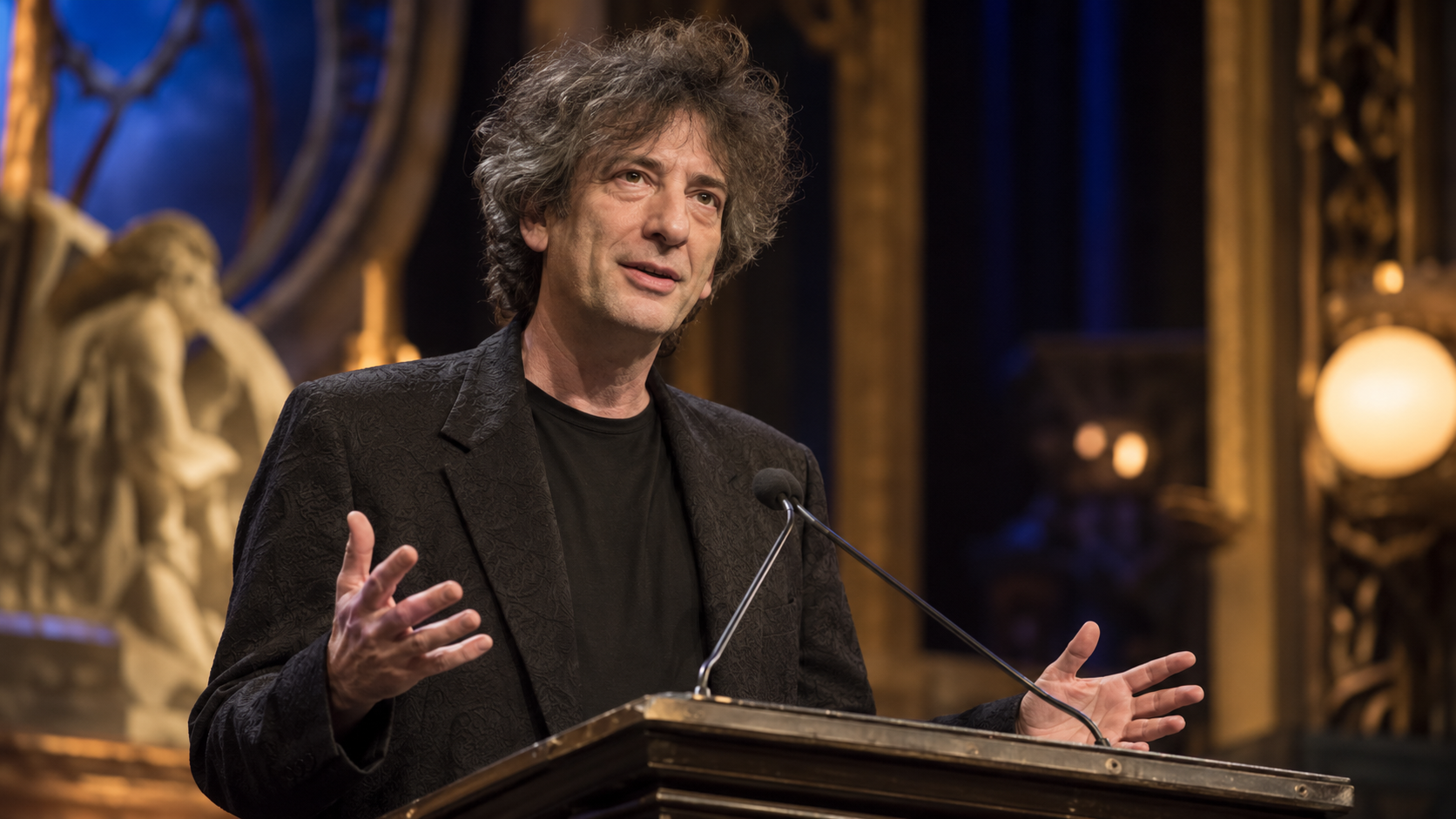
“Go and make interesting mistakes, make amazing mistakes, make glorious and fantastic mistakes.”
Neil Gaiman said, “Go and make interesting mistakes, make amazing mistakes, make glorious and fantastic mistakes.” in 2012. Gaiman delivered the line to the University of the Arts class of 2012 in the speech remembered as “Make Good Art.” He addressed graduates entering creative fields without a dependable map, drawing on a career built outside a conventional plan. His list of mistakes was exuberant because it tied error to experimentation, novelty, and the freedom to make work that had not existed before. Read in full, the line belongs to a specific public moment rather than a floating piece of motivational language. That setting matters because it shows what problem the speaker was naming and which audience was being asked to respond.
The quotation’s force lies in the way it compresses a larger creative argument. An interesting mistake contains information. It may reveal a voice, process, or possibility that a perfectly executed imitation would never uncover. Gaiman’s repetition turns failure from a shameful interruption into part of artistic movement. The adjective matters: the goal is not carelessness but the kind of error produced when ambition reaches beyond a creator’s current technique and forces learning to occur. In popular culture, a short sentence travels farther than its original speech, but its value depends on keeping the work, relationships, and history around it visible. The line becomes more useful when it changes how a decision is made rather than merely decorating an image.
The useful reading also needs limits. Mistakes can harm collaborators, budgets, audiences, or the people represented in a work. Those errors require repair, not romantic language. Experimentation still needs consent, research, and professional responsibility. The quote is best applied to creative risk whose costs are understood and contained. Repeating the same avoidable problem is not bold; it is evidence that reflection or a production system has failed. Context protects the quotation from becoming a slogan that asks individuals to solve every structural problem alone. It also preserves room for disagreement, revision, and circumstances the original stage could not contain. A durable lesson should increase agency without simplifying the lives to which it is applied.
For a practical application, Design a small experiment in which failure will be affordable and visible. Change one variable—a form, tool, scale, or collaborator—and decide what you hope to learn. Afterward, record the unexpected result before judging whether it is useful. Gaiman’s advice turns practice into exploration: make the mistake distinctive enough to teach you something, then carry the lesson forward instead of polishing all evidence of risk away. The aim is a repeatable behavior, not a burst of inspiration that disappears by tomorrow. A quotation earns its place in daily life when it sharpens observation, creates a better question, or supports a more responsible next choice. That is how a famous line can remain alive after the applause and the headline have passed.
Gaiman delivered the line to the University of the Arts class of 2012 in the speech remembered as “Make Good Art.” He addressed graduates entering creative fields without a dependable map, drawing on a career built outside a conventional plan. His list of mistakes was exuberant because it tied error to experimentation, novelty, and the freedom to make work that had not existed before.
Mistakes can harm collaborators, budgets, audiences, or the people represented in a work. Those errors require repair, not romantic language. Experimentation still needs consent, research, and professional responsibility. The quote is best applied to creative risk whose costs are understood and contained. Repeating the same avoidable problem is not bold; it is evidence that reflection or a production system has failed.
Design a small experiment in which failure will be affordable and visible. Change one variable—a form, tool, scale, or collaborator—and decide what you hope to learn. Afterward, record the unexpected result before judging whether it is useful. Gaiman’s advice turns practice into exploration: make the mistake distinctive enough to teach you something, then carry the lesson forward instead of polishing all evidence of risk away.
Explore more "Quotes of The Day"
Discover more notable quotes from influential voices across politics, science, business, technology, sports, and culture. Each quote offers insight into how ideas, beliefs, and decisions shape the world around us.