

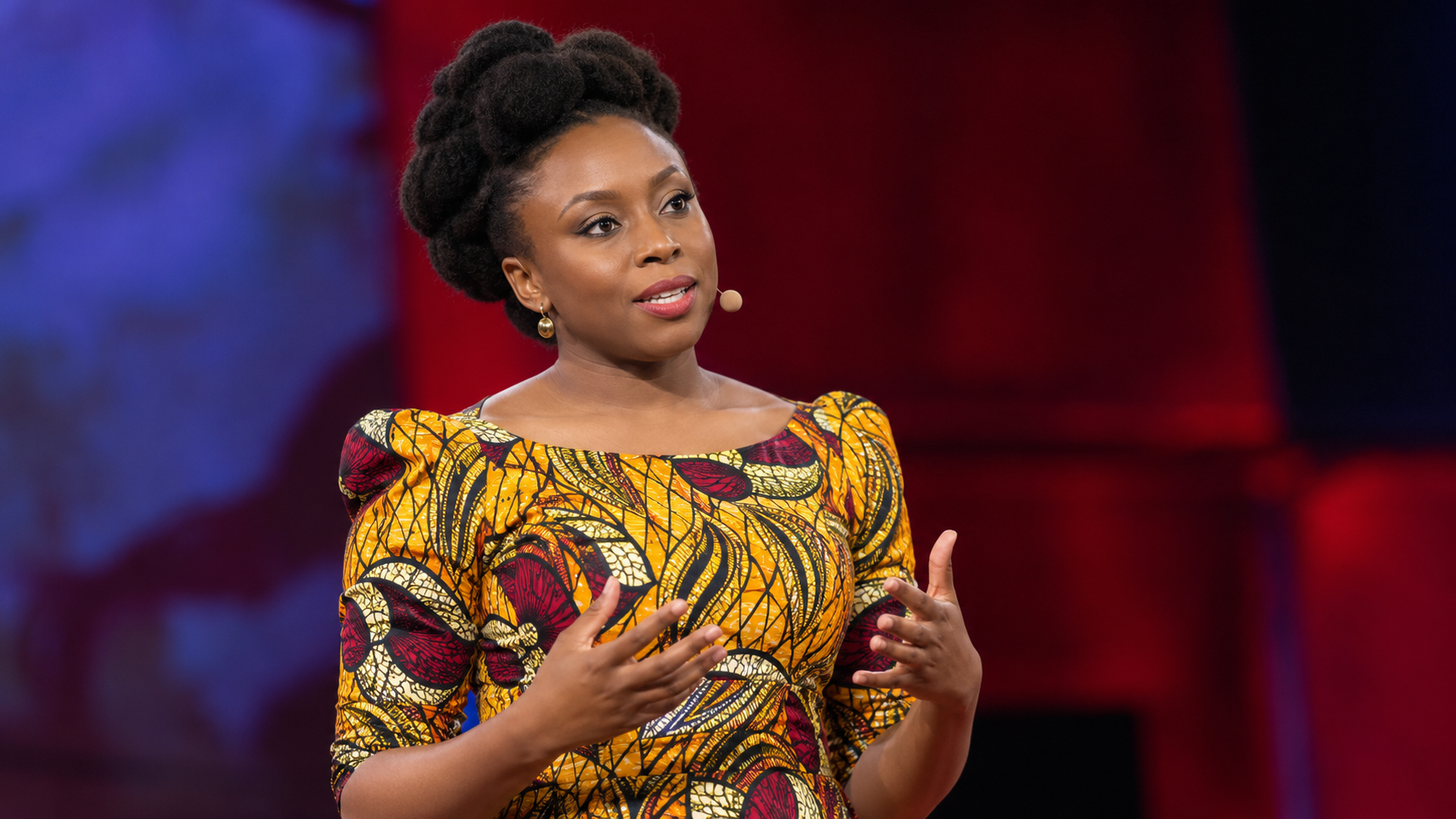
“Culture does not make people. People make culture.”
Chimamanda Ngozi Adichie said, “Culture does not make people. People make culture.” in 2012. Adichie made the statement in her TEDxEuston talk “We Should All Be Feminists.” She was challenging the claim that women’s subordination must be accepted because it is cultural. Drawing on Nigerian examples and her own family, she noted that customs change across time and argued that a tradition denying women’s full humanity should be remade rather than defended as permanent. Read in full, the line belongs to a specific public moment rather than a floating piece of motivational language. That setting matters because it shows what problem the speaker was naming and which audience was being asked to respond.
The quotation’s force lies in the way it compresses a larger creative argument. Culture can feel larger than any individual because it is carried through language, ritual, media, and institutions. Yet each repetition is also a human choice. Films, songs, jokes, and family habits do not merely reflect a society; they teach people what the society will reward or ridicule. Adichie’s reversal makes that process visible and therefore available for revision. In popular culture, a short sentence travels farther than its original speech, but its value depends on keeping the work, relationships, and history around it visible. The line becomes more useful when it changes how a decision is made rather than merely decorating an image.
The useful reading also needs limits. Changing culture is not as simple as choosing a new attitude. Power determines whose choices become rules, whose stories receive distribution, and who faces punishment for dissent. Respect for tradition can coexist with criticism, and communities should not be treated as static or homogeneous. The line creates responsibility without pretending that every person has equal authority to reshape a shared system. Context protects the quotation from becoming a slogan that asks individuals to solve every structural problem alone. It also preserves room for disagreement, revision, and circumstances the original stage could not contain. A durable lesson should increase agency without simplifying the lives to which it is applied.
For a practical application, Notice one cultural practice you describe as inevitable and replace “that’s just how it is” with a historical question: when did it begin, who maintains it, and who is excluded? Support a creator or institution offering a fuller alternative. Adichie’s sentence turns criticism into authorship. People inherit culture, but they also edit it through what they repeat, fund, challenge, and teach to the next person. The aim is a repeatable behavior, not a burst of inspiration that disappears by tomorrow. A quotation earns its place in daily life when it sharpens observation, creates a better question, or supports a more responsible next choice. That is how a famous line can remain alive after the applause and the headline have passed.
Adichie made the statement in her TEDxEuston talk “We Should All Be Feminists.” She was challenging the claim that women’s subordination must be accepted because it is cultural. Drawing on Nigerian examples and her own family, she noted that customs change across time and argued that a tradition denying women’s full humanity should be remade rather than defended as permanent.
Changing culture is not as simple as choosing a new attitude. Power determines whose choices become rules, whose stories receive distribution, and who faces punishment for dissent. Respect for tradition can coexist with criticism, and communities should not be treated as static or homogeneous. The line creates responsibility without pretending that every person has equal authority to reshape a shared system.
Notice one cultural practice you describe as inevitable and replace “that’s just how it is” with a historical question: when did it begin, who maintains it, and who is excluded? Support a creator or institution offering a fuller alternative. Adichie’s sentence turns criticism into authorship. People inherit culture, but they also edit it through what they repeat, fund, challenge, and teach to the next person.
Explore more "Quotes of The Day"
Discover more notable quotes from influential voices across politics, science, business, technology, sports, and culture. Each quote offers insight into how ideas, beliefs, and decisions shape the world around us.