

On This Day in AI: April 4, 2022
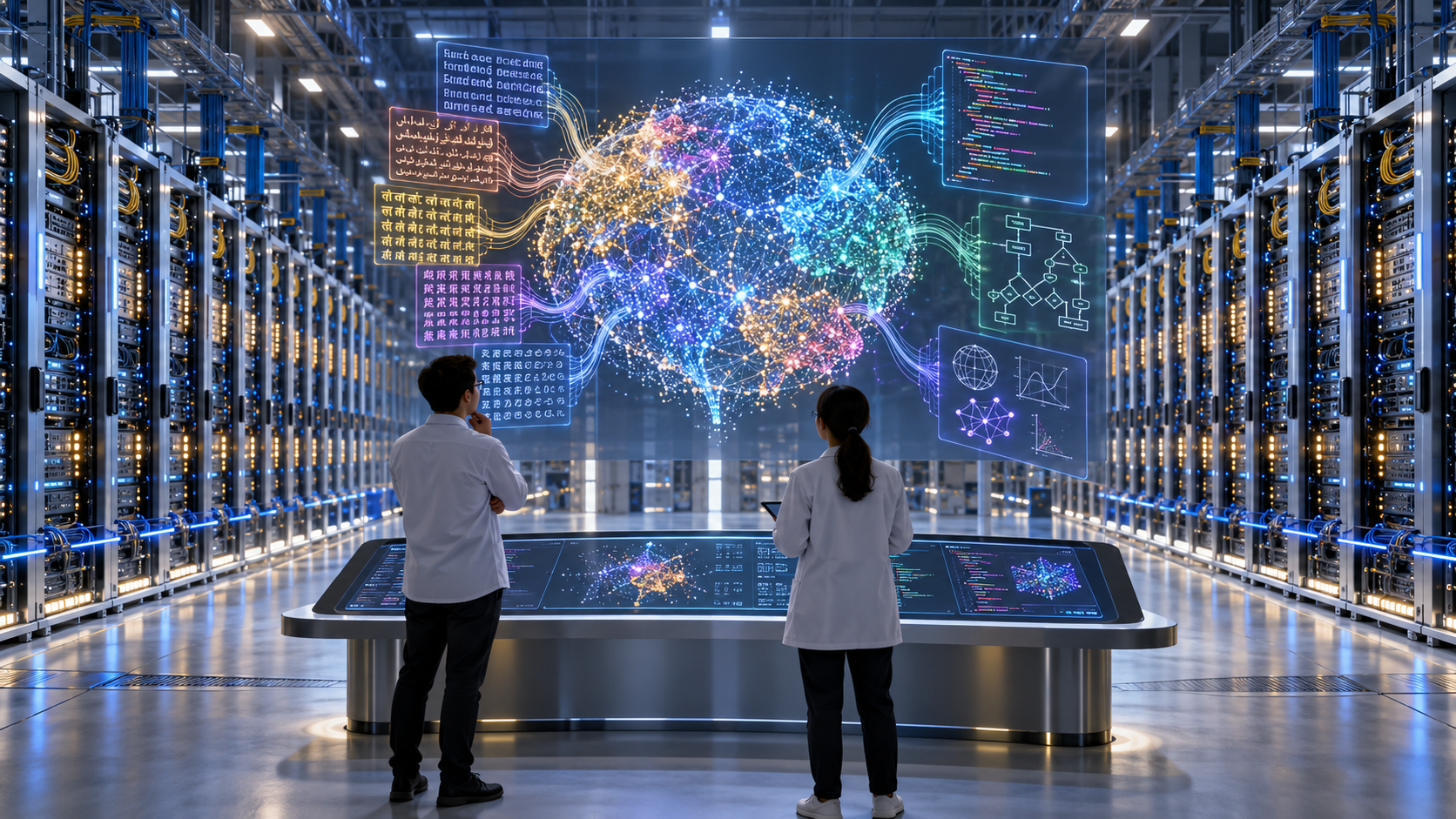
On April 4, 2022, Google announced PaLM, a 540-billion-parameter language model trained across thousands of TPU chips with the Pathways system. The model demonstrated strong few-shot performance across language understanding, generation, reasoning, translation, and code while revealing sharp gains on some tasks as scale increased. Large language models had already shown that one pretrained network could adapt to many tasks from examples in a prompt. Researchers were testing how far that pattern could scale and whether a single model could combine multilingual knowledge, symbolic reasoning, and program synthesis without separate task-specific training. The date matters because it turned a fast-moving technical or policy development into a visible milestone that people, institutions, and researchers could evaluate.
The substance of Google’s introduction of the Pathways Language Model was as important as the headline. PaLM was trained on 780 billion tokens using 6,144 TPU v4 chips. Google highlighted results on hundreds of evaluations, including BIG-bench tasks, chain-of-thought reasoning, explanation generation, and source-code understanding, while also documenting bias, toxicity, and memorization risks. Those choices reveal what the people behind the milestone believed was necessary at the time. AI history rarely advances through one breakthrough alone; research, product design, infrastructure, governance, and access all shape what a system can become.
The immediate consequences reached beyond the organization at the center of the event. The release became a major proof point for scaling laws and for Google’s Pathways vision of broadly capable models. It also helped make chain-of-thought prompting a central research direction by showing that sufficiently large systems could improve when encouraged to produce intermediate reasoning steps. The moment also invited scrutiny, because new capabilities create new dependencies. Reliability, safety, cost, privacy, and human control determine whether an impressive demonstration becomes a trustworthy part of everyday life. Those practical limits are essential to understanding both the achievement and the response it received.
In retrospect, PaLM led to specialized systems such as Minerva and influenced later Google language models, including the PaLM 2 and Gemini eras. Its significance lies in joining vast computing scale with general-purpose prompting and in making emergent abilities a central question for AI research. Looking back from today’s rapidly changing AI landscape, this event belongs to a larger transition from specialized machine-learning experiments to systems embedded in ordinary products, workplaces, institutions, and public decisions. Its enduring lesson is that technical progress becomes historically significant when it changes what people can do and what society expects next. That connection between capability and consequence gives the milestone its lasting relevance. The anniversary therefore records a turning point, not simply an announcement.
Google announced PaLM, a 540-billion-parameter language model trained across thousands of TPU chips with the Pathways system. The model demonstrated strong few-shot performance across language understanding, generation, reasoning, translation, and code while revealing sharp gains on some tasks as scale increased.
PaLM was trained on 780 billion tokens using 6,144 TPU v4 chips. Google highlighted results on hundreds of evaluations, including BIG-bench tasks, chain-of-thought reasoning, explanation generation, and source-code understanding, while also documenting bias, toxicity, and memorization risks.
The release became a major proof point for scaling laws and for Google's Pathways vision of broadly capable models. It also helped make chain-of-thought prompting a central research direction by showing that sufficiently large systems could improve when encouraged to produce intermediate reasoning steps.
The event connected a concrete technical, commercial, or policy decision with the wider development of artificial intelligence.
PaLM led to specialized systems such as Minerva and influenced later Google language models, including the PaLM 2 and Gemini eras. Its significance lies in joining vast computing scale with general-purpose prompting and in making emergent abilities a central question for AI research.
Its influence can be traced through later products, research, governance, or industry practice.
Explore more of "On This Day ..."
Discover more events from the same date across news, politics, technology, sports, and other fields. Each link highlights significant moments that shaped history on different fronts.