

On This Day in AI: April 29, 2021
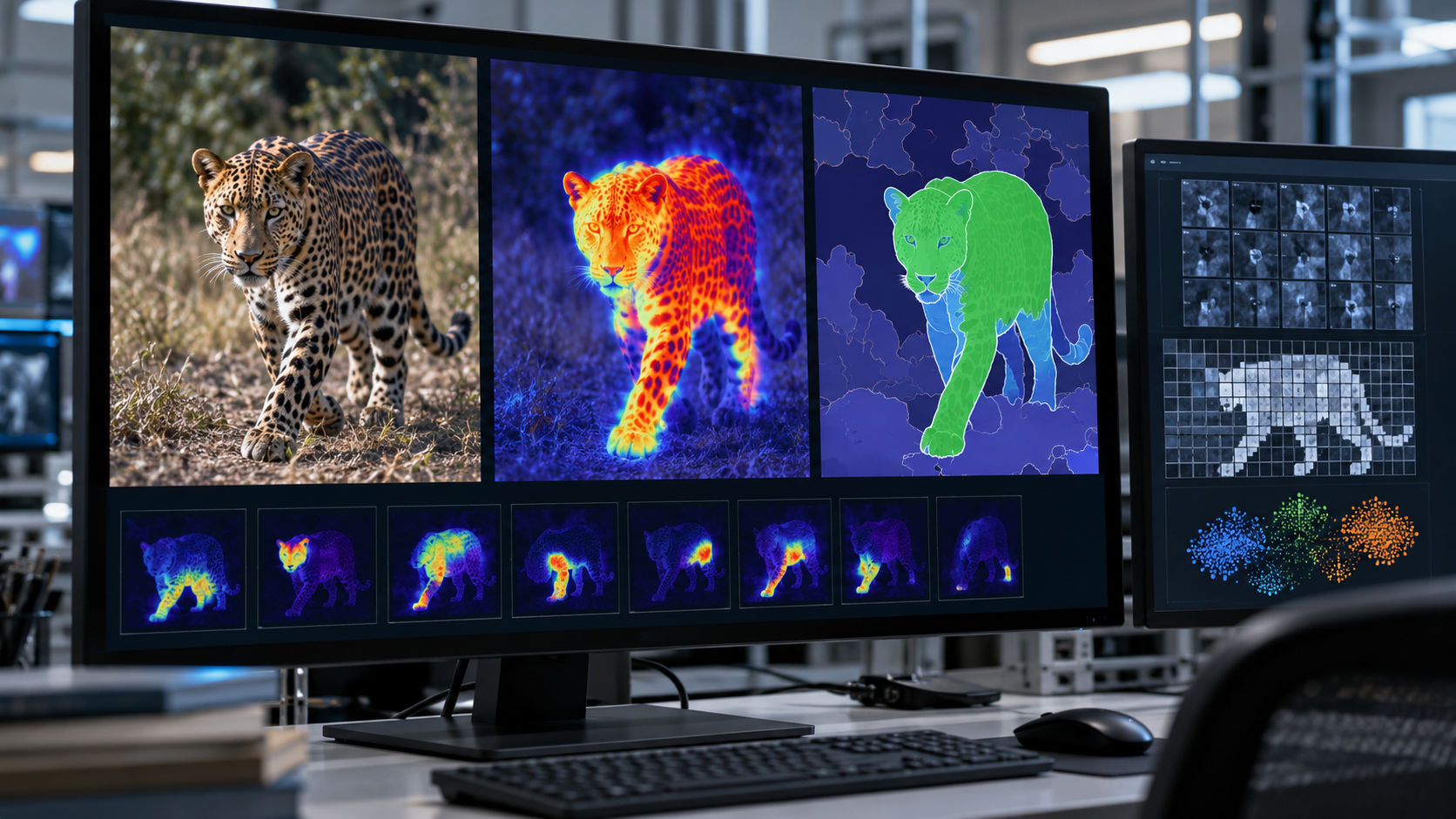
On April 29, 2021, Facebook AI researchers introduced DINO, a self-distillation method that trained Vision Transformers without labeled images. The resulting models produced strong classification features and displayed attention maps that discovered object boundaries even though they had never been taught segmentation labels. Vision Transformers had shown promise, but their success often depended on massive supervised datasets. Researchers wanted methods that could learn useful visual concepts directly from ordinary image collections and reveal whether transformer attention captured meaningful scene structure. The date matters because it turned a fast-moving technical or policy development into a visible milestone that people, institutions, and researchers could evaluate.
The substance of the publication of DINO self-supervised vision research was as important as the headline. DINO trained a student network to match the output of a slowly updated teacher across different crops of the same image. Careful centering, sharpening, and multi-crop augmentation prevented collapse, while the learned features supported nearest-neighbor retrieval, linear evaluation, and emergent object segmentation. Those choices reveal what the people behind the milestone believed was necessary at the time. AI history rarely advances through one breakthrough alone; research, product design, infrastructure, governance, and access all shape what a system can become.
The immediate consequences reached beyond the organization at the center of the event. The work made self-supervised Vision Transformers practical and showed that semantic organization could arise without human categories. It provided a foundation for later improvements, including DINOv2, and influenced research on segmentation, retrieval, depth, and visual representation learning. The moment also invited scrutiny, because new capabilities create new dependencies. Reliability, safety, cost, privacy, and human control determine whether an impressive demonstration becomes a trustworthy part of everyday life. Those practical limits are essential to understanding both the achievement and the response it received.
In retrospect, DINO became a landmark in the transition from labeled computer vision to general visual pretraining. Its surprising attention maps also gave researchers a concrete example of useful structure emerging from a training objective that never explicitly requested it. Looking back from today’s rapidly changing AI landscape, this event belongs to a larger transition from specialized machine-learning experiments to systems embedded in ordinary products, workplaces, institutions, and public decisions. Its enduring lesson is that technical progress becomes historically significant when it changes what people can do and what society expects next. That connection between capability and consequence gives the milestone its lasting relevance. The anniversary therefore records a turning point, not simply an announcement.
Facebook AI researchers introduced DINO, a self-distillation method that trained Vision Transformers without labeled images. The resulting models produced strong classification features and displayed attention maps that discovered object boundaries even though they had never been taught segmentation labels.
DINO trained a student network to match the output of a slowly updated teacher across different crops of the same image. Careful centering, sharpening, and multi-crop augmentation prevented collapse, while the learned features supported nearest-neighbor retrieval, linear evaluation, and emergent object segmentation.
The work made self-supervised Vision Transformers practical and showed that semantic organization could arise without human categories. It provided a foundation for later improvements, including DINOv2, and influenced research on segmentation, retrieval, depth, and visual representation learning.
The event connected a concrete technical, commercial, or policy decision with the wider development of artificial intelligence.
DINO became a landmark in the transition from labeled computer vision to general visual pretraining. Its surprising attention maps also gave researchers a concrete example of useful structure emerging from a training objective that never explicitly requested it.
Its influence can be traced through later products, research, governance, or industry practice.
Explore more of "On This Day ..."
Discover more events from the same date across news, politics, technology, sports, and other fields. Each link highlights significant moments that shaped history on different fronts.