

Dubbing Explainer
Dubbing replaces or supplements a screen work's original spoken dialogue with recorded performance in another language. It is a new production, not a word-for-word reading. Translators and adapters must preserve story information, character relationships, humor, tone, and cultural meaning while fitting the duration and visible mouth movement of each scene. The result also has to sound natural to an audience that experiences the target language every day, even when the original sentence structure cannot be carried across directly.
The workflow begins with reference video, an original-language dialogue list, timecodes, annotations, and other creative guidance. A translator establishes meaning; an adapter reshapes lines for speakability, timing, and lip synchronization. Casting considers acting range, character age, vocal quality, continuity across a series, and appropriate representation. Exact imitation of an original voice is not always the goal. The selected performer must create a credible character in the target language and work effectively with the dubbing director.
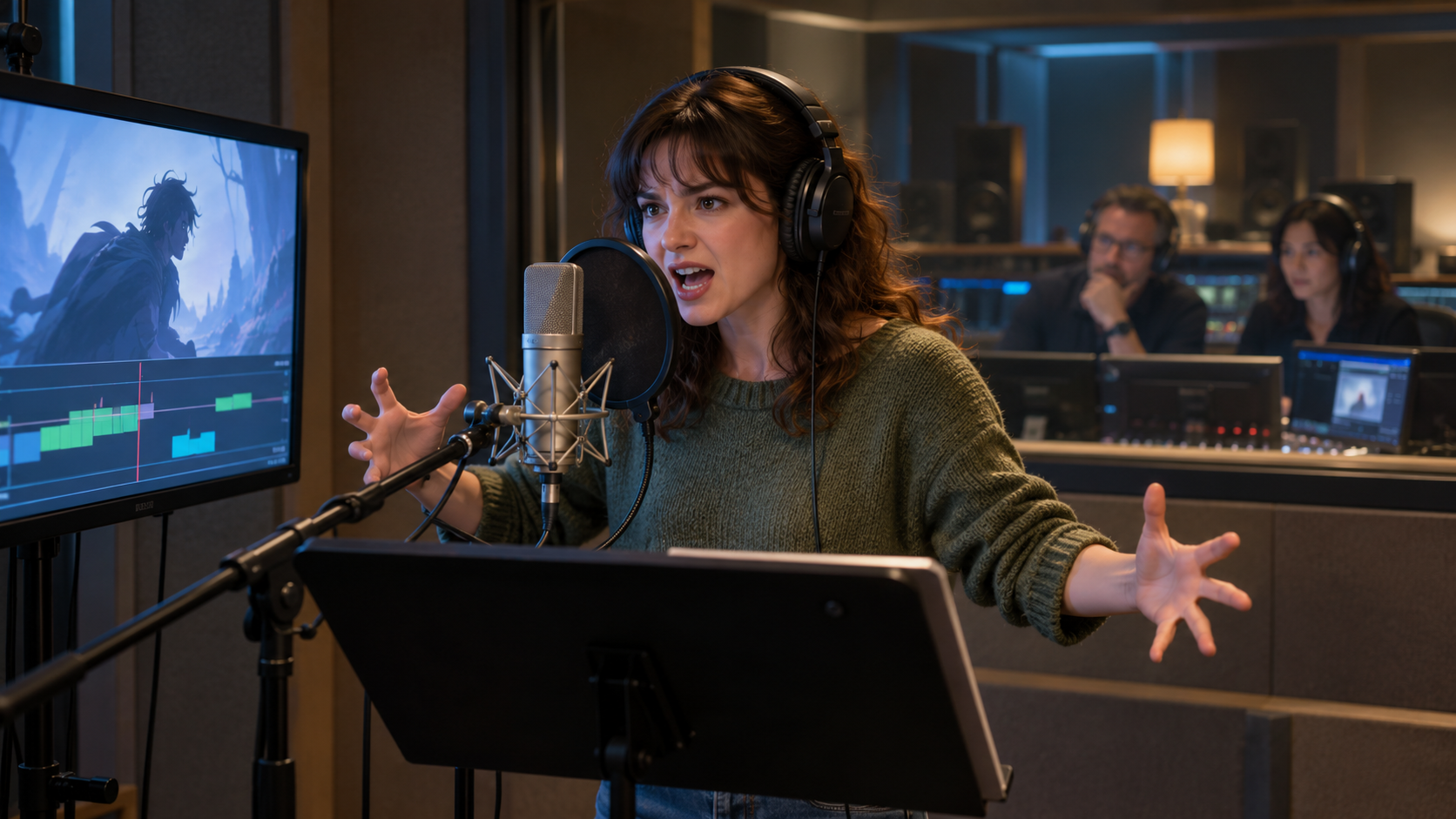
In the studio, actors watch short sections of picture and record lines against timing cues. Live-action lip sync pays special attention to visible mouth openings, closures, pace, breath, and physical effort. Animation may offer more freedom or different constraints. Directors guide intention and continuity while engineers manage microphone position, clean recording, and session organization. Performers often record separately, so direction and reference tracks help sustain relationships that the actors may not play together in real time.
After recording, editors select takes, tighten sync, and prepare dialogue for the final mix. The dubbed voices must sit convincingly among music, effects, ambience, and room acoustics. Forced narrative subtitles may translate on-screen writing that the new audio does not cover. An as-recorded script documents what was actually performed, including timing and relevant annotations, because the final dialogue can differ from the earlier adaptation after performance and editorial changes. Good dubbing is judged by more than whether every mouth closure matches. Performance, clarity, emotional truth, language variety, mix perspective, and consistency all shape the experience. Some viewers prefer original audio with subtitles, while others rely on or enjoy dubbing; neither method is inherently complete for every audience. A useful comparison asks what meaning changed, whether the new lines feel playable, how the voices occupy the scene, and whether the version respects both the original intent and the target culture. A practical way to read or discuss Dubbing is to begin with the basic definition and then identify the choices made in a particular example. Dubbing creates a new-language performance that must carry meaning, character, timing, and the surrounding soundtrack together. Next, ask who sets the relevant rules, who performs the work, and which results follow from creative judgment, law, contracts, technology, budget, or production limits. Similar-looking examples can operate differently because their audience, market, format, timing, and agreements are different. Lip sync balances visible mouth shapes, duration, pauses, breath, and physical action without forcing unnatural language. It also helps to distinguish a formal industry category from an informal critical label or one organization's current practice. That separation keeps a memorable anecdote from becoming a false universal rule. Dates and territories matter: tools, distribution systems, audience behavior, and standard agreements change, while older examples can preserve assumptions that no longer apply everywhere. When a claim sounds absolute, compare it with a second kind of source and look for the conditions under which the claim is true. Then trace the process from the visible result back through the less visible decisions, handoffs, and quality checks that produced it. An as-recorded script documents the final dubbed wording and timing after changes made during performance and post-production. Finally, compare the example with a contrasting case and note which part of the definition still holds. This method keeps the explanation grounded, highlights the people and systems behind the outcome, and leaves room for reasonable disagreement about hybrid or borderline cases.
Dubbing creates a new-language performance that must carry meaning, character, timing, and the surrounding soundtrack together.
A dialogue list supplies timed source speech and annotations; translators and adapters turn it into speakable target-language lines.
Casting prioritizes authentic performance and character fit, which may matter more than mechanically matching the original actor's pitch.
Lip sync balances visible mouth shapes, duration, pauses, breath, and physical action without forcing unnatural language.
Editors and mixers place recorded voices into music, effects, ambience, and acoustic space so they belong to the scene.
An as-recorded script documents the final dubbed wording and timing after changes made during performance and post-production.
Explore more "Explainers"
Discover additional explainers across politics, science, business, technology, and other fields. Each explainer breaks down a complex idea into clear, everyday language—helping you better understand how major concepts, systems, and debates shape the world around us.