

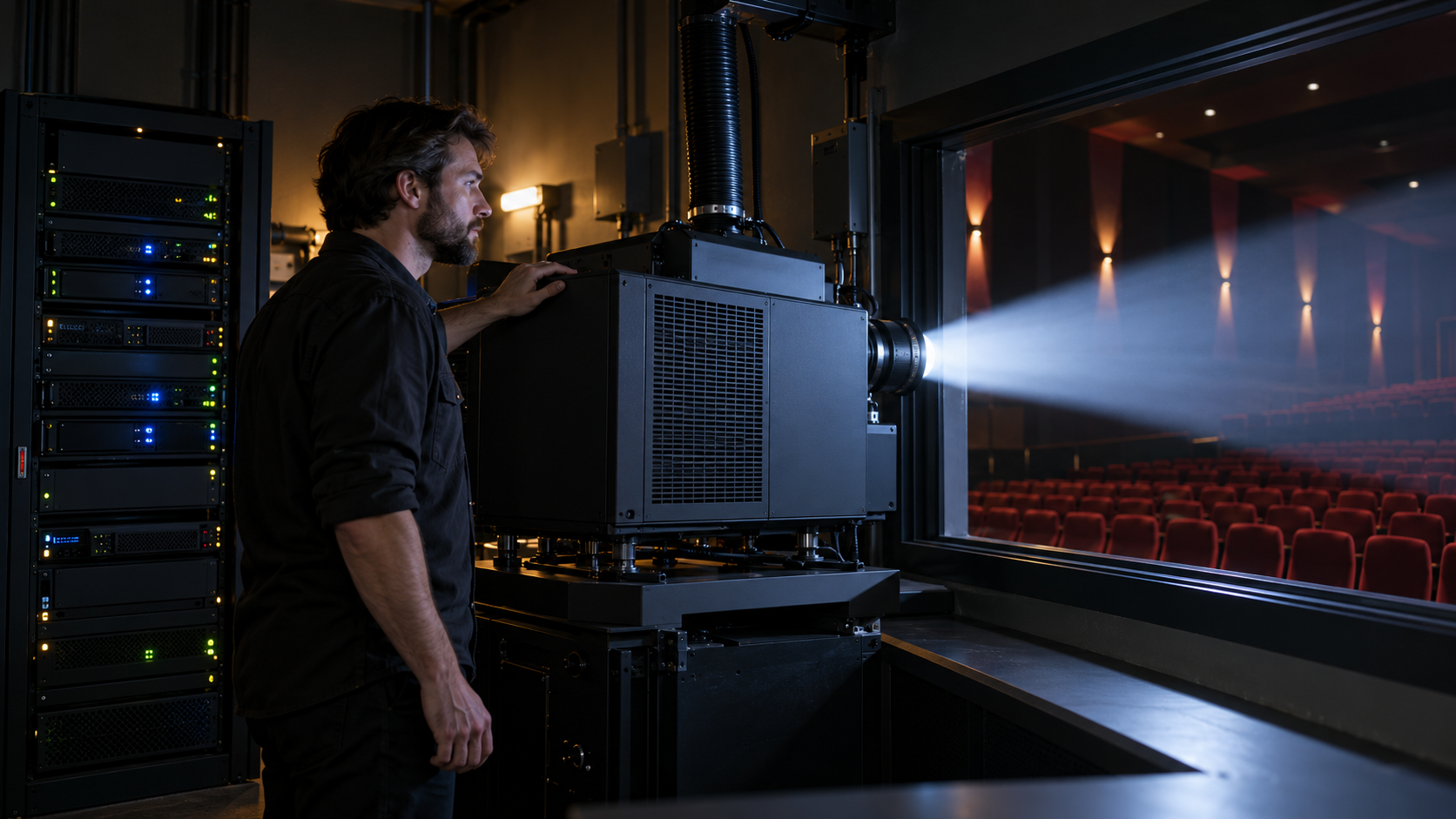
Digital Cinema Projection Explainer
Digital cinema projection is the theatrical playback of standardized digital picture, sound, subtitle, and metadata files rather than a reel of release print film. A distributor supplies a Digital Cinema Package, or DCP, containing track files and composition instructions. The theater ingests that package onto a server, verifies it, builds a show playlist, and routes decoded media to the projector and cinema sound system. Standardization lets a correctly prepared package play across compliant equipment from different manufacturers.
The DCP separates components so the same picture can be paired with different language soundtracks, captions, or versions when the package is authored that way. A composition playlist identifies which assets belong together and in what order. The theater management system can coordinate features, trailers, advertisements, masking, lights, sound format, and automation cues. Staff still inspect content, storage, schedule, and auditorium assignment because a technically valid file can be the wrong version or mapped to an unsuitable room.
Picture data is compressed for cinema and decoded by a secure media block. The projector converts the image data into controlled light while the sound processor sends synchronized channels to the auditorium system. Color, frame rate, resolution, screen luminance, alignment, focus, and audio level all affect the presentation. The existence of a digital file does not remove calibration; it shifts quality control from worn prints toward servers, networks, optics, software, and measured theater conditions.
Many commercial packages are encrypted. A Key Delivery Message can authorize a specific playback system to decrypt a particular composition during a defined time window. This limits unauthorized exhibition but creates operational dependencies: an incorrect certificate, date, time zone, server identity, or version can stop a scheduled show. Unencrypted packages are also possible, especially for tests, archives, and some independent screenings. Encryption is a distribution choice layered onto the core package standards. Digital cinema is sometimes mistaken for ordinary video projection. The distinction lies in specifications for mastering, packaging, security, playback, color, synchronization, and interoperability designed for theatrical exhibition. Viewers can judge presentation by stable framing, correct aspect ratio, consistent focus, balanced brightness, intelligible dialogue, and sound located as intended. When problems occur, the cause may sit anywhere from package authoring to playlist automation, media block, projector, lens, screen, or auditorium calibration. A practical way to read or discuss Digital Cinema Projection is to begin with the basic definition and then identify the choices made in a particular example. A DCP is a structured set of picture, sound, subtitle, and metadata files governed by composition instructions. Next, ask who sets the relevant rules, who performs the work, and which results follow from creative judgment, law, contracts, technology, budget, or production limits. Similar-looking examples can operate differently because their audience, market, format, timing, and agreements are different. Encrypted content uses timed authorization messages tied to trusted playback equipment, so certificate and scheduling accuracy matter. It also helps to distinguish a formal industry category from an informal critical label or one organization's current practice. That separation keeps a memorable anecdote from becoming a false universal rule. Dates and territories matter: tools, distribution systems, audience behavior, and standard agreements change, while older examples can preserve assumptions that no longer apply everywhere. When a claim sounds absolute, compare it with a second kind of source and look for the conditions under which the claim is true. Then trace the process from the visible result back through the less visible decisions, handoffs, and quality checks that produced it. Interoperability standards let distributors and theaters exchange packages without relying on one vendor's closed playback format. Finally, compare the example with a contrasting case and note which part of the definition still holds. This method keeps the explanation grounded, highlights the people and systems behind the outcome, and leaves room for reasonable disagreement about hybrid or borderline cases.
A DCP is a structured set of picture, sound, subtitle, and metadata files governed by composition instructions.
The cinema ingests the package, verifies assets, creates a playlist, and assigns playback to compatible server and projector equipment.
Separate track files can support alternate languages or accessibility assets without duplicating every component of the feature.
Encrypted content uses timed authorization messages tied to trusted playback equipment, so certificate and scheduling accuracy matter.
Projectors and sound systems still require alignment and calibration; digital delivery does not guarantee a correct presentation by itself.
Interoperability standards let distributors and theaters exchange packages without relying on one vendor's closed playback format.
Explore more "Explainers"
Discover additional explainers across politics, science, business, technology, and other fields. Each explainer breaks down a complex idea into clear, everyday language—helping you better understand how major concepts, systems, and debates shape the world around us.