

Live Television Production Explainer
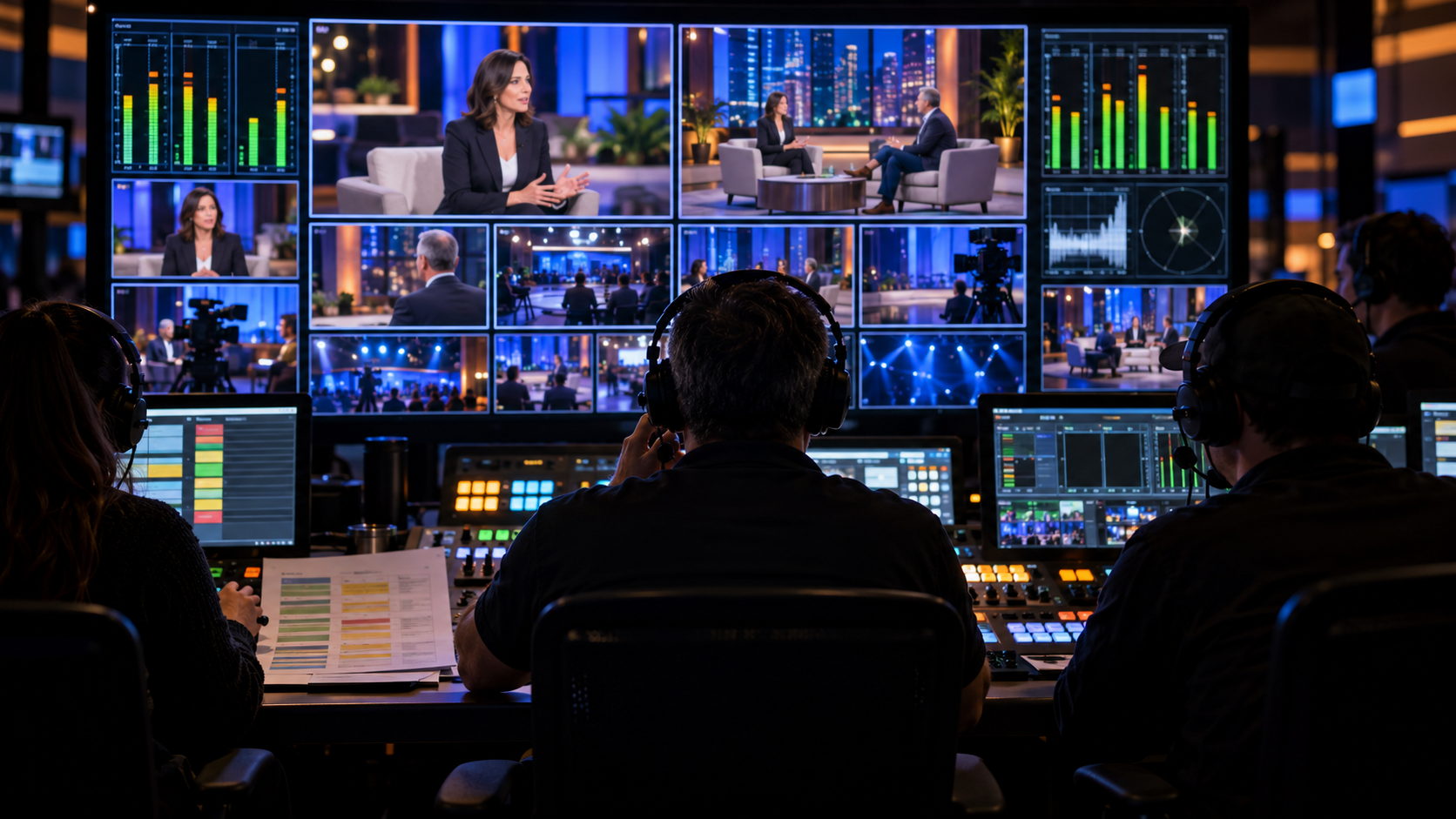
Live television production creates a program while the underlying event is happening, leaving little or no opportunity to rebuild the sequence later. Sports, news, awards, concerts, debates, and studio shows use different scales, but all depend on preparation, communication, synchronized systems, and rapid editorial choices. Multiple cameras and microphones provide possibilities; the production team selects, mixes, labels, replays, and transmits them in real time while managing timing, rights, safety, and the risk of unexpected events.
The director calls camera shots and transitions from a control room or production truck. A technical director operates the switcher, camera operators frame action, audio mixers balance sources, graphics teams prepare verified information, replay operators capture and retrieve moments, and producers shape the running order. Floor managers, stage managers, lighting teams, engineers, transmission staff, and editorial personnel communicate through intercom channels. Clear terminology matters because several instructions may be in flight at once.
A rundown divides the program into segments with planned durations, sources, graphics, cues, and commercial breaks. Rehearsals test entrances, demonstrations, remote guests, playback, and handoffs, but a live event can ignore the plan. Producers add or drop items, stretch interviews, and count presenters toward a hard network join or sign-off. Delay systems can create a short buffer for standards or technical intervention, yet delay is not the same as ordinary post-production and cannot solve every problem.
Modern facilities increasingly carry separate uncompressed video, audio, and data streams over managed IP networks using standards such as SMPTE ST 2110. Precision timing lets distributed devices remain synchronized. Routing flexibility can support remote and cloud-assisted workflows, but network design, discovery, monitoring, bandwidth, security, and fallback paths become production concerns. Traditional baseband and hybrid systems remain common, and a successful show depends on tested interoperability rather than a fashionable architecture. Redundancy protects critical paths: backup microphones, power, playback, graphics, encoders, network routes, and transmission feeds can be ready to take over. Teams rehearse failures because a backup that has never been monitored may not work when needed. Viewers can analyze a live program by noticing how it establishes geography, chooses reactions, handles delays, verifies information, and recovers from errors. The smooth surface is the result of detailed planning combined with practiced decisions under pressure. A practical way to read or discuss Live Television Production is to begin with the basic definition and then identify the choices made in a particular example. Live television selects and assembles pictures, sound, graphics, replay, and transmission while the event continues to unfold. Next, ask who sets the relevant rules, who performs the work, and which results follow from creative judgment, law, contracts, technology, budget, or production limits. Similar-looking examples can operate differently because their audience, market, format, timing, and agreements are different. SMPTE ST 2110 carries synchronized professional video, audio, and data as separate streams over managed IP networks. It also helps to distinguish a formal industry category from an informal critical label or one organization's current practice. That separation keeps a memorable anecdote from becoming a false universal rule. Dates and territories matter: tools, distribution systems, audience behavior, and standard agreements change, while older examples can preserve assumptions that no longer apply everywhere. When a claim sounds absolute, compare it with a second kind of source and look for the conditions under which the claim is true. Then trace the process from the visible result back through the less visible decisions, handoffs, and quality checks that produced it. A good live production makes instant choices feel coherent while preserving accuracy, safety, timing, and the audience's orientation. Finally, compare the example with a contrasting case and note which part of the definition still holds. This method keeps the explanation grounded, highlights the people and systems behind the outcome, and leaves room for reasonable disagreement about hybrid or borderline cases.
Live television selects and assembles pictures, sound, graphics, replay, and transmission while the event continues to unfold.
Directors, switcher operators, camera crews, audio mixers, producers, graphics teams, replay operators, and engineers work through coordinated cues.
A rundown plans segment timing and sources, while producers adjust it continuously to meet editorial priorities and fixed joins or breaks.
SMPTE ST 2110 carries synchronized professional video, audio, and data as separate streams over managed IP networks.
Redundant equipment and signal paths reduce risk only when they are tested, monitored, and supported by rehearsed handover procedures.
A good live production makes instant choices feel coherent while preserving accuracy, safety, timing, and the audience's orientation.
Explore more "Explainers"
Discover additional explainers across politics, science, business, technology, and other fields. Each explainer breaks down a complex idea into clear, everyday language—helping you better understand how major concepts, systems, and debates shape the world around us.