

Live Sound Engineering Explainer
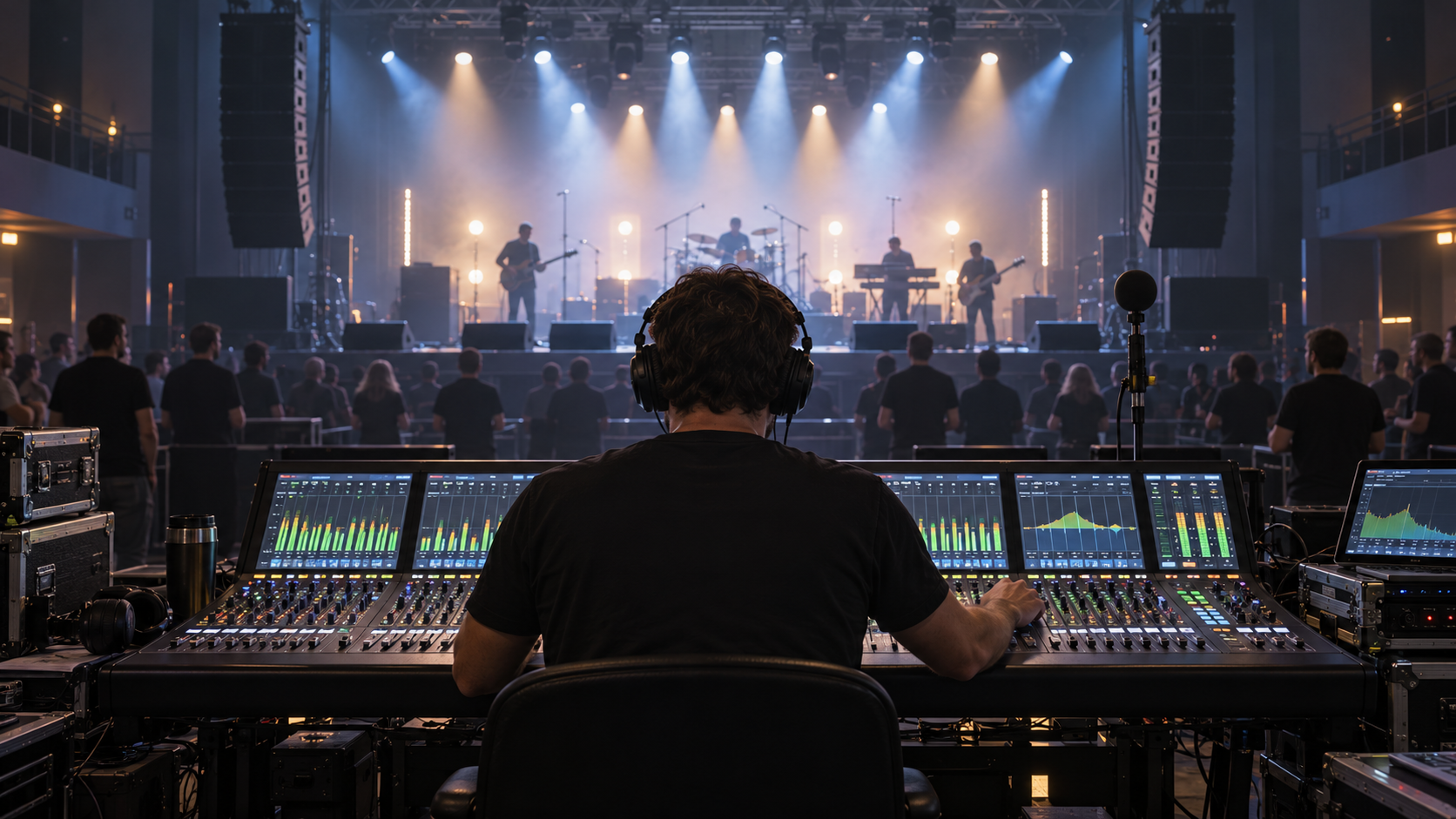
Live sound engineering captures voices and instruments, processes and combines them, and reproduces the result for performers, audiences, broadcasts, or recordings while the event is happening. The system includes microphones and direct inputs, stage boxes, consoles, signal networks, processors, amplifiers, loudspeakers, monitors, power, rigging, and communication. Equipment matters, but the engineer's central task is translation: preserving musical intention across a venue whose acoustics, audience, weather, and stage volume continuously affect what people hear.
Before the show, the team advances technical requirements, designs the system, plans patching, checks power and rigging, and coordinates with the venue and artists. A line check confirms that each input reaches the expected channel. Soundcheck sets gain, equalization, dynamics, effects, monitor mixes, and balances while performers can respond. Digital consoles can store scenes, but a saved setting is only a starting point because microphones, instruments, temperature, crowd absorption, and performance level change.
The front-of-house engineer mixes for the audience, while a monitor engineer may create separate mixes for stage wedges or in-ear systems. Microphone choice and placement influence clarity and spill. Gain structure keeps signals strong without overload; equalization addresses tone and resonances; compression controls range; effects create space. Routing sends different combinations to mains, fills, delays, subs, recording, broadcast, and assistive systems. Each path must remain synchronized and appropriate to its destination.
Loudspeaker design aims for even coverage rather than maximum volume. Main arrays, front fills, under-balcony speakers, and delay systems divide the room, with timing and level adjusted so overlapping sources reinforce rather than smear. Feedback occurs when amplified sound reenters a microphone strongly enough to sustain a loop. Placement, directional control, appropriate gain, equalization, and stage management reduce that risk more effectively than simply removing large parts of the frequency spectrum. Engineers monitor sound level as well as artistic balance because excessive exposure can harm audiences and workers. Local rules, venue policy, program dynamics, measurement position, and duration all matter. Critical listening includes walking the room, comparing reference material, checking communication, and recognizing fatigue. Viewers at a concert hear the combined result of the performance, room, system, and mix; a good engineer adapts throughout the show so technical control supports the shared musical event rather than drawing attention to itself. A practical way to read or discuss Live Sound Engineering is to begin with the basic definition and then identify the choices made in a particular example. Live sound carries stage sources through microphones, routing, processing, amplification, loudspeakers, monitoring, and communications in real time. Next, ask who sets the relevant rules, who performs the work, and which results follow from creative judgment, law, contracts, technology, budget, or production limits. Similar-looking examples can operate differently because their audience, market, format, timing, and agreements are different. Coverage design uses main, fill, delay, and subwoofer systems with controlled timing and level across the venue. It also helps to distinguish a formal industry category from an informal critical label or one organization's current practice. That separation keeps a memorable anecdote from becoming a false universal rule. Dates and territories matter: tools, distribution systems, audience behavior, and standard agreements change, while older examples can preserve assumptions that no longer apply everywhere. When a claim sounds absolute, compare it with a second kind of source and look for the conditions under which the claim is true. Then trace the process from the visible result back through the less visible decisions, handoffs, and quality checks that produced it. Sound-level monitoring considers exposure over time, not just a single peak, while preserving musical dynamics and audience safety. Finally, compare the example with a contrasting case and note which part of the definition still holds. This method keeps the explanation grounded, highlights the people and systems behind the outcome, and leaves room for reasonable disagreement about hybrid or borderline cases.
Live sound carries stage sources through microphones, routing, processing, amplification, loudspeakers, monitoring, and communications in real time.
Advance work, patch plans, line checks, soundcheck, and rehearsed scenes establish a reliable starting point before the audience arrives.
Front-of-house and monitor mixes serve different listeners, and performers may need several distinct wedge or in-ear balances.
Coverage design uses main, fill, delay, and subwoofer systems with controlled timing and level across the venue.
Feedback is an acoustic loop managed through placement, directionality, stage level, gain, and careful equalization.
Sound-level monitoring considers exposure over time, not just a single peak, while preserving musical dynamics and audience safety.
Explore more "Explainers"
Discover additional explainers across politics, science, business, technology, and other fields. Each explainer breaks down a complex idea into clear, everyday language—helping you better understand how major concepts, systems, and debates shape the world around us.