

How Boxing Knockdowns Are Counted and Scored Explainer
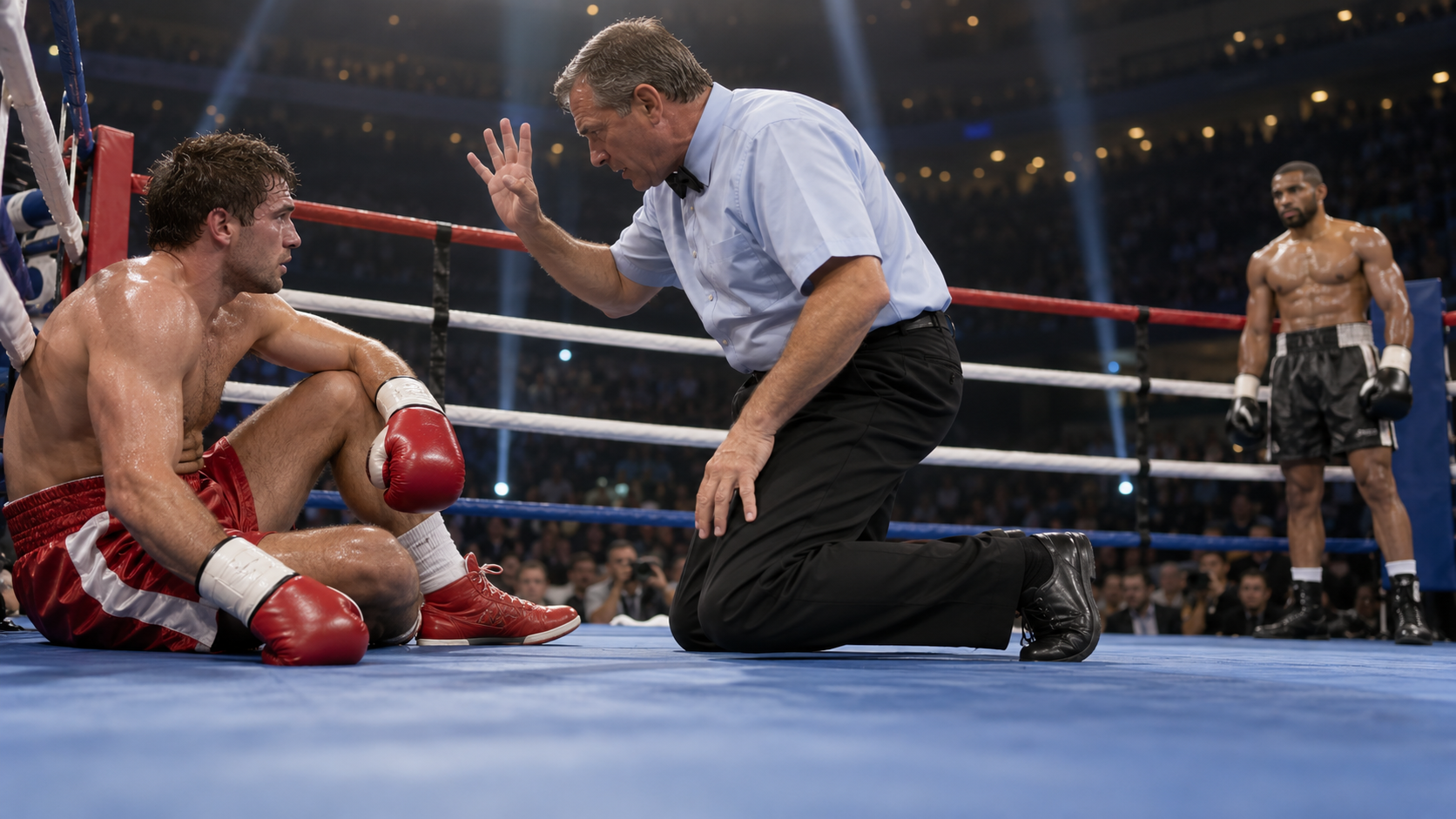
A professional boxing knockdown is called when a legal blow causes a boxer to touch the canvas with something other than the feet, be held up by the ropes, or hang defenselessly through them. The referee distinguishes a knockdown from a slip and is the official whose signal controls the scoring.
The standing opponent must move to the far neutral corner. The referee administers a mandatory eight count and evaluates whether the downed boxer can safely continue. Rising before eight does not eliminate the count, and the referee may stop the contest at any point if continuing would be unsafe.
Under the unified rules, a boxer has up to the count of ten to rise after an ordinary knockdown. A boxer knocked out of the ring receives a different 20-second count and must return without assistance. There is no standing eight count and no automatic three-knockdown rule under the standard unified rules.
Judges usually score a round with one knockdown 10-8, though the rest of the round still matters. Two knockdowns commonly support 10-7. Fouls and point deductions are recorded separately. The count protects the boxer; the score reflects the competitive effect of the knockdown.
The referee.
Yes, a mandatory eight count is standard after a knockdown.
The round is commonly 10-8, though the rest of the round still matters.
Explore more "Explainers"
Discover additional explainers across politics, science, business, technology, and other fields. Each explainer breaks down a complex idea into clear, everyday language—helping you better understand how major concepts, systems, and debates shape the world around us.