

Late-Night Television Explainer
Late-night television is a family of programs usually organized around a host, opening comedy, interviews, recurring segments, and music or other performance. The familiar desk-and-couch image is only one arrangement. Shows can include field pieces, sketches, games, correspondent reports, audience interaction, and extended political commentary. The format balances consistency, so viewers recognize its rhythm, with topical flexibility, so the program can respond to events that happened hours before recording.
A typical production cycle begins with morning news review and idea pitches. Writers develop monologue jokes and segment concepts while producers book guests, clear clips, prepare research, coordinate bands or acts, and revise the running order. Rehearsals test timing, props, graphics, and camera moves. Material can change until taping because a story develops or a joke fails. Editors then prepare the broadcast or online version under a narrow deadline.
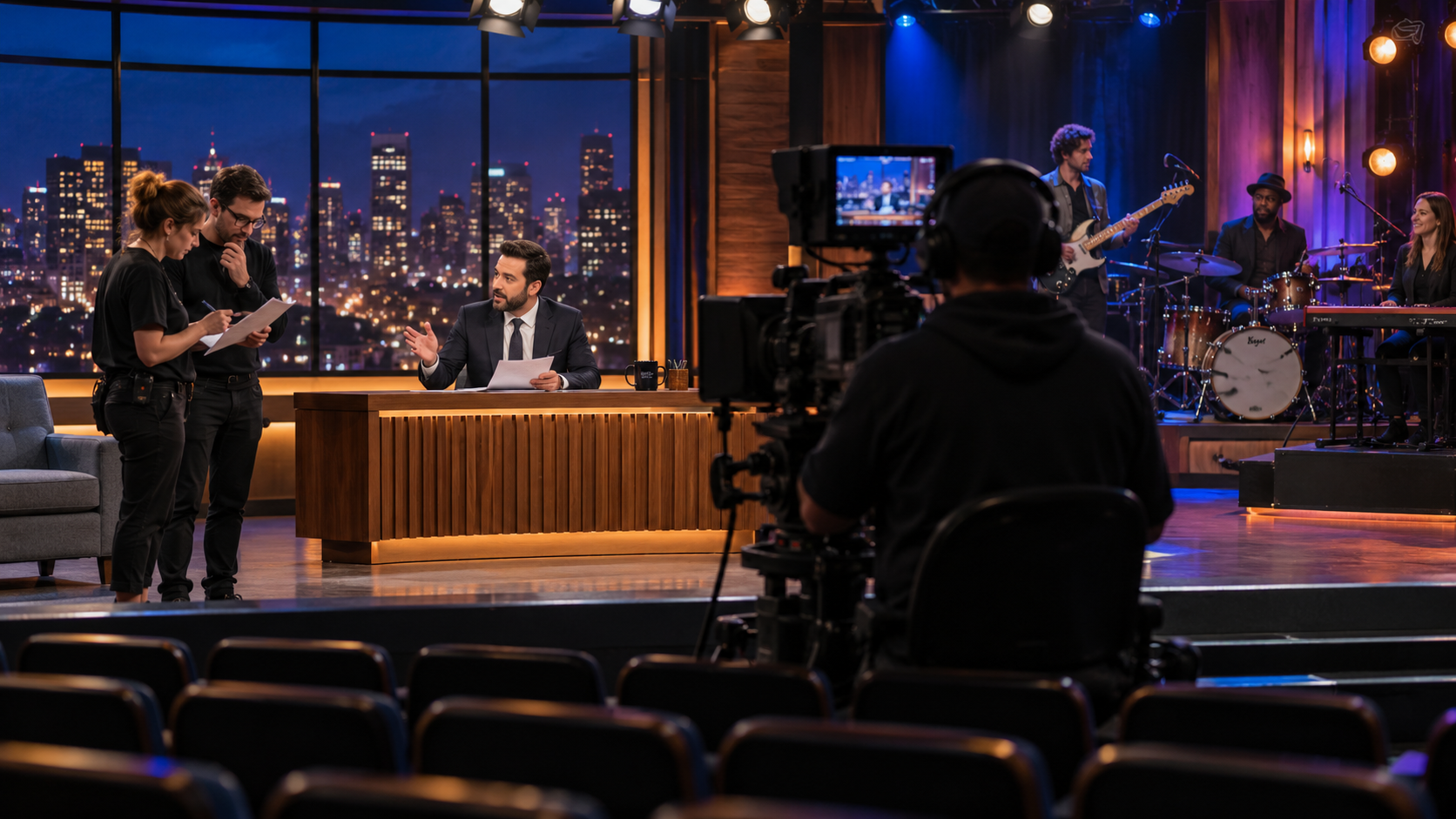
The host is the program's central voice, but the performance is collective. Writers shape point of view and joke structure; producers determine bookings and segment length; researchers establish facts; cue-card, graphic, music, wardrobe, makeup, stage, camera, lighting, sound, and editorial teams create the live-to-tape flow. A band can provide transitions and comic responses. The studio audience adds energy, though its reaction is also captured, mixed, and placed within a designed production.
Interviews must serve several purposes at once. A guest may promote a project, tell an accessible story, demonstrate chemistry with the host, or address a serious topic within a compressed segment. Preparatory interviews help producers identify material, but the televised conversation still depends on spontaneity and boundaries. Political comedy adds another layer: jokes can frame an issue, expose contradiction, or build community, yet humor and factual explanation are not interchangeable. Late-night influence cannot be measured only by its overnight time slot. Clips travel through social platforms, headlines, podcasts, and international distribution, allowing individual segments to reach audiences who never watch the full episode. To analyze a show, separate format from personality: examine its segment mix, production cadence, booking strategy, writing voice, and distribution. The genre endures because its stable container can absorb entertainment, promotion, satire, conversation, and performance as the news cycle changes. A practical way to read or discuss Late-Night Television is to begin with the basic definition and then identify the choices made in a particular example. Late-night programs often combine a host monologue, interviews, comedy pieces, recurring segments, and musical performance. Next, ask who sets the relevant rules, who performs the work, and which results follow from creative judgment, law, contracts, technology, budget, or production limits. Similar-looking examples can operate differently because their audience, market, format, timing, and agreements are different. Guest interviews mix promotion, storytelling, conversation, timing, and the editorial identity of the show. It also helps to distinguish a formal industry category from an informal critical label or one organization's current practice. That separation keeps a memorable anecdote from becoming a false universal rule. Dates and territories matter: tools, distribution systems, audience behavior, and standard agreements change, while older examples can preserve assumptions that no longer apply everywhere. When a claim sounds absolute, compare it with a second kind of source and look for the conditions under which the claim is true. Then trace the process from the visible result back through the less visible decisions, handoffs, and quality checks that produced it. Online clips extend the genre beyond its broadcast slot and can make one segment more visible than the full episode. Finally, compare the example with a contrasting case and note which part of the definition still holds. This method keeps the explanation grounded, highlights the people and systems behind the outcome, and leaves room for reasonable disagreement about hybrid or borderline cases.
Late-night programs often combine a host monologue, interviews, comedy pieces, recurring segments, and musical performance.
Writers and producers work on a rapid cycle, revising topical material through rehearsal and sometimes close to taping.
The host's apparent spontaneity rests on research, booking, writing, cueing, graphics, music, camera, sound, and editing.
Guest interviews mix promotion, storytelling, conversation, timing, and the editorial identity of the show.
Political humor can frame public events but should not be mistaken for a complete factual account of them.
Online clips extend the genre beyond its broadcast slot and can make one segment more visible than the full episode.
Explore more "Explainers"
Discover additional explainers across politics, science, business, technology, and other fields. Each explainer breaks down a complex idea into clear, everyday language—helping you better understand how major concepts, systems, and debates shape the world around us.