

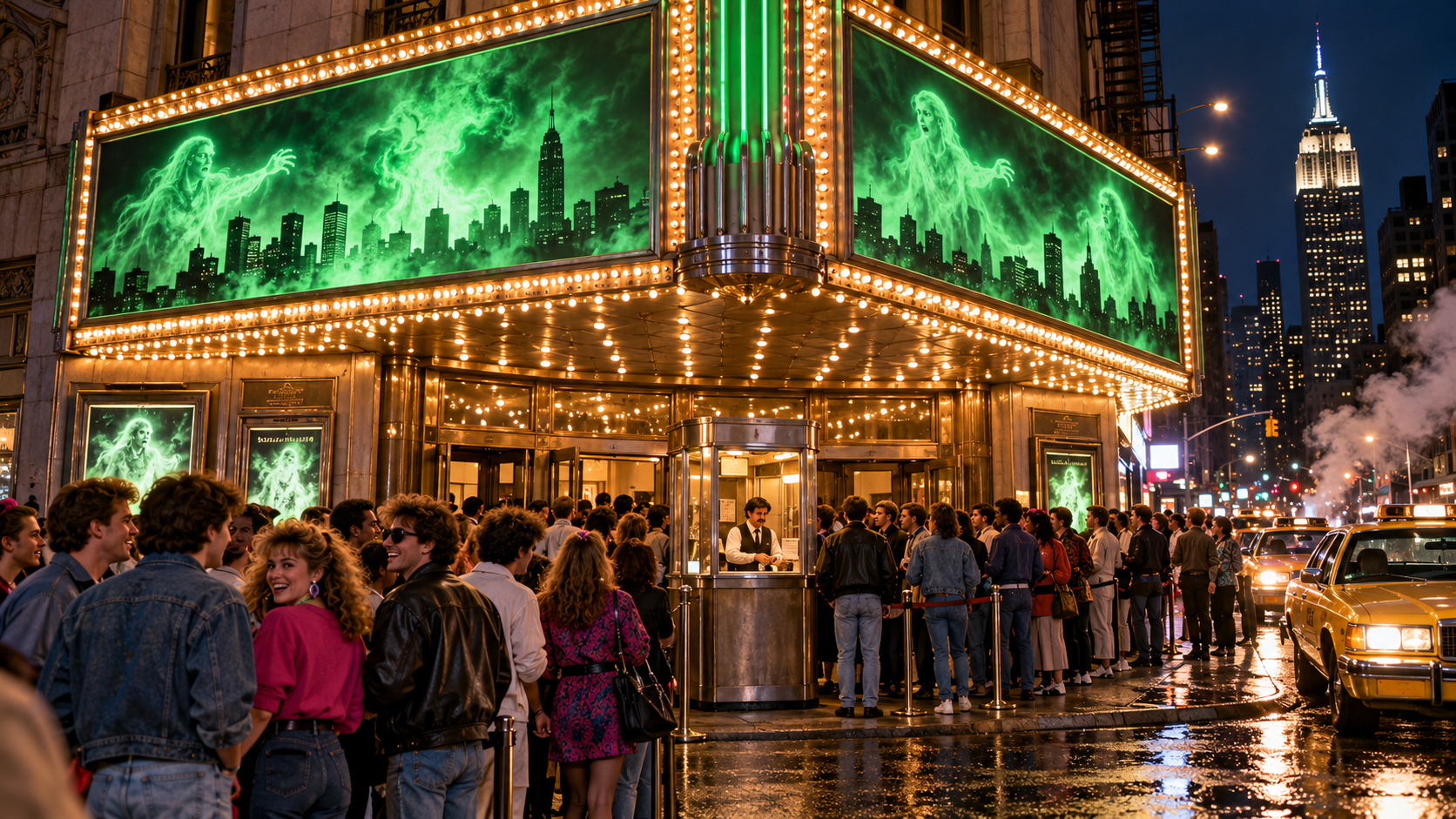
On This Day in Pop: June 8, 1984
On June 8, 1984, Ghostbusters opened in theaters in New York and Los Angeles, one day after a Los Angeles premiere. Directed by Ivan Reitman and written by Dan Aykroyd and Harold Ramis, the film imagined paranormal researchers turning ghost removal into a scrappy New York business. Bill Murray, Aykroyd, Ramis and Ernie Hudson played the team with a mixture of deadpan skepticism, manic invention and workplace camaraderie. Sigourney Weaver and Rick Moranis grounded the escalating supernatural plot in recognizable city life. The production joined large-scale visual effects, creature work and elaborate sets to the rhythms of an ensemble comedy—a costly combination that studios did not yet treat as routine. Ray Parker Jr.’s theme song, a propulsive call-and-response hook, extended the film’s identity beyond the theater almost immediately.
The opening mattered because Ghostbusters proved that a summer effects spectacle could be sold primarily through comic personality. Its ghosts were often frightening in design, but the film’s tone treated the impossible as another municipal problem involving permits, rent, equipment and customer service. That blend created a world broad enough for adults, teenagers and children, while the performers’ improvisational energy kept the machinery from overwhelming the jokes. The film earned more than thirteen million dollars during its opening weekend and remained number one at the box office for seven consecutive weeks. Its logo, theme song, uniforms and equipment became instantly legible pieces of pop culture, demonstrating how a movie’s fictional workplace could function like a brand without losing its character-based appeal.
Ghostbusters generated a 1989 sequel, animated television series, games, toys and later theatrical continuations, but its influence is also visible in the broader grammar of blockbuster comedy. Films and series repeatedly borrowed its formula of skeptical professionals confronting fantastic danger with specialized gear and workplace banter. The Academy nominated it for visual effects and original song, and the Library of Congress selected it for the National Film Registry in 2015. Rewatching the film also invites discussion of the creative roles and screen time given to different team members, especially Hudson’s Winston. Even with those limitations, the original remains unusually cohesive: casting, music, design and effects reinforce the same playful idea. On opening day in 1984, a strange genre hybrid became a shared language almost overnight.
Remembering ghostbusters opens in u.s. theaters on June 8 is valuable because anniversaries turn a familiar cultural object back into a specific decision, release or broadcast. The surrounding technology, business and audience conditions explain why the moment could happen then, while its later uses show that meaning never stops changing. Seen at that scale, the date is not trivia. It is a checkpoint between creation and memory: a place to separate what occurred from the legend accumulated around it and to ask why the work still attracts attention.
Ghostbusters opened in New York and Los Angeles on June 8, 1984 after a Los Angeles premiere the previous day.
The moment reached audiences through the media and distribution systems of 1984, influencing how the initial response developed.
The film combined an ensemble comedy with unusually expensive visual effects and a hit theme song.
Its early impact was substantial but not universal, and later retellings sometimes compressed a more complicated contemporary response.
It stayed atop the box office for seven consecutive weeks and entered the National Film Registry in 2015.
Anniversary coverage continues to place Ghostbusters Opens within the broader history of popular culture while distinguishing documented evidence from later legend.
Explore more of "On This Day ..."
Discover more events from the same date across news, politics, technology, sports, and other fields. Each link highlights significant moments that shaped history on different fronts.