

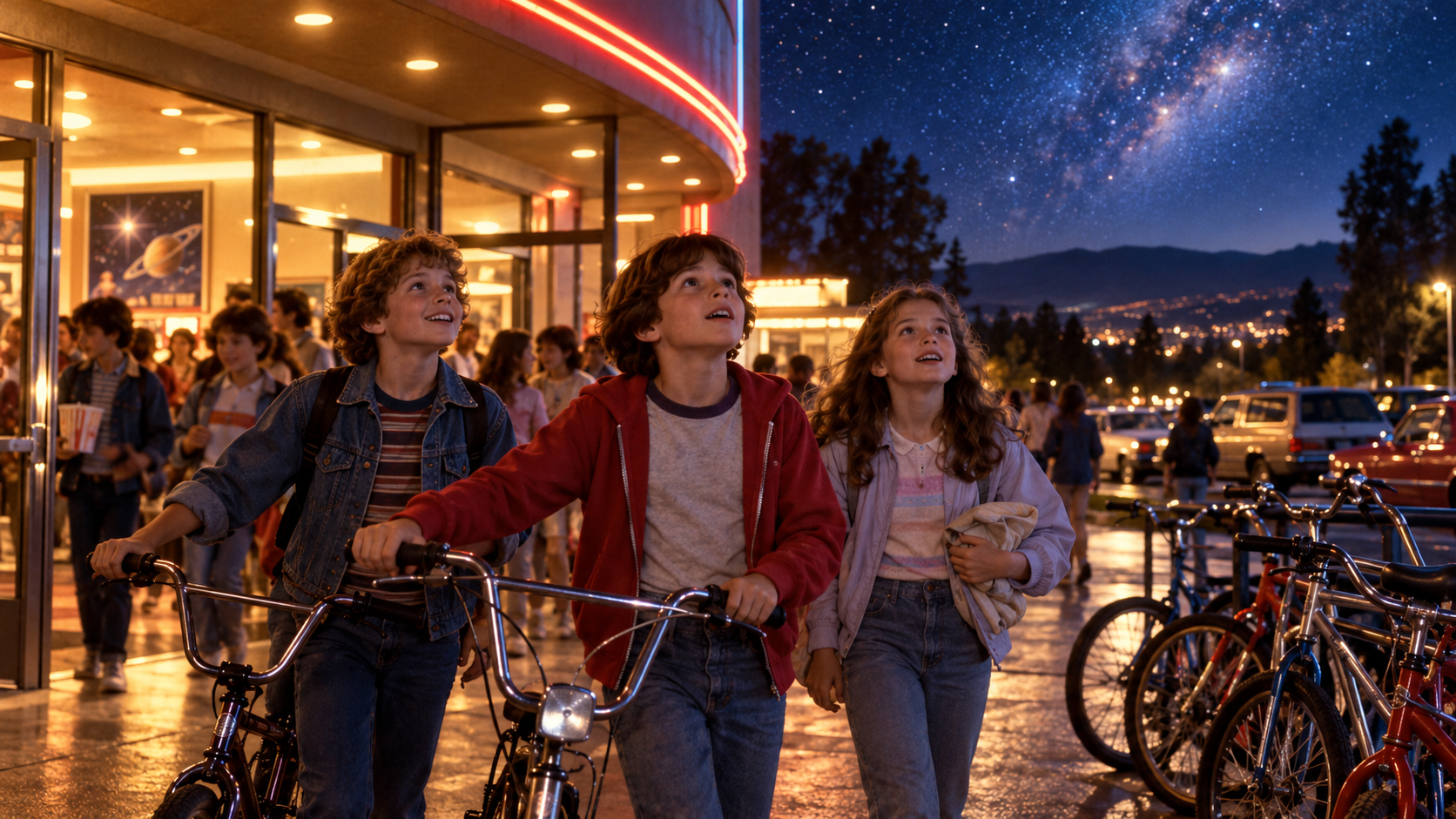
On This Day in Pop: June 11, 1982
On June 11, 1982, E.T. the Extra-Terrestrial opened in Los Angeles and New York after a Hollywood premiere the previous evening. Directed by Steven Spielberg from Melissa Mathison’s screenplay, the film followed Elliott, a lonely suburban boy who shelters an alien accidentally left on Earth. The story kept government pursuit at the edge of a child’s emotional world, allowing discovery to unfold through bedrooms, bicycles, toys and whispered plans. Carlo Rambaldi’s creature design made E.T. visibly unfamiliar but expressive enough for a friendship built on gesture, touch and a handful of words. John Williams’s score expanded the final escape into an emotional flight, yet much of the film’s power came from small domestic details and from a camera that often stayed near children’s eye level.
The opening mattered because E.T. joined large-scale genre filmmaking to unusual intimacy. Science-fiction hits had accustomed audiences to space battles and dazzling hardware; Spielberg placed the visitor in an ordinary California subdivision and made empathy the central special effect. The film’s marketing and wide release created lines around theaters, while word of mouth turned the opening into a national phenomenon. It earned about thirteen million dollars in its first three days, then remained popular for months and eventually surpassed Star Wars in domestic rentals at the time. Product tie-ins—especially Reese’s Pieces—showed how a story’s objects could move into consumer culture, but the film never felt merely engineered around merchandise. Its strongest image was not a product or weapon; it was two vulnerable beings refusing separation.
E.T. became a durable family classic, returned to theaters and home video repeatedly, and helped define the logo of Spielberg’s Amblin company. Its influence can be seen in later stories about children encountering the fantastic within recognizable neighborhoods, from gentle wonder to darker variations. The film also preserved a specific emotional portrait of early-1980s suburbia: divorce, sibling alliances, absent adults and the freedom children found beyond supervised spaces. A digitally altered anniversary edition later prompted debate about revising familiar imagery, and the original version was restored to prominence. That conversation reinforced how deeply audiences felt ownership of the film. On opening day, E.T. offered spectacle without cynicism and proved that a blockbuster could become enormous by making private feelings—homesickness, grief, loyalty and the fear of saying goodbye—visible to a crowd.
Remembering e.t. the extra-terrestrial opens in theaters on June 11 is valuable because anniversaries turn a familiar cultural object back into a specific decision, release or broadcast. The surrounding technology, business and audience conditions explain why the moment could happen then, while its later uses show that meaning never stops changing. Seen at that scale, the date is not trivia. It is a checkpoint between creation and memory: a place to separate what occurred from the legend accumulated around it and to ask why the work still attracts attention.
E.T. the Extra-Terrestrial opened in Los Angeles and New York on June 11, 1982.
The moment reached audiences through the media and distribution systems of 1982, influencing how the initial response developed.
Steven Spielberg directed Melissa Mathison's story of Elliott and an alien stranded in suburban California.
Its early impact was substantial but not universal, and later retellings sometimes compressed a more complicated contemporary response.
The film became a box-office phenomenon and briefly surpassed Star Wars in domestic rentals.
Anniversary coverage continues to place E.T. Comes Home within the broader history of popular culture while distinguishing documented evidence from later legend.
Explore more of "On This Day ..."
Discover more events from the same date across news, politics, technology, sports, and other fields. Each link highlights significant moments that shaped history on different fronts.