

On This Day in Pop: June 15, 1994
On June 15, 1994, The Lion King began a limited theatrical run in New York and Los Angeles before expanding nationwide on June 24. Walt Disney Feature Animation’s film followed Simba, a lion cub driven from his home after the death of his father, Mufasa, and eventually called back to confront his uncle Scar. Directors Roger Allers and Rob Minkoff led a large team that combined character animation with landscape studies, digital tools and a story not directly adapted from a single fairy tale. Songs by Elton John and Tim Rice, Hans Zimmer’s score and choral work associated with Lebo M gave the film a musical identity that moved between Broadway structure, pop melody and African vocal textures. The opening Circle of Life sequence announced the scale immediately.
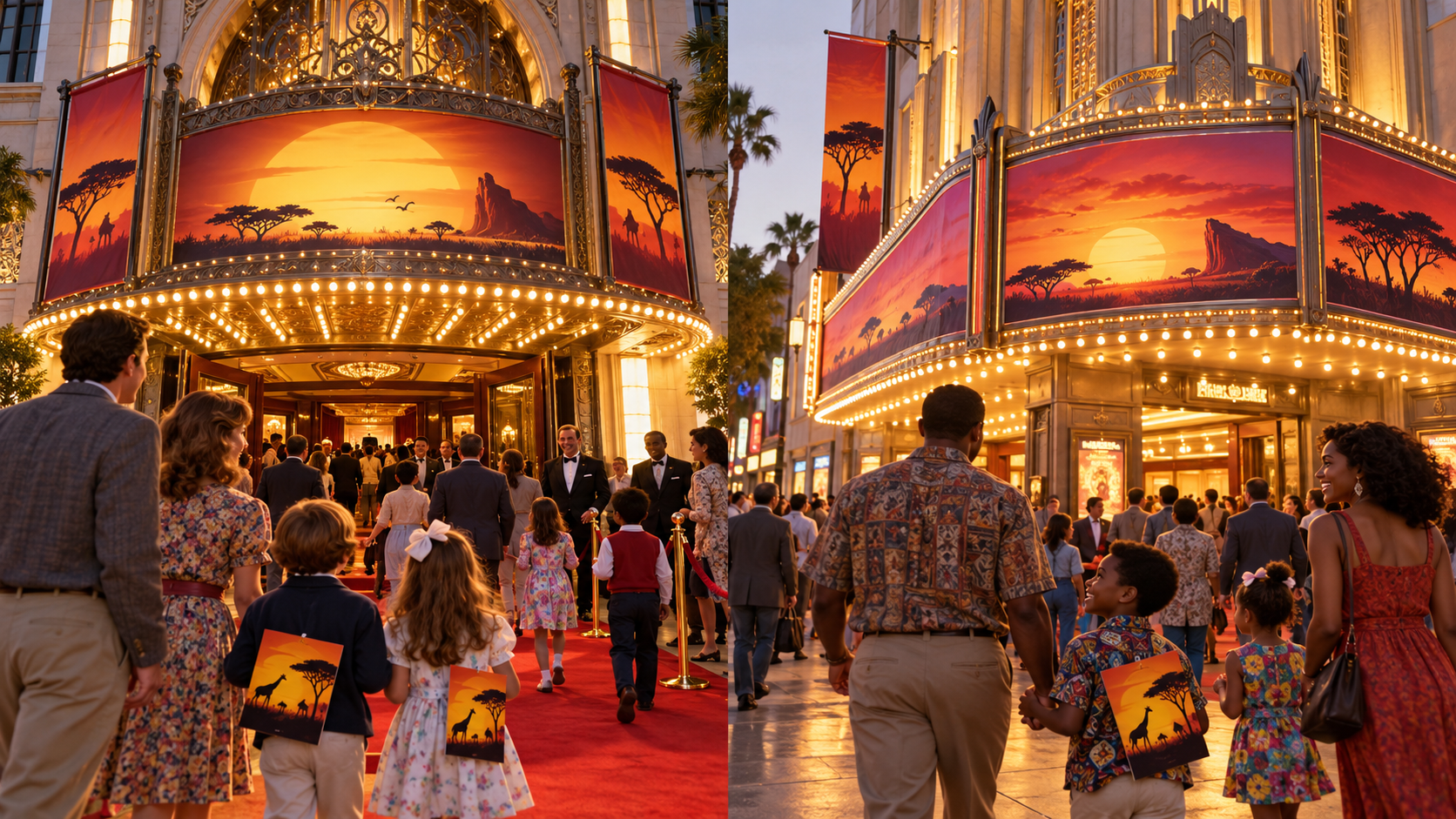
The limited opening mattered because it framed an animated feature as a prestige event, not merely children’s programming. Audiences at Radio City Music Hall and the El Capitan encountered elaborate live presentation around the film, while reviews and word of mouth built toward the wide release. Inside Disney, some artists had initially viewed other projects as safer bets, yet The Lion King’s emotional clarity and original setting connected with viewers across ages. Its story drew on familiar patterns—succession, exile, guilt and return—while the animation gave each relationship distinct physical behavior. The film’s treatment of monarchy, ecology and villainy can be questioned, but its confidence expanded expectations for what a studio cartoon could carry in dramatic and commercial terms.
The Lion King became the highest-grossing traditionally animated feature of its era, won Academy Awards for score and song, and generated a media world of sequels, television, games and merchandise. Most consequentially, Julie Taymor’s stage adaptation transformed masks, puppetry and visible theatrical mechanics into a long-running global success rather than imitating the film literally. Disney later remade the story through photorealistic computer animation, evidence of the property’s reach and of changing assumptions about realism. The 1994 original remains distinctive because its expressive drawings never pretend to be nature footage; color, movement and music make emotion legible. That June 15 engagement was a controlled beginning, but the response quickly exceeded the frame. A film once treated as an internal risk became one of the defining cultural landmarks of Disney’s animation renaissance.
Remembering the lion king begins its limited theatrical release on June 15 is valuable because anniversaries turn a familiar cultural object back into a specific decision, release or broadcast. The surrounding technology, business and audience conditions explain why the moment could happen then, while its later uses show that meaning never stops changing. Seen at that scale, the date is not trivia. It is a checkpoint between creation and memory: a place to separate what occurred from the legend accumulated around it and to ask why the work still attracts attention.
The Lion King opened in limited release in New York and Los Angeles on June 15, 1994 before going wide June 24.
The moment reached audiences through the media and distribution systems of 1994, influencing how the initial response developed.
Roger Allers and Rob Minkoff directed, with songs by Elton John and Tim Rice and a score by Hans Zimmer.
Its early impact was substantial but not universal, and later retellings sometimes compressed a more complicated contemporary response.
The film became a major global hit and inspired an influential stage adaptation by Julie Taymor.
Anniversary coverage continues to place The Lion King Roars within the broader history of popular culture while distinguishing documented evidence from later legend.
Explore more of "On This Day ..."
Discover more events from the same date across news, politics, technology, sports, and other fields. Each link highlights significant moments that shaped history on different fronts.