

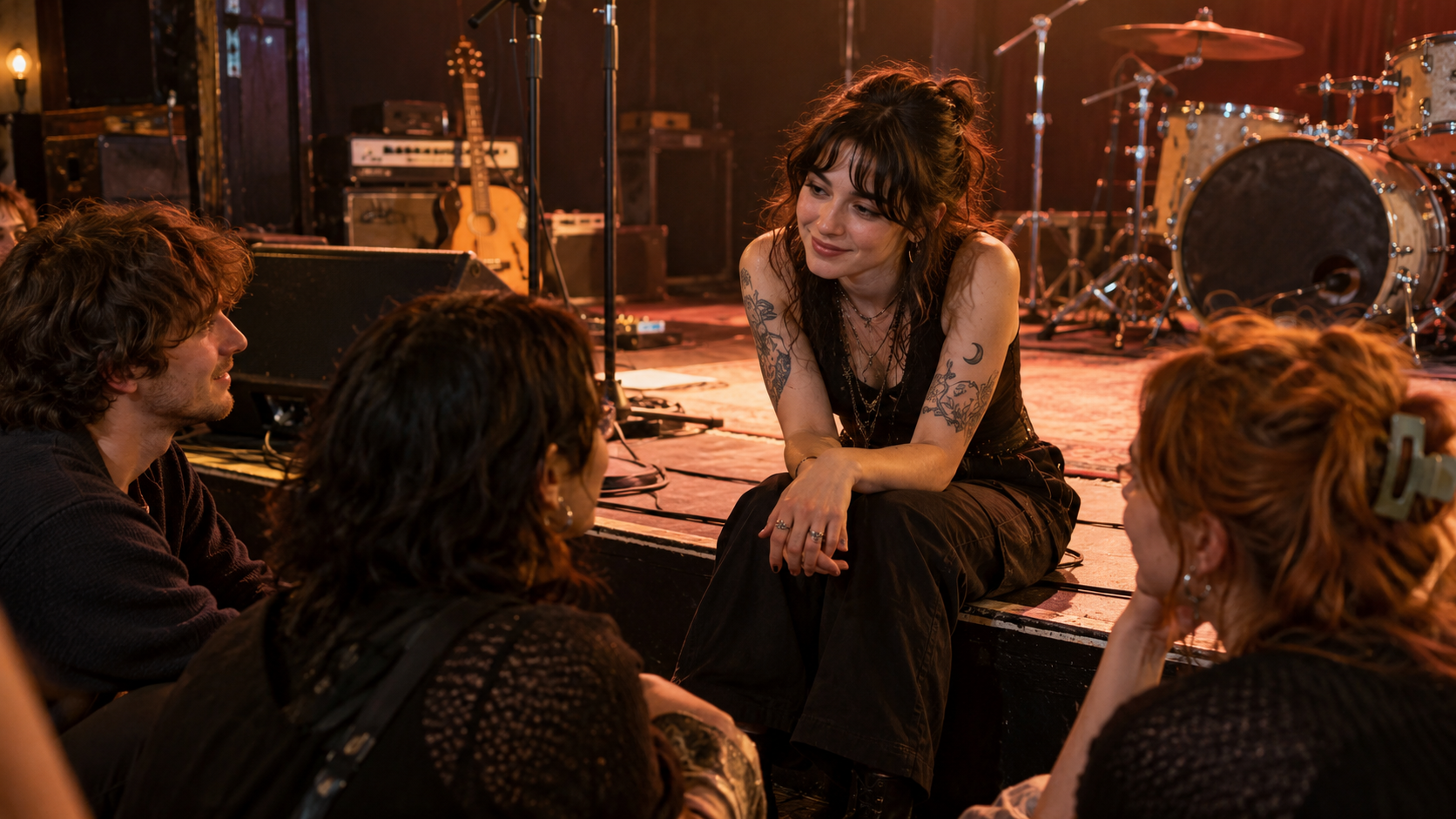
“People had been asking the wrong question: “How do we make people pay for music?””
Palmer presented this question in a TED talk about her years as a street performer, direct relationships with listeners, and a record-setting crowdfunding campaign. She contrasted making people pay with building enough connection that people could choose to support the work. The wording is traceable to a documented public setting rather than a later quotation graphic or anonymous compilation. Reading the surrounding remarks matters because the event, audience, and neighboring ideas determine what the compact sentence can responsibly carry.
Changing the question changes the design. “Make” imagines enforcement and a resistant customer; “let” and “ask” imagine access, trust, and participation. The model treats attention and relationship as part of the exchange rather than assuming a fixed price is the only proof of value. Read closely, the line does not promise an effortless result. Its force comes from directing attention toward a choice, relationship, or condition that the larger speech makes visible. Popular culture can send a short phrase much farther than the full remarks, so a fair interpretation keeps the memorable wording connected to its original argument.
Trust-based models can shift risk onto artists and unpaid collaborators, and a visible crowdfunding success is not easily reproduced. Fans have unequal means, platforms take fees, and openness can create boundary pressures. Voluntary support still needs transparent budgets, fair compensation, and realistic expectations. That limitation is essential, because an admired performer’s experience is evidence of one perspective, not a universal rule. A memorable sentence can open reflection, but it should never substitute for history, expertise, resources, or accountability. Context turns inspiration into a more honest standard and prevents admiration from flattening the people or problems being discussed.
The quote remains useful across memberships, newsletters, games, podcasts, and independent film. Creators can explain costs, offer accessible entry points, invite support without shame, and report what funding enabled. Audiences can decide deliberately which work they want to sustain instead of treating free access as costless production. A practical way to use the line is to convert its value into one observable habit, decision, or question rather than merely repeating it. In creative life, ideals become credible through working conditions, credit, access, and sustained attention. The lasting value is not celebrity alone; it is the invitation to notice more carefully and act with greater purpose. That follow-through preserves the quotation’s energy while testing it against circumstances beyond the stage, screen, or auditorium where the words first drew attention. Repetition matters less than the quality of the next concrete choice.
Palmer presented this question in a TED talk about her years as a street performer, direct relationships with listeners, and a record-setting crowdfunding campaign. She contrasted making people pay with building enough connection that people could choose to support the work.
Changing the question changes the design. “Make” imagines enforcement and a resistant customer; “let” and “ask” imagine access, trust, and participation. The model treats attention and relationship as part of the exchange rather than assuming a fixed price is the only proof of value.
Trust-based models can shift risk onto artists and unpaid collaborators, and a visible crowdfunding success is not easily reproduced. Fans have unequal means, platforms take fees, and openness can create boundary pressures. Voluntary support still needs transparent budgets, fair compensation, and realistic expectations.
Explore more "Quotes of The Day"
Discover more notable quotes from influential voices across politics, science, business, technology, sports, and culture. Each quote offers insight into how ideas, beliefs, and decisions shape the world around us.