

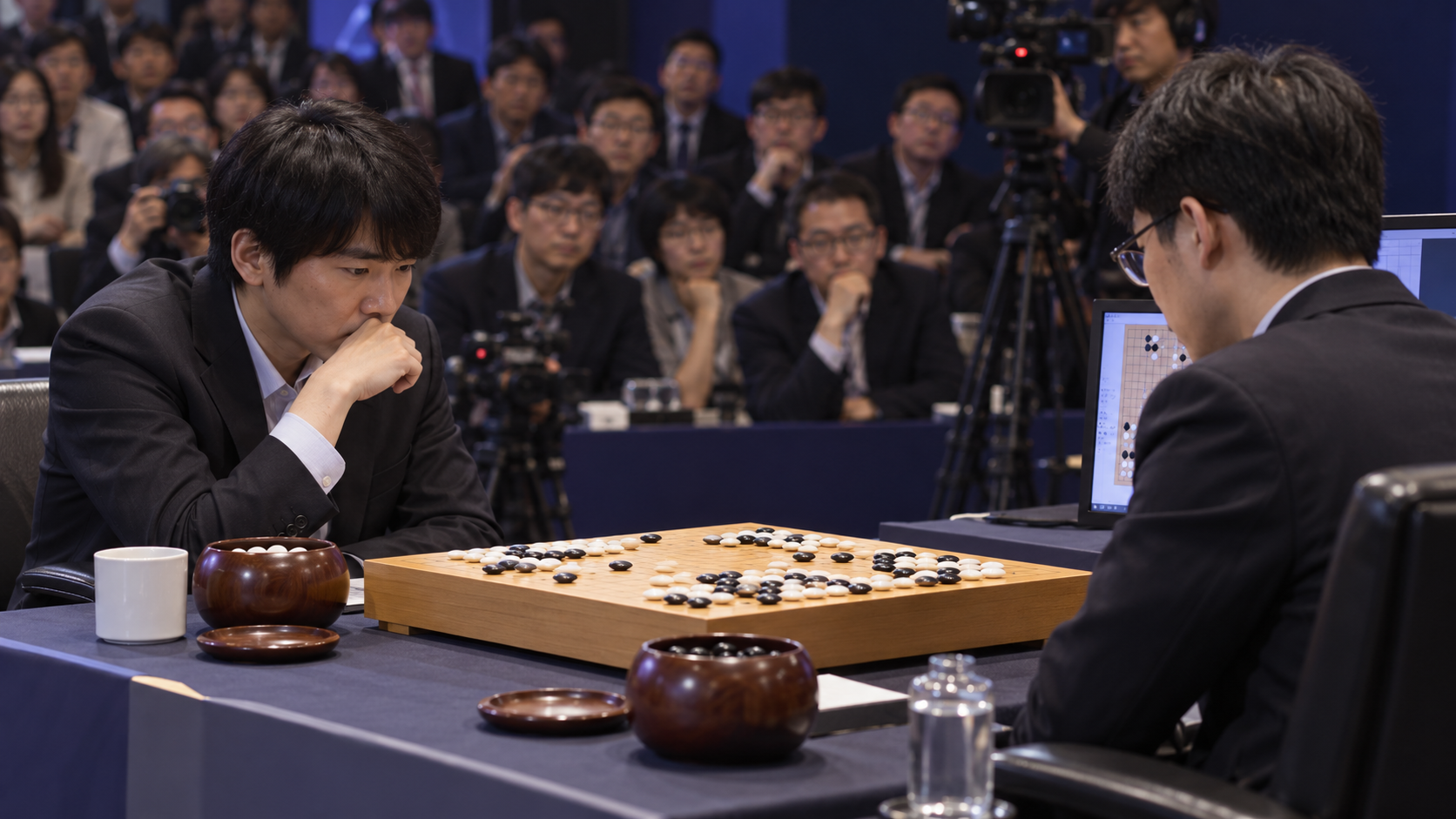
March 9, 2016: AlphaGo Wins the First Game
On March 9, 2016, Google DeepMind’s AlphaGo defeated eighteen-time world champion Lee Sedol in the opening game of their five-match contest in Seoul. The victory was the first step in a result many experts had expected to remain years away because the ancient board game offered an enormous number of possible positions. Computers had surpassed humans in chess, but Go resisted conventional search because its branching factor was vastly larger and evaluating a position required subtle judgment. AlphaGo combined deep neural networks, reinforcement learning, and Monte Carlo tree search rather than trying to calculate every possible continuation. The date matters because it turned a fast-moving technical or policy development into a visible milestone that people, institutions, and researchers could evaluate.
The substance of AlphaGo’s first victory over Lee Sedol was as important as the headline. Lee played the black stones and resigned after 186 moves when AlphaGo’s advantage became clear. The system used a policy network to propose promising moves and a value network to estimate the likely winner, with extensive self-play helping it discover strategies beyond its original human game records. Those choices reveal what the people behind the milestone believed was necessary at the time. AI history rarely advances through one breakthrough alone; research, product design, infrastructure, governance, and access all shape what a system can become.
The immediate consequences reached beyond the organization at the center of the event. The win shocked professional players and drew a worldwide audience to modern machine learning. It transformed reinforcement learning from an abstract research area into a visible demonstration of strategic competence, while the match’s human drama helped the public understand that the system’s moves could challenge centuries of expert intuition. The moment also invited scrutiny, because new capabilities create new dependencies. Reliability, safety, cost, privacy, and human control determine whether an impressive demonstration becomes a trustworthy part of everyday life.
In retrospect, AlphaGo’s first game opened one of the defining episodes of twenty-first-century AI. Techniques developed around the project later influenced successors such as AlphaZero and MuZero and encouraged researchers to apply learning and planning to scientific optimization, biology, and other domains with difficult search spaces. Looking back from today’s rapidly changing AI landscape, this event belongs to a larger transition from specialized machine-learning experiments to systems embedded in ordinary products, workplaces, institutions, and public decisions. Its enduring lesson is that technical progress becomes historically significant when it changes what people can do and what society expects next. That connection between capability and consequence gives the milestone its lasting relevance.
Google DeepMind's AlphaGo defeated eighteen-time world champion Lee Sedol in the opening game of their five-match contest in Seoul. The victory was the first step in a result many experts had expected to remain years away because the ancient board game offered an enormous number of possible positions.
Lee played the black stones and resigned after 186 moves when AlphaGo's advantage became clear. The system used a policy network to propose promising moves and a value network to estimate the likely winner, with extensive self-play helping it discover strategies beyond its original human game records.
The win shocked professional players and drew a worldwide audience to modern machine learning. It transformed reinforcement learning from an abstract research area into a visible demonstration of strategic competence, while the match's human drama helped the public understand that the system's moves could challenge centuries of expert intuition.
The event connected a concrete technical, commercial, or policy decision with the wider development of artificial intelligence.
AlphaGo's first game opened one of the defining episodes of twenty-first-century AI. Techniques developed around the project later influenced successors such as AlphaZero and MuZero and encouraged researchers to apply learning and planning to scientific optimization, biology, and other domains with difficult search spaces.
Its influence can be traced through later products, research, governance, or industry practice.
Explore more of "On This Day ..."
Discover more events from the same date across news, politics, technology, sports, and other fields. Each link highlights significant moments that shaped history on different fronts.