

On This Day in Business: January 18, 2005
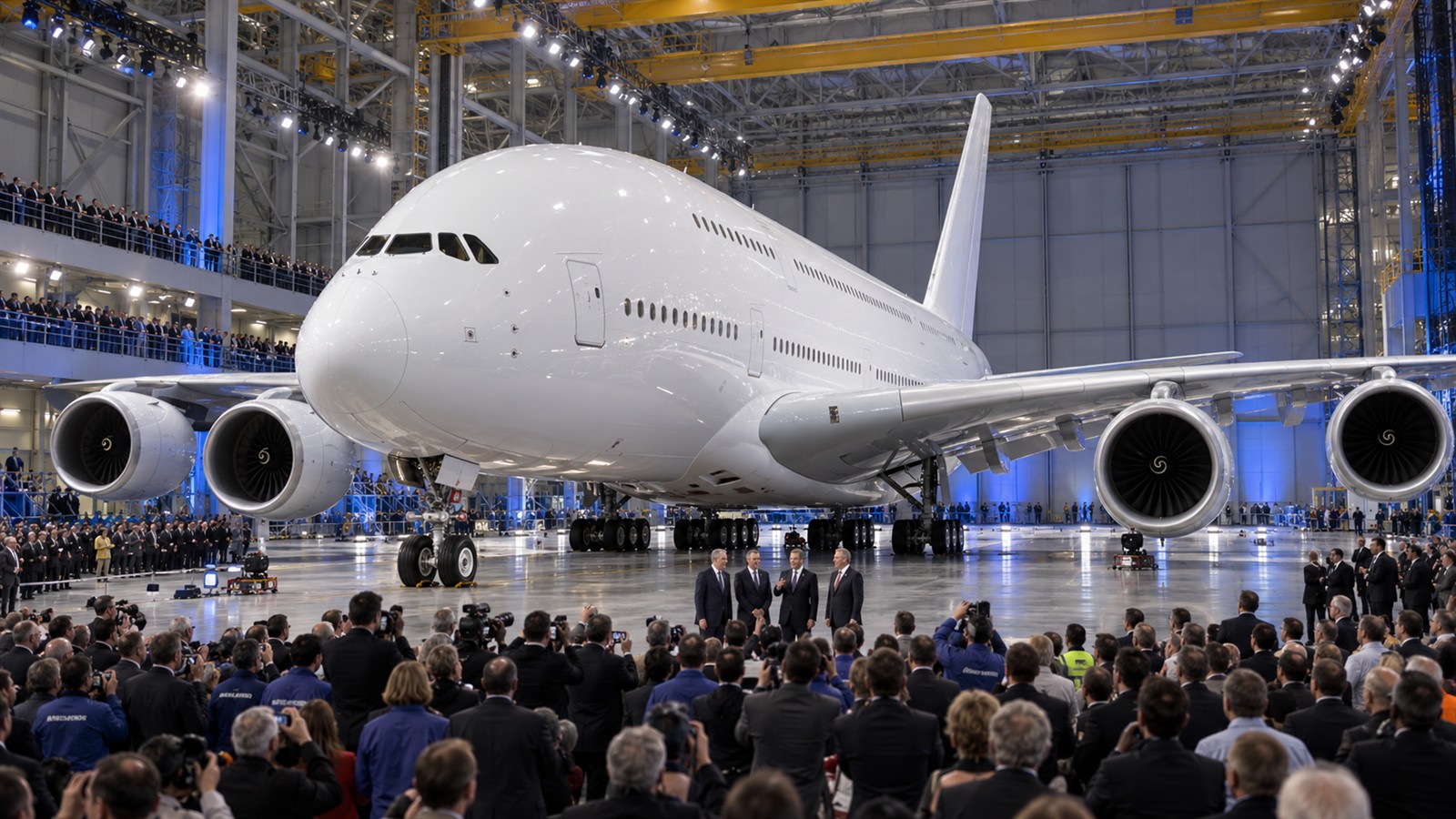
On January 18, 2005, Airbus publicly unveiled the first complete A380 at its Jean-Luc Lagardère final-assembly hall in Toulouse, France. The aircraft stood before about 5,000 guests, including the leaders of France, Germany, Britain and Spain and representatives of customer airlines. Its full-length double deck, four engines and immense wingspan made the presentation as much an industrial statement as a product reveal. Airbus had launched the program in December 2000 to challenge assumptions about how airlines would handle long-term traffic growth. The ceremony showed that a design assembled through a multinational European supply chain had moved from drawings and major sections into a recognizable commercial aircraft.
The business case rested on scale. Airbus promoted the A380 as a 555-seat flagship that could move more passengers between congested hub airports without adding an equal number of flights. Its planned range of roughly 8,000 nautical miles was intended to connect major cities nonstop, while a spacious two-deck cabin gave airlines room to differentiate premium service. The program also represented a direct competitive bet against Boeing's view that airlines would increasingly favor smaller long-range jets serving more city pairs. By concentrating passengers in one aircraft, Airbus was wagering that the world's busiest routes and airports would reward capacity, comfort and lower costs per seat.
The reveal was only one milestone in a demanding certification and production campaign. The first A380 flew on April 27, 2005, beginning thousands of hours of testing across several development aircraft. Entry into airline service took longer than Airbus had expected as wiring complexity and manufacturing coordination caused delays. Singapore Airlines eventually operated the first commercial service in October 2007. Those setbacks exposed the risk of managing a product whose huge components were designed and built across several countries, transported to Toulouse and customized for airline customers. They also showed how schedule slippage on a capital-intensive program can affect supplier plans, customer fleets and corporate earnings.
The A380 became a passenger favorite and a symbol of European engineering, but its market remained narrower than Airbus originally projected. Airlines increasingly chose efficient twin-engine wide-bodies, and the hub-to-hub demand behind the superjumbo's business case did not expand enough to sustain production indefinitely. Airbus delivered the final aircraft in 2021, although the fleet is expected to remain in service for years. January 18 therefore marks both an engineering triumph and a consequential strategic wager. The unveiling made visible the scale of the investment, the coordination behind it and the market forecast Airbus was asking customers to accept—an enduring lesson in how bold industrial products combine technical achievement with uncertain commercial timing.
Airbus launched the A380 program in December 2000, betting that congested global hubs would need an aircraft able to carry far more passengers per flight.
Its multinational production system assigned major structures to factories across France, Germany, Britain and Spain before final assembly in Toulouse.
On January 18, 2005, the first complete A380 was revealed to about 5,000 guests in the Jean-Luc Lagardère assembly hall.
The 555-seat concept promised long range, a full-length double deck and lower costs per seat on dense routes, directly challenging Boeing's market assumptions.
Testing, wiring problems and manufacturing coordination delayed entry into service until Singapore Airlines began commercial operations in October 2007.
Production ended in 2021 as airlines favored efficient twin-engine jets, leaving the A380 as both an engineering landmark and a high-stakes market bet.
Explore more of "On This Day ..."
Discover more events from the same date across news, politics, technology, sports, and other fields. Each link highlights significant moments that shaped history on different fronts.