

On This Day in Business: February 6, 1959
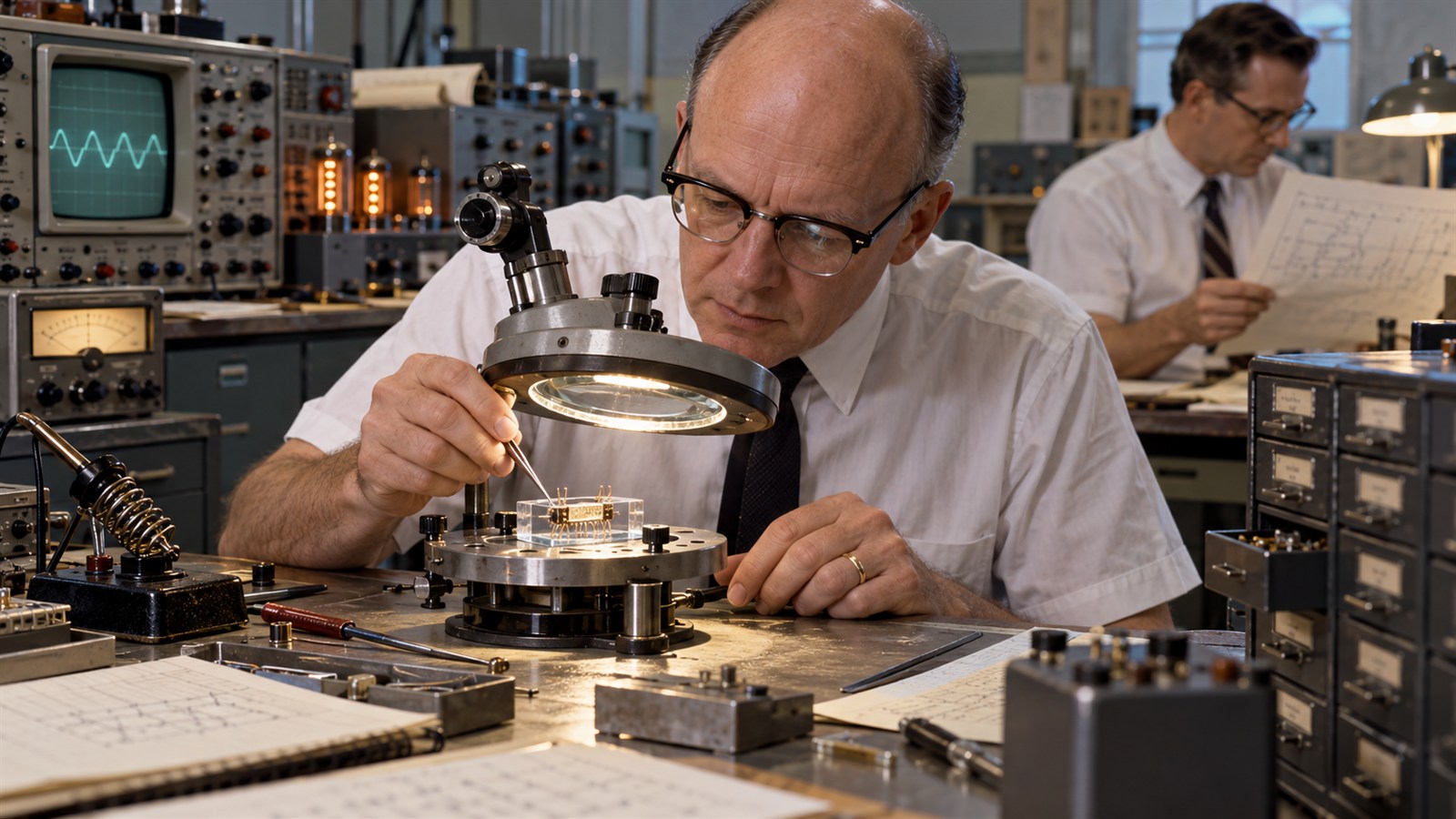
On February 6, 1959, Texas Instruments engineer Jack Kilby filed a patent application for a miniaturized electronic circuit whose components were formed in a single piece of semiconductor material. Kilby had demonstrated a working germanium prototype the previous September, wiring a tiny sliver by hand to prove that resistors, capacitors and a transistor could be fabricated together. The idea addressed the "tyranny of numbers": as electronic systems grew more capable, connecting thousands of separate components created cost, size and reliability problems faster than designers could solve them.
The patent application converted the demonstration into an intellectual-property claim and a prospective product platform. Kilby's first device was crude by later standards, and its external wire connections made mass production difficult. At Fairchild Semiconductor, Robert Noyce independently developed a silicon integrated-circuit approach that used the planar manufacturing process and metal interconnections on the chip. The two paths were complementary. Kilby's work established the principle of integration, while Noyce's approach proved especially suited to scalable fabrication. Patent agreements and cross-licensing eventually helped the emerging industry move past a potentially paralyzing ownership dispute.
Integrated circuits changed the economics of electronics. Manufacturers could make many devices through repeated photographic and chemical steps on a wafer, test them, cut them apart and package the working chips. Unit costs fell as volumes and yields improved, while smaller dimensions increased speed and reduced power. Military and space programs provided early demand because they valued compactness and reliability, but calculators, computers, industrial controls and consumer devices soon expanded the market. Texas Instruments commercialized integrated circuits and used patents, manufacturing expertise and customer relationships to compete in the new semiconductor ecosystem.
The February filing matters because it links invention to the institutional machinery that turns a laboratory result into an industry. A useful chip required more than a clever circuit: companies needed process engineering, clean manufacturing, design methods, packaging, customers and agreements about intellectual property. Over following decades, integrated circuits became the foundation for microprocessors, memory and digital networks, enabling businesses that Kilby could not have specified in 1959. His application captures the earliest commercial logic of the platform—replace fragile assemblies of discrete parts with reproducible functions inside one material system. The result was not simply a smaller component but a compounding manufacturing model in which each generation could place more capability on the same basic unit. The invention also shifted competitive advantage from assembling parts toward mastering processes. Semiconductor firms increasingly won through yield, miniaturization and design ecosystems, capabilities that improved cumulatively and demanded sustained investment rather than a single successful prototype.
Complex electronic systems depended on growing numbers of separately manufactured parts and hand connections, creating severe cost and reliability limits.
Jack Kilby demonstrated in 1958 that multiple circuit elements could be formed in one semiconductor body and connected into a working oscillator.
On February 6, 1959, Kilby filed the patent application that became U.S. Patent 3,138,743 for a miniaturized electronic circuit.
Robert Noyce separately developed a planar silicon design with on-chip metal interconnections, providing a more scalable manufacturing route.
Cross-licensing, process improvement and early government demand helped integrated circuits move from prototypes into repeatable commercial production.
Falling cost and rising density eventually made chips the common platform for calculators, computers, communications and modern digital services.
Explore more of "On This Day ..."
Discover more events from the same date across news, politics, technology, sports, and other fields. Each link highlights significant moments that shaped history on different fronts.