

On This Day in Business: February 7, 1964
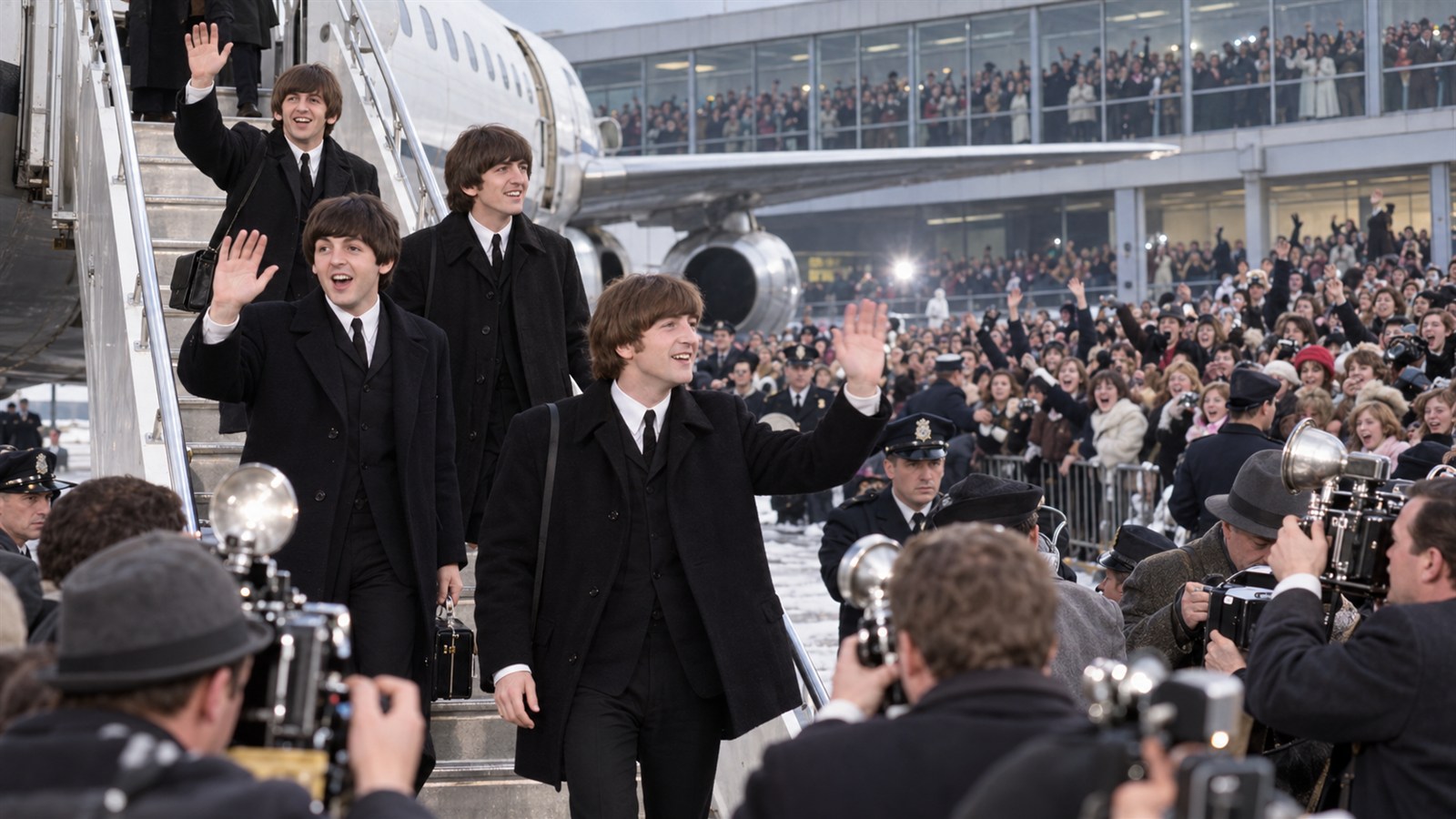
On February 7, 1964, the Beatles arrived at New York's newly renamed John F. Kennedy International Airport. Thousands of fans crowded observation areas and terminal approaches while reporters packed a press conference. The visit was not a spontaneous invasion. Capitol Records had prepared a concentrated American campaign around the single "I Want to Hold Your Hand," radio airplay, print promotion and the group's coming appearance on The Ed Sullivan Show. By the time Pan American Flight 101 landed, the record was already number one, turning the airport arrival into a national news event rather than a conventional artist introduction.
The campaign exploited a fast-changing media system. Teenagers could hear the same song on powerful AM stations, buy an inexpensive single at a local store and see the performers on network television. Managers, record executives, promoters and broadcasters synchronized those channels around a distinctive image: four young British musicians with matching suits, humor and haircuts unlike those of most American pop acts. Two nights after the arrival, an estimated 73 million viewers watched the Beatles on Sullivan. That audience transformed awareness into demand for records, concert tickets, magazines and licensed merchandise almost instantly.
The business effects extended beyond one group. American labels rushed to sign and promote other British acts, while radio formats and concert promotion adjusted to a youth audience with increasing spending power. Albums became more important artistic and commercial statements, and bands gained greater leverage as songwriting and self-contained performance became central to their identity. The Beatles' success also demonstrated how international repertoire could cross the Atlantic when marketing, touring and broadcasting were coordinated. Cultural novelty became an exportable asset supported by multinational distribution.
February 7 is therefore a milestone in audience formation as much as music history. The airport crowd supplied vivid proof of demand, news coverage amplified the spectacle and television delivered a shared national experience. Each medium made the next more valuable, producing a launch sequence that modern entertainment companies still try to recreate across streaming, social platforms, live events and merchandise. The Beatles' later artistic evolution cannot be reduced to promotion, but the American breakthrough shows that exceptional content travels fastest when gatekeepers align timing and consumers can participate through several products at once. A plane landing became the opening scene of a coordinated market entry that changed labels, performers and youth culture on both sides of the Atlantic. The visit further showed that fan communities were not passive audiences. Their screams, signs and purchases became marketing material in their own right, supplying images that newspapers, broadcasters and record companies could recirculate to enlarge the sense of a national event.
Capitol Records paired a rising single with radio promotion, print coverage and a national television booking before the group reached the United States.
Teenagers formed a powerful common market because AM radio, affordable records and network television could concentrate attention across the country.
On February 7, 1964, the Beatles landed at JFK Airport to a huge fan crowd and an unusually intense press reception.
The airport spectacle created news footage that reinforced the campaign and prepared viewers for the band's first Ed Sullivan appearance two nights later.
Record sales, concerts and merchandise surged, while American labels accelerated their search for other British performers and self-contained bands.
The launch became a durable entertainment-business model: coordinate media channels, turn audience enthusiasm into news and offer participation across products.
Explore more of "On This Day ..."
Discover more events from the same date across news, politics, technology, sports, and other fields. Each link highlights significant moments that shaped history on different fronts.