

On This Day in Business: March 5, 1872
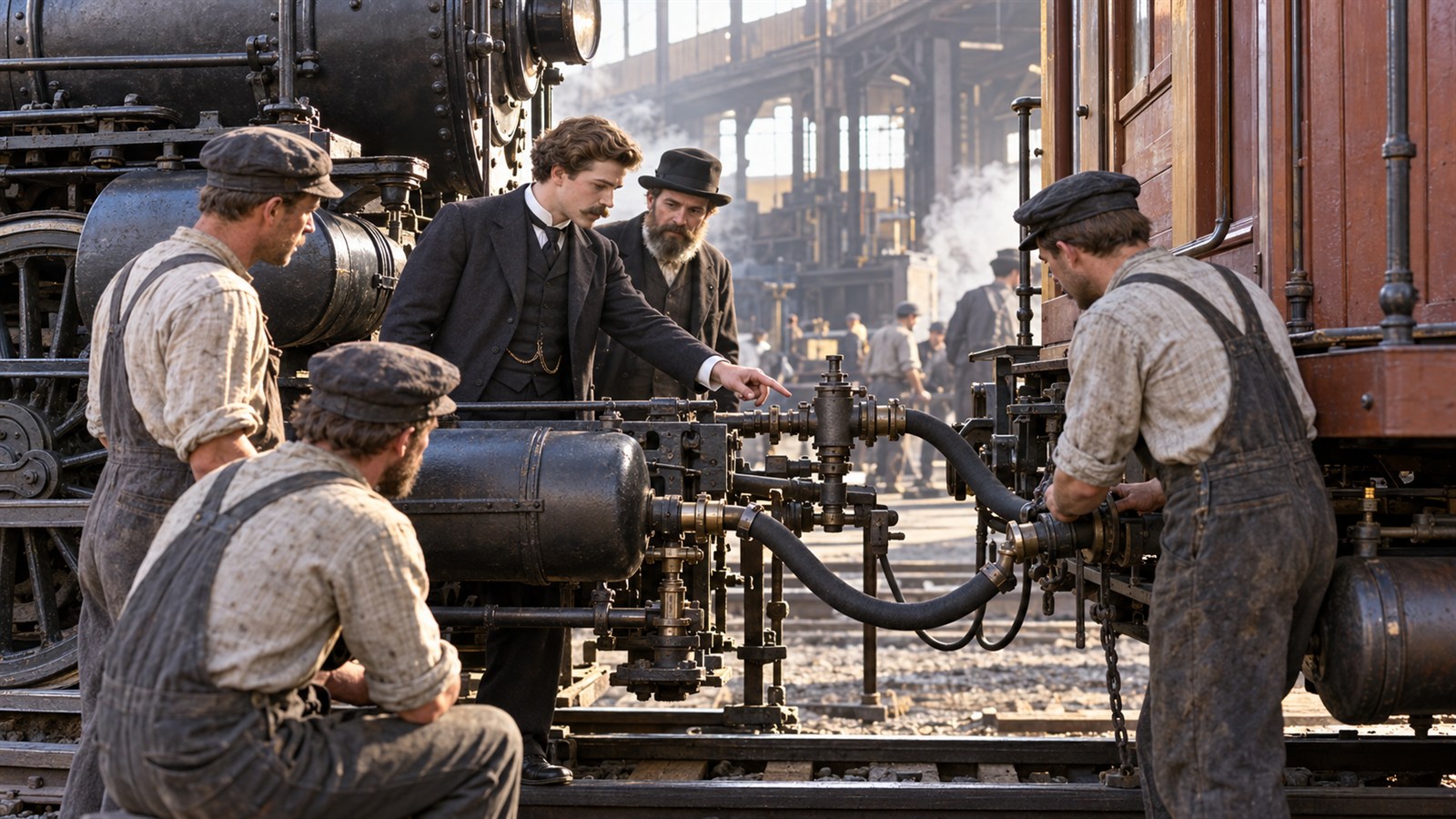
On March 5, 1872, George Westinghouse received a patent for an improved automatic air-brake system. Railroad trains had become longer and faster, but stopping them still depended heavily on brakemen turning wheels atop individual cars after hearing a whistle. The work was slow, dangerous, and uneven. Westinghouse's earlier straight-air brake let an engineer apply brakes through compressed air, but a broken connection could disable the system. The automatic design reversed that weakness: a loss of pressure helped trigger braking, so a separated train or failed hose could produce a safer response rather than remove control.
The invention addressed both safety and operating economics. More reliable braking allowed trains to travel at useful speeds while maintaining better control, and it reduced dependence on workers moving across car roofs in all weather. A practical system still required standardized pipes, valves, reservoirs, and couplings throughout a train. Westinghouse therefore had to do more than license an isolated component. His company demonstrated the technology, manufactured compatible equipment, supported installation, and persuaded railroads that systemwide conversion was worth the capital and disruption.
Adoption was gradual because railroads owned large fleets and equipment from many builders. A safety improvement could not deliver its full value if only a few cars used it. Regulation eventually accelerated the transition: the federal Safety Appliance Act of 1893 required railroads engaged in interstate commerce to equip trains with power brakes and other protections. By then, Westinghouse Air Brake had built technical experience and an industrial position around a standard that railroads increasingly needed. The company grew with the network it made safer.
The automatic brake is a case study in fail-safe design and systems entrepreneurship. Westinghouse recognized that a device should respond usefully when its power or connection failed, an idea now central to engineering risk management. He also understood that infrastructure technologies succeed through coordinated adoption, dependable supply, maintenance, training, and common interfaces. The patent protected a mechanism, but the business value came from turning that mechanism into an operating system trusted across many railroads. Safer stopping increased the productive capacity of the entire network, showing how risk reduction can be a source of industrial growth. Safety innovation also changed bargaining among railroads, workers, insurers, and regulators. When a practical alternative existed, preventable injuries became harder to defend as an unavoidable cost of transportation. Better braking reduced risk while enabling heavier and faster trains, aligning protection with productivity. That combination is commercially powerful: improvements spread more readily when they do not merely satisfy a rule but also expand capacity, reduce disruption, and make the underlying service more dependable.
Early railroad braking required brakemen to move across car roofs and apply hand brakes individually, a hazardous and imprecise process.
Westinghouse's automatic design used pressure so that a broken train line could initiate braking instead of leaving the engineer without control.
The March 5 patent improved the technical foundation for coordinated brakes that could be operated from the locomotive.
Railroads still faced the expense of converting mixed fleets, maintaining equipment, and agreeing on compatible system standards.
Federal safety requirements in the 1890s helped speed broad adoption, benefiting suppliers prepared to deliver complete and dependable systems.
Automatic air brakes increased railroad safety and capacity while establishing fail-safe engineering as a commercially valuable design principle.
Explore more of "On This Day ..."
Discover more events from the same date across news, politics, technology, sports, and other fields. Each link highlights significant moments that shaped history on different fronts.