

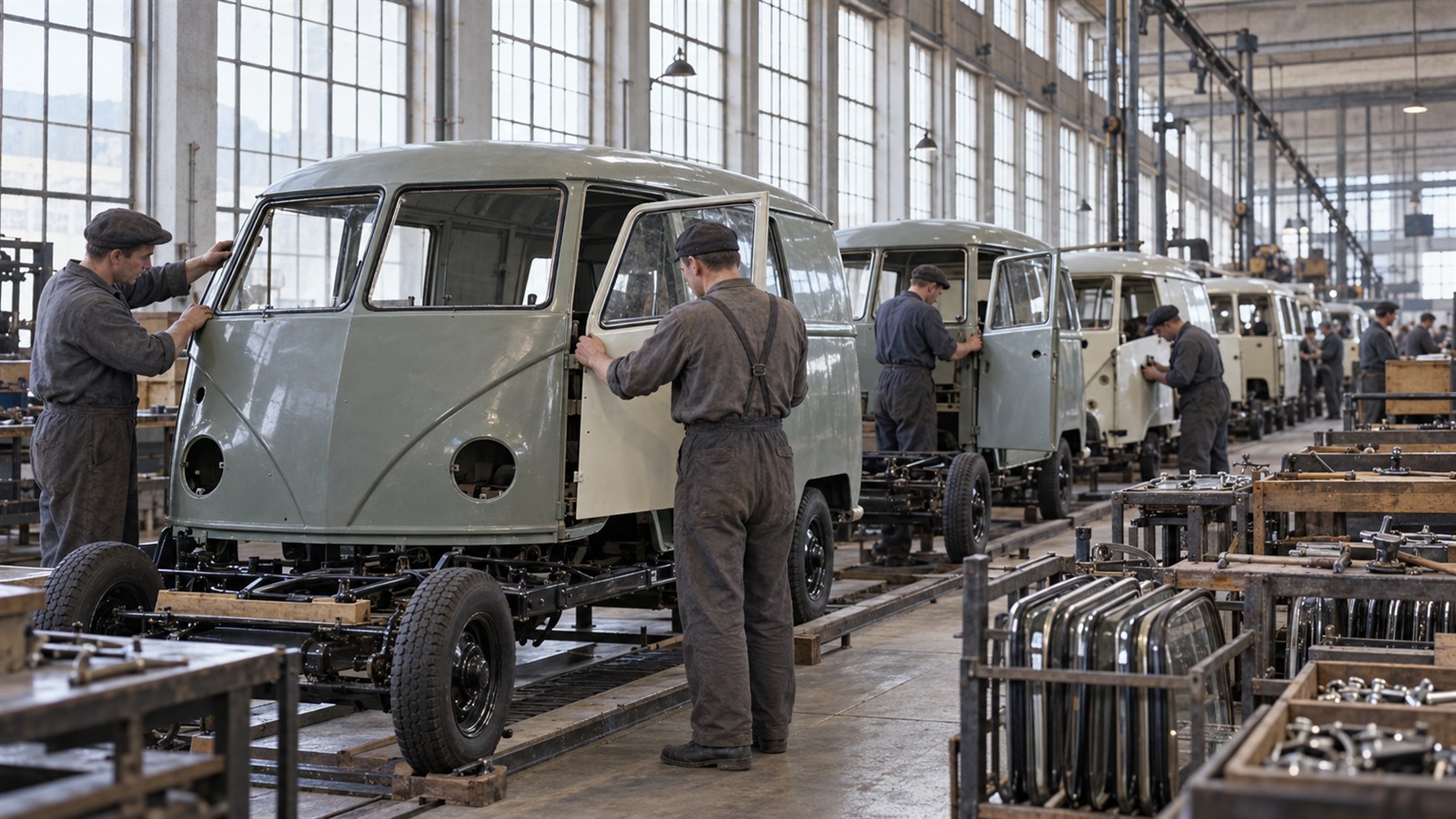
On This Day in Business: March 8, 1950
On March 8, 1950, Volkswagen began series production of the Type 2 Transporter at its Wolfsburg plant. The rear-engined vehicle borrowed components and engineering ideas from the Beetle but rearranged them around a box-shaped body with far more usable space. Dutch importer Ben Pon had sketched the basic concept after seeing industrial vehicles at the factory, and Volkswagen engineers developed it into a practical production model. The first versions included a panel van and passenger bus, giving tradespeople and institutions a compact vehicle that could carry goods, tools, or people.
The Transporter's appeal came from adaptable capacity rather than luxury. Its flat load floor, broad doors, and relatively small footprint suited rebuilding economies and growing urban businesses. A common mechanical base with the Beetle simplified parts supply and service, while different bodies let Volkswagen address many customer segments without designing an entirely new vehicle for each one. This platform logic made manufacturing investment work harder. Dealers could serve owners using familiar components, and fleet buyers could select configurations for delivery, construction, public service, or passenger transport.
Demand soon exceeded the room available at Wolfsburg. Volkswagen built a dedicated commercial-vehicle plant in Hanover, where Transporter production began in 1956. Successive generations added capacity, comfort, and technical change while preserving the vehicle's recognizable purpose. The model became associated with small enterprise, travel, emergency services, and counterculture, an unusually broad set of identities for a commercial van. Those meanings grew from actual utility: the same basic space could become a shop, ambulance, minibus, camper, or mobile workplace.
The Type 2 demonstrates how modular design can create a long-lived product family. Volkswagen reused proven systems, concentrated change where customers would notice it, and offered variations around a shared industrial core. That approach reduced development risk and supported scale, yet left room for buyers to adapt the product to local needs. The vehicle's cultural fame can obscure its business foundation: it succeeded because it moved people and goods efficiently. Beginning on March 8, 1950, the Transporter turned versatility into a durable market position and helped define the modern van category. The van also made customer customization part of distribution. Dealers, coachbuilders, and owners adapted the common shell for ambulances, campers, workshops, and local delivery. Volkswagen did not have to predict every use centrally; it provided a dependable base that others could specialize. That division of innovation widened the market and produced communities around particular versions. The Transporter became resilient because practical users continually found new jobs for the same recognizable architecture.
Postwar businesses needed compact, economical vehicles for deliveries, trades, public services, and passenger movement during rapid reconstruction.
Volkswagen developed Ben Pon's concept using Beetle-related components beneath a spacious, forward-control body designed for flexible use.
Series production of the Type 2 began at Wolfsburg on March 8, 1950, initially including panel-van and passenger configurations.
Strong demand created a capacity problem, leading Volkswagen to establish a dedicated commercial-vehicle factory in Hanover.
Many body styles and generations made the Transporter useful to fleets, families, campers, emergency services, and independent businesses worldwide.
Its longevity shows how shared components, modular variants, and a clear practical job can support an enduring industrial platform.
Explore more of "On This Day ..."
Discover more events from the same date across news, politics, technology, sports, and other fields. Each link highlights significant moments that shaped history on different fronts.