

On This Day in Business: April 10, 1849
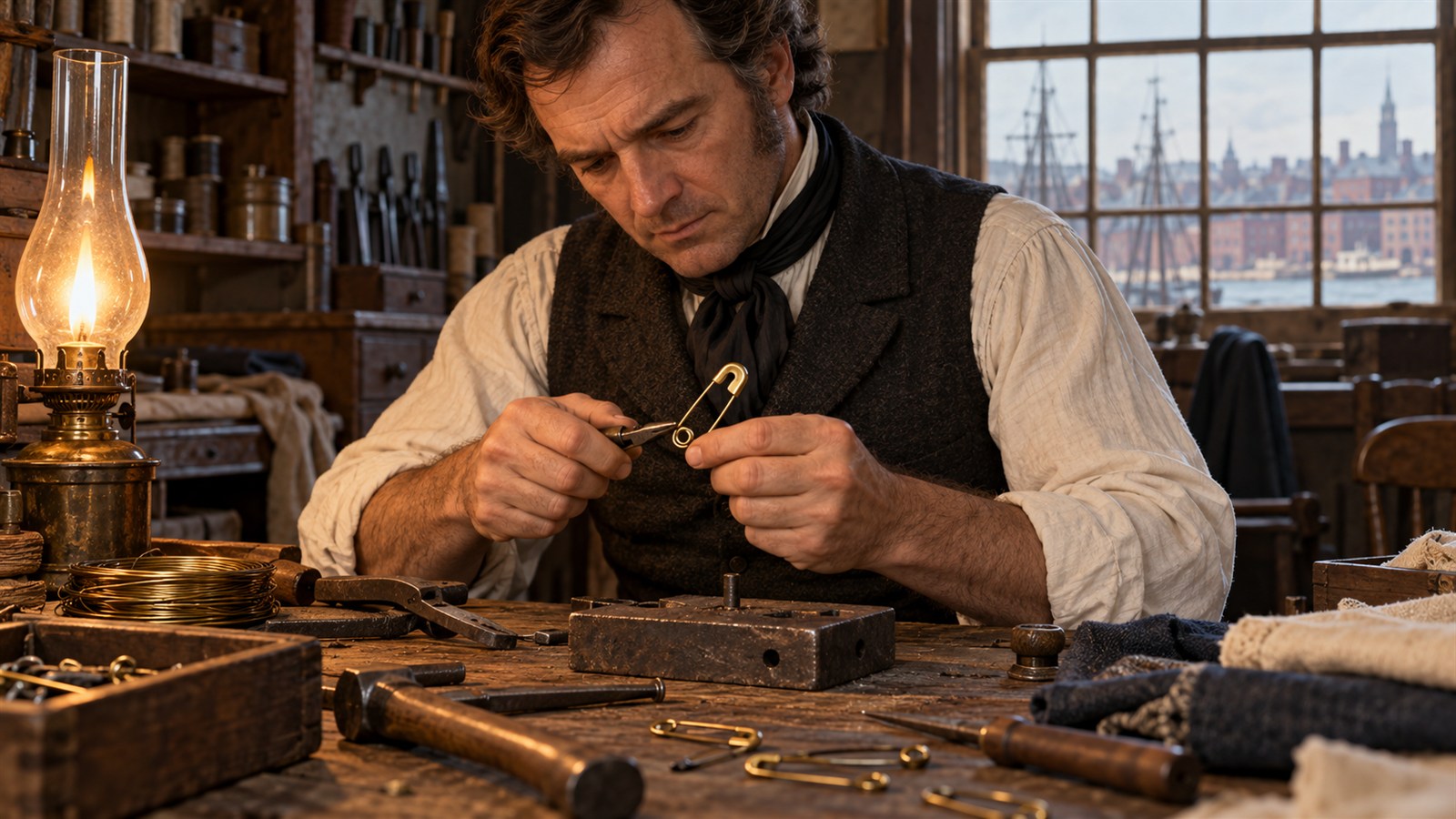
On April 10, 1849, inventor Walter Hunt received U.S. Patent No. 6,281 for a dress pin formed from a single piece of wire. The design coiled the wire to create spring tension and enclosed the sharp point in a clasp, allowing the pin to hold fabric while reducing accidental injury. Hunt reportedly developed the device while looking for a way to repay a small debt. He twisted wire as he considered the problem, then recognized that the coil and protective catch produced a useful fastening tool. The patent drawings described a compact mechanism whose basic operating principle remains familiar today.
The safety pin succeeded because it combined usefulness with manufacturability. A product made from one wire could be formed rapidly with relatively little material, transported cheaply, and sold into many households and trades. Its value did not depend on complex instruction or supporting infrastructure. Clothing, diapers, bandages, tags, and emergency repairs all created demand. The clasp also addressed a clear risk present in ordinary straight pins. Simple products often appear inevitable after they spread, but Hunt's design required seeing several functions—spring, fastener, and guard—as one economical object.
Hunt's financial outcome became a cautionary story. He sold rights to the invention for a modest sum rather than building a manufacturing business or retaining a continuing royalty. That choice solved an immediate need but surrendered much of the value generated as the product diffused. Inventors in the nineteenth century often lacked capital, factories, distribution, and legal resources, so selling a patent could be rational even when later profits appeared large. Hunt also created or improved other devices, including sewing machinery, but did not consistently capture the commercial returns from his technical creativity.
The patent illustrates the difference between invention and value capture. A clever mechanism can create social value for generations, yet the inventor benefits only through an effective ownership and commercialization strategy. Timing, bargaining power, financing, and access to production determine who receives the economic surplus. The safety pin also shows why small design changes matter: reducing harm and simplifying use can turn an ordinary component into a universal product. Businesses still search for such solutions—objects or interfaces whose simplicity hides careful integration and whose low unit value is multiplied by enormous, recurring demand. Mass production preserved the essential mechanism while allowing changes in size, metal, finish, and packaging. That flexibility widened the customer base without fragmenting how the object worked. A universal design lowers education and distribution costs because retailers do not need to explain a new process for every use. The safety pin became infrastructure at a tiny scale: inexpensive, interchangeable, and available before a user knows exactly which problem it will solve.
Walter Hunt was a prolific mechanic who often devised practical objects in response to immediate problems rather than long development programs.
His safety-pin design used one wire coil to provide spring force and a clasp to shield the point after fastening.
The United States granted Patent No. 6,281 on April 10, 1849, documenting the mechanism in a concise set of drawings and claims.
Hunt sold his rights for a relatively small payment, trading future participation for immediate cash and freedom from a debt.
Low material cost, easy transport, intuitive operation, and many possible uses helped the design become a mass-produced staple.
The story separates technical originality from commercialization and asks how inventors should finance, protect, and share in the value they create.
Explore more of "On This Day ..."
Discover more events from the same date across news, politics, technology, sports, and other fields. Each link highlights significant moments that shaped history on different fronts.