

On This Day in Business: April 21, 1989
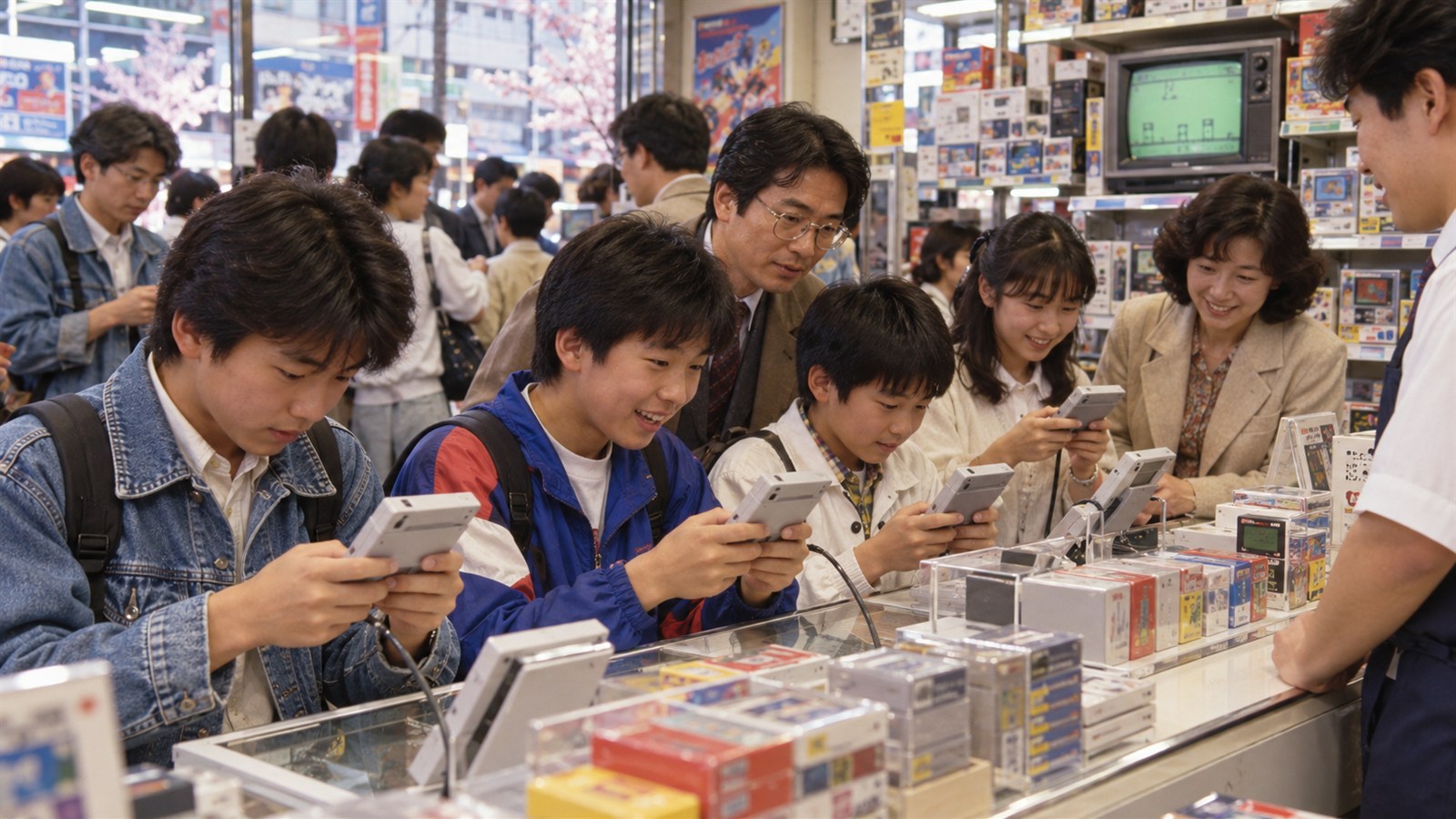
On April 21, 1989, Nintendo launched the Game Boy in Japan. Designed under Gunpei Yokoi and Nintendo's Research & Development 1 group, the handheld used a monochrome liquid-crystal screen, interchangeable cartridges, simple controls, and four AA batteries. Competing devices would offer color displays, but Nintendo favored affordability, long battery life, durability, and familiar game design. The compact gray machine was not visually luxurious, yet it could be carried easily and played for hours away from a television. That practical balance helped define what consumers expected from portable gaming.
Hardware alone was only part of the proposition. Nintendo controlled a library of recognizable games and worked with outside publishers under licensing rules developed during the home-console era. In Japan, the launch lineup included titles such as Super Mario Land, while the later North American package with Tetris demonstrated how one broadly appealing game could sell a platform. The Link Cable enabled two players to connect systems, adding a social feature without a network. Each additional owner made cartridge development more attractive, and a larger game catalog made the hardware easier to choose.
The Game Boy sold in enormous numbers across its original and Color versions and remained commercially relevant for more than a decade. Nintendo refreshed the design through smaller bodies, new colors, improved screens, and compatible successors rather than forcing an immediate break with the installed base. Pokémon later gave the platform a second surge by combining collecting, trading, and two-copy variation. The product created revenue across hardware, first-party games, licensing, accessories, batteries, and retail distribution, while establishing portable gaming as a durable segment rather than a novelty.
The launch shows that technical restraint can be a competitive advantage. Nintendo selected mature components that supported cost, battery life, and reliable mass production, then concentrated differentiation in software and experience. A color screen would have looked impressive but could have made the device more expensive and less portable. The company also protected customer investment through cartridge compatibility and gradual evolution. April 21 marks the start of a platform whose success came not from maximizing every specification, but from optimizing the whole system for ordinary use and giving developers and players reasons to remain within it. Portability also changed when and where games could be sold and played. Travel, school breaks, waiting rooms, and shared family spaces became occasions for use, expanding time available to the medium. Retailers gained a small, giftable device and recurring cartridge purchases. The Game Boy did not simply shrink a console; it created new consumption contexts. That distinction matters whenever a company moves a service onto a mobile form factor and discovers demand beyond the original setting.
Nintendo sought a portable system that balanced price, toughness, battery life, and software quality rather than leading every hardware specification.
The development team combined a monochrome screen, familiar controls, interchangeable cartridges, and components suited to mass production.
Game Boy launched in Japan on April 21, 1989, with a small lineup and a form designed for play away from television sets.
Color competitors appeared more advanced, but higher cost and shorter battery life weakened some of their practical appeal.
Tetris, Pokémon, outside publishers, link-cable play, and compatible redesigns extended the platform's market life for years.
The product demonstrates how a well-balanced ecosystem can outperform technically richer devices by solving the complete customer problem.
Explore more of "On This Day ..."
Discover more events from the same date across news, politics, technology, sports, and other fields. Each link highlights significant moments that shaped history on different fronts.