

On This Day in Business: April 25, 1954
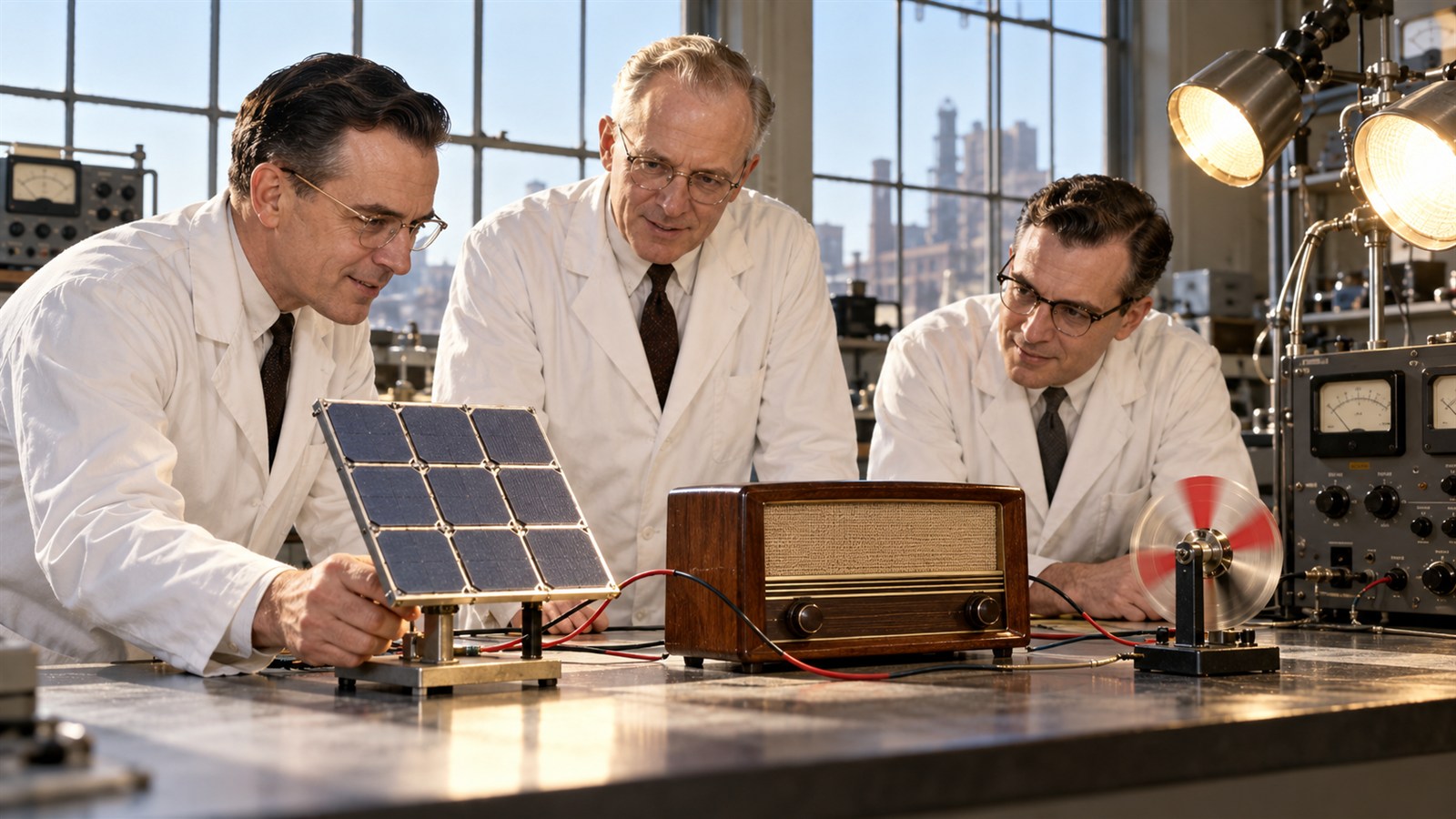
On April 25, 1954, Bell Telephone Laboratories publicly demonstrated a silicon solar cell capable of converting sunlight into useful electrical power. Researchers Daryl Chapin, Calvin Fuller, and Gerald Pearson had combined work on power sources, semiconductor junctions, and silicon processing. Earlier photovoltaic devices produced too little power or were too costly for many practical tasks. The Bell cell achieved efficiency near six percent, enough to operate small equipment during the demonstration. News reports described a solar battery, and the device offered a striking vision of electricity produced directly from light without fuel or moving machinery.
The invention emerged from collaborative research rather than a single linear plan. Chapin sought a durable power source for remote telephone equipment, Pearson observed a strong photovoltaic response in silicon, and Fuller contributed diffusion techniques that formed an effective junction. Bell Labs could bring physics, chemistry, materials, testing, and potential applications together under one organization. That environment made it possible to recognize that a laboratory effect had commercial significance. Yet high manufacturing cost meant the first cells could not immediately compete with conventional grid power.
Spaceflight supplied an early market where price mattered less than weight, reliability, and the ability to generate power far from fuel supplies. Solar cells powered satellites and improved as governments, universities, and companies invested in materials and manufacturing. Terrestrial adoption grew later through calculators, remote systems, rooftop modules, utility projects, policy support, and enormous production scale. Efficiency increased while cost declined. Supply chains expanded across polysilicon, wafers, cells, modules, inverters, construction, finance, and grid services, turning a laboratory device into a global energy industry.
The demonstration shows how breakthrough technology often needs a sequence of markets. An expensive invention may first succeed where its unusual advantages solve a problem that alternatives cannot, then reach broader customers as learning and scale reduce cost. Bell Labs also illustrates the value of interdisciplinary research and patient capital when the commercial path is uncertain. Modern solar power is far removed from the small 1954 device, but it still relies on the same core conversion. April 25 marks the moment silicon photovoltaics became a credible engineering platform rather than an intriguing scientific effect. The research also benefited from an organization willing to connect a telephone problem with broader materials science. Remote communication equipment needed power, but the solution eventually reached markets far beyond telecommunications. Firms can miss such opportunities when divisions evaluate an invention only against their immediate product plans. Bell Labs created value by allowing knowledge to cross boundaries. The solar cell's later history validates the option value of research whose largest customer may not yet exist.
Earlier photovoltaic materials demonstrated the effect but delivered limited efficiency, stability, or economic usefulness for real equipment.
Chapin, Fuller, and Pearson combined application needs, silicon-junction behavior, and fabrication methods within Bell Labs' interdisciplinary environment.
The team demonstrated a practical silicon solar cell on April 25, 1954, powering small devices directly with sunlight.
High production costs initially kept the technology from competing with ordinary electricity in most homes and businesses.
Satellites and remote uses supported early adoption before better efficiency, manufacturing scale, and policy opened mass terrestrial markets.
The cell's history shows how a breakthrough can move from a premium niche to global infrastructure through accumulated learning and investment.
Explore more of "On This Day ..."
Discover more events from the same date across news, politics, technology, sports, and other fields. Each link highlights significant moments that shaped history on different fronts.