

On This Day in Business: May 7, 1946
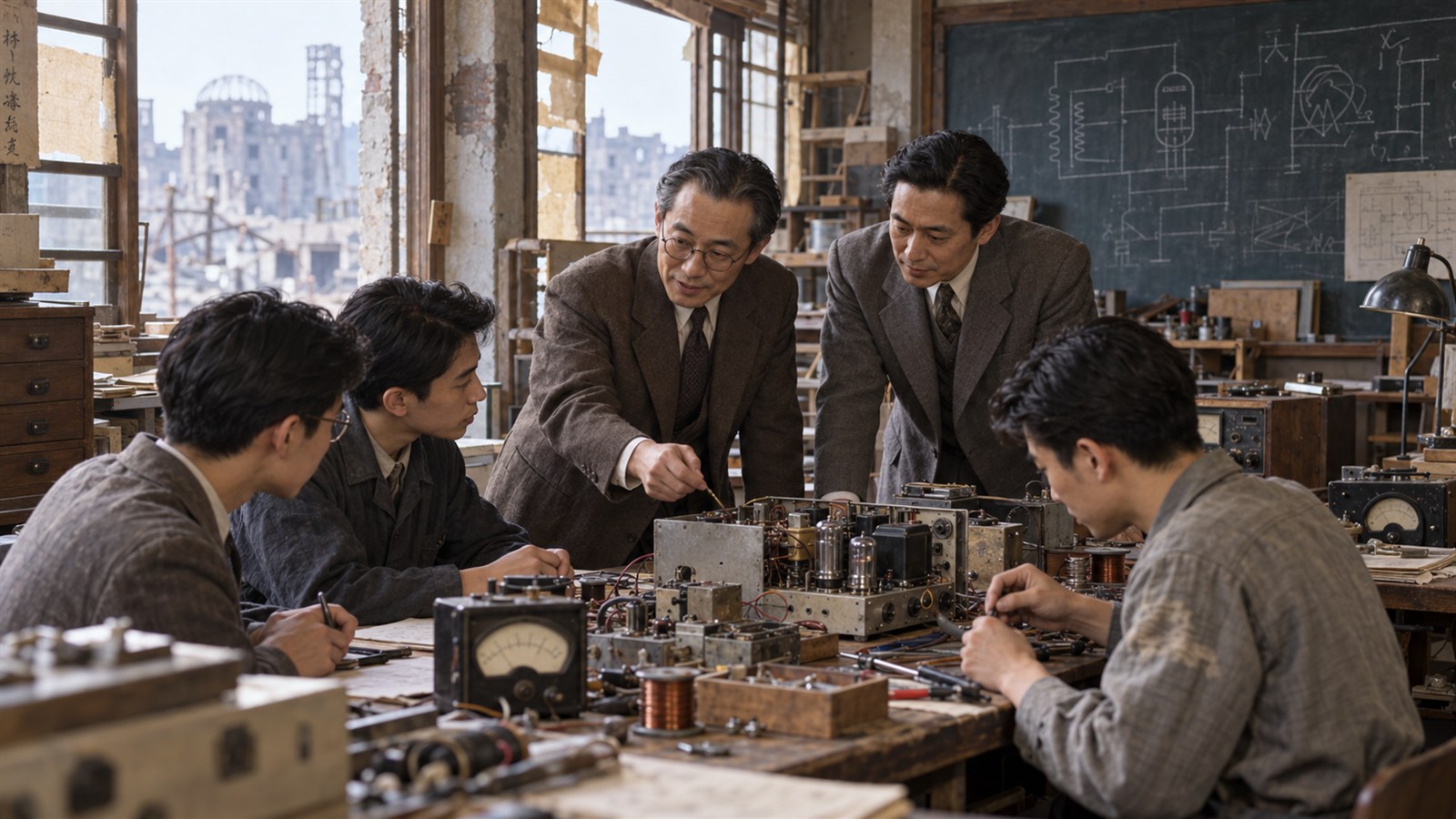
On May 7, 1946, Masaru Ibuka and Akio Morita formally established Tokyo Tsushin Kogyo, or Tokyo Telecommunications Engineering Corporation, the company later renamed Sony. Japan’s cities and industrial base had been damaged by war, consumer goods were scarce, and the founders began with limited capital and a small staff. Ibuka brought engineering leadership and an earlier repair workshop; Morita combined technical knowledge with business judgment and family resources. Their prospectus emphasized useful technology, freedom for engineers, and products that could contribute to society, setting an identity more ambitious than the modest facilities in which the company began.
The young firm searched for products it could build with scarce materials and sell in a disrupted economy. Early experiments included an electric rice cooker that never became a commercial success. Radio repair and adapters generated practical work, while a later encounter with an American tape recorder inspired the company to develop magnetic recording technology in Japan. Producing a recorder was only part of the challenge; customers also had to understand why they needed one. Demonstrations for schools, courts, and institutions helped create a market where none had previously existed.
Tokyo Tsushin Kogyo continued to pursue compact electronics and licensed transistor technology from Bell Laboratories. Its transistor radios combined miniaturization, manufacturing discipline, and export ambition. The company adopted the name Sony in 1958, choosing a short word that could travel across languages and fit on small products. Radios, televisions, audio equipment, and later entertainment businesses turned the firm into a global consumer brand. The path was not linear, but recurring bets on portable products helped Sony translate component advances into experiences ordinary buyers could immediately value.
The founding matters because it joined a strong internal culture with outward-looking commercialization. Ibuka and Morita wanted engineers to attempt work larger companies might avoid, yet technical novelty alone was never enough. Sony learned to demonstrate unfamiliar products, build international channels, and create a name designed for global recall. Scarcity forced the startup to begin with repairs and experiments, but it did not confine its ambition. The lesson is that an innovation company can define itself before it possesses scale: hiring, project selection, market education, and brand architecture gradually make the founding idea real. Sony’s later reach grew from the ability to connect laboratory possibility with portable, desirable products. The partnership balanced different temperaments. Ibuka concentrated on engineering possibility, while Morita repeatedly considered financing, communication, and overseas buyers. Neither role was secondary. A technology company must protect room for difficult experiments while continually translating them into products, prices, and markets. Sony's early resilience came from allowing those perspectives to challenge and reinforce one another.
Masaru Ibuka created a small postwar electronics workshop and soon partnered with Akio Morita.
The company was formally established on May 7, 1946, with limited capital, a small team, and an ambitious founding prospectus.
Repairs and unsuccessful experiments taught the founders to match technical possibility with a real customer problem.
Magnetic tape recorders required demonstrations and market education before institutions understood their value.
Transistor radios gave the firm a compact export product, while the Sony name made the brand easier to carry worldwide.
Its growth rested on a repeatable pattern: encourage engineers, miniaturize useful technology, and teach customers how to use it.
Explore more of "On This Day ..."
Discover more events from the same date across news, politics, technology, sports, and other fields. Each link highlights significant moments that shaped history on different fronts.