

On This Day in Business: May 6, 1937
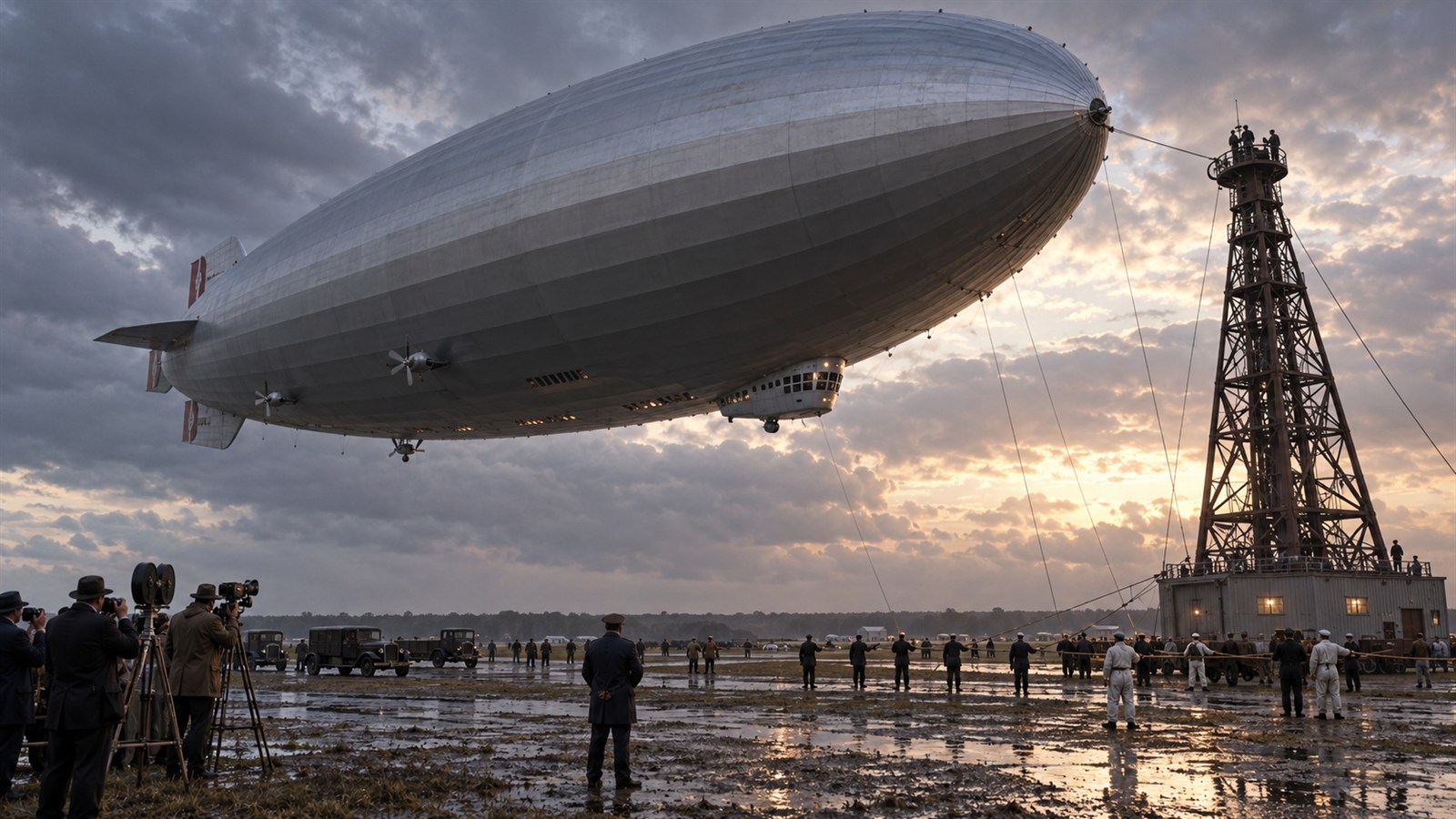
On May 6, 1937, the German passenger airship Hindenburg caught fire while approaching its mooring mast at Naval Air Station Lakehurst, New Jersey. The hydrogen-filled craft was completing a transatlantic flight when flames spread through the hull and brought it to the ground within seconds. Thirty-five of the ninety-seven people aboard died, along with one member of the ground crew. News cameras, photographers, and radio reporting made the disaster immediately visible to a wide public. The event destroyed confidence in a form of premium long-distance transportation that operators had marketed as spacious, quiet, and technologically advanced.
Large rigid airships occupied a distinctive commercial niche. They could cross oceans without the noise and vibration of contemporary airplanes, offering cabins, dining space, and a deliberately luxurious journey. Germany’s Zeppelin organization supported schedules, specialized ground facilities, trained crews, and extensive publicity around the Hindenburg and its sister ships. Yet the system carried concentrated risks. The United States restricted export of helium, so the Hindenburg used flammable hydrogen for lift. The craft also depended on favorable weather, mooring crews, and infrastructure available at relatively few destinations.
Investigations debated the exact ignition mechanism, but the commercial outcome was unmistakable. Film of the burning ship and Herbert Morrison’s emotional broadcast gave the accident an enduring public presence. Passenger airship service did not recover, while heavier-than-air aircraft were improving in range, capacity, and reliability. The disaster therefore accelerated a market shift already forming. Capital, engineering talent, airport investment, and passenger expectations moved toward airplanes, leaving the rigid airship without a credible path back to scheduled transatlantic travel.
The end of the Hindenburg era matters because public trust is part of transportation infrastructure. A vehicle may be technically impressive and operationally refined, but customers will abandon it when a vivid failure makes its underlying hazard unacceptable. Safety claims must survive rare events, not only routine voyages, and risk communication cannot reverse images that expose a system’s vulnerability. The episode also shows how competing technologies are evaluated in relation to one another. Airships did not fail in isolation; they failed as airplanes offered an increasingly practical alternative. After Lakehurst, investment followed the platform with the stronger safety trajectory and growth potential, demonstrating how one catastrophe can redirect an industry’s capital and timetable. Insurance and finance also react to trust. After a catastrophic event, premiums, liability, operating permission, and access to capital can change before engineers finish every technical explanation. Management must therefore prepare for both physical loss and confidence loss. A resilient system needs transparent investigation, credible corrective action, and alternatives for customers whose plans cannot wait.
Rigid airships sold an unusually spacious and quiet transatlantic experience supported by specialized crews and ground facilities.
Because helium exports were restricted, the Hindenburg relied on highly flammable hydrogen for lift.
The ship caught fire during its Lakehurst approach on May 6, 1937, killing thirty-six people aboard and on the ground.
Newsreel film, photographs, and radio reporting made the accident a defining media event.
Confidence in commercial passenger airships collapsed as conventional airplanes improved in capability.
The disaster demonstrated that transportation businesses depend on public acceptance of risk as much as engineering performance.
Explore more of "On This Day ..."
Discover more events from the same date across news, politics, technology, sports, and other fields. Each link highlights significant moments that shaped history on different fronts.