

On This Day in Business: May 15, 1940
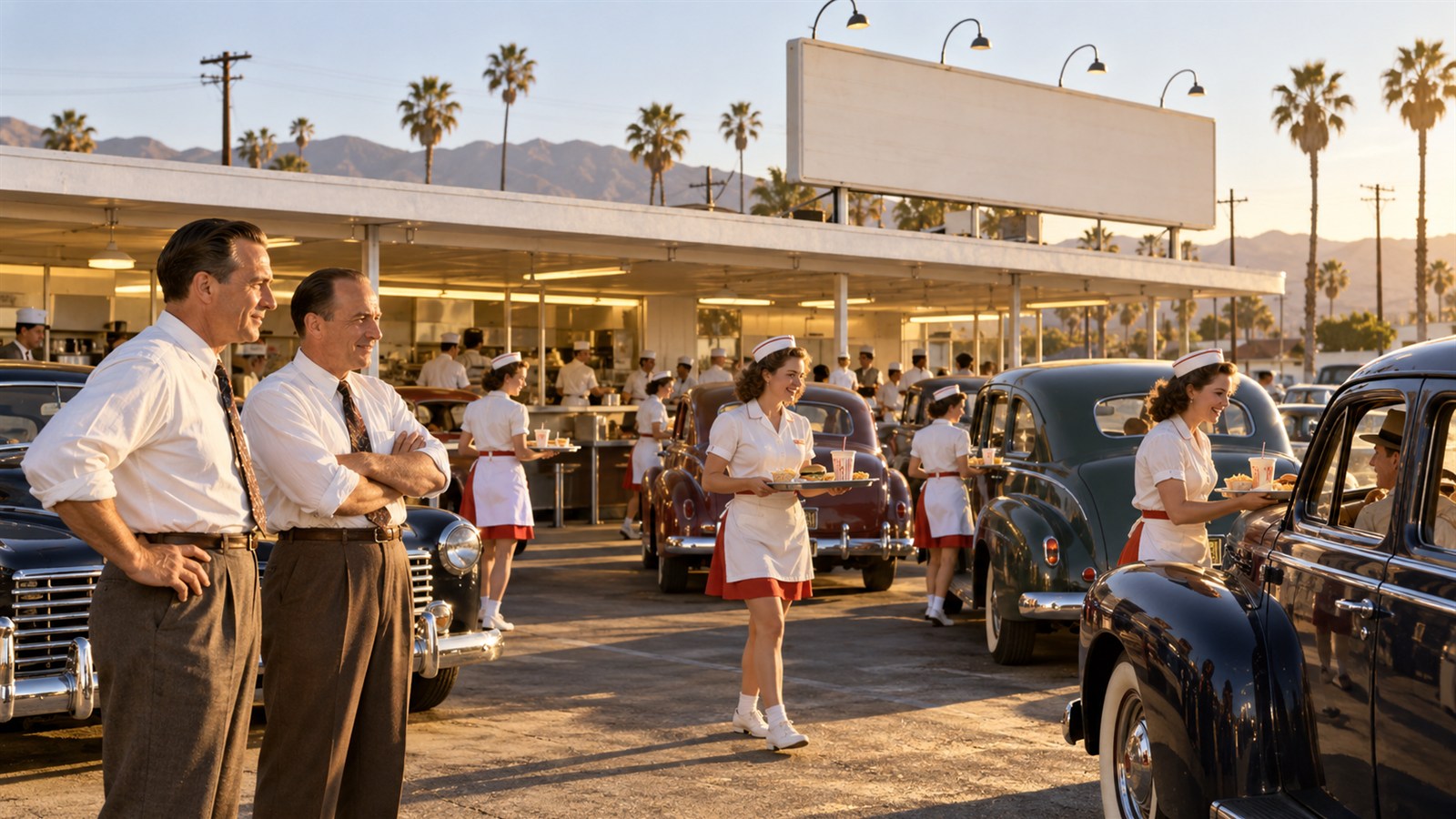
On May 15, 1940, brothers Richard and Maurice McDonald opened McDonald’s Bar-B-Que at Fourteenth and E Streets in San Bernardino, California. The drive-in had a broad menu and carhop service, resembling many restaurants serving the growing automobile market. It was not yet the streamlined hamburger operation recognized today. The brothers first learned the economics of traffic, parking, menu demand, kitchen labor, and customers who wanted convenient food without leaving their cars. That experience gave them data for a more radical redesign after the restaurant had operated for several years.
In 1948, the brothers closed and rebuilt the operation around their Speedee Service System. They reduced the menu, eliminated carhops, moved ordering to a walk-up window, and organized food preparation as a carefully sequenced production line. Burgers, fries, and drinks could be made quickly with less variation and lower labor cost. Customers sacrificed table service and extensive choice in exchange for speed, consistency, and price. The kitchen became a repeatable process rather than a collection of individual cooks improvising many dishes.
The system attracted franchise interest and eventually Ray Kroc, a milkshake-machine salesman impressed by the restaurant’s volume. Kroc became the national franchising agent in 1954, opened his own location in 1955, and later bought the brothers’ interest. Standardized buildings, suppliers, training, advertising, and operating procedures allowed the chain to expand while franchisees supplied local capital and management. Real estate and strict quality controls reinforced the model. The founding restaurant’s name remained, but the scalable enterprise grew from the operational redesign developed years after opening.
The 1940 opening matters because successful business models often emerge through observation and subtraction. The brothers did not begin with a perfect fast-food blueprint; they learned which items sold, where delays occurred, and how automobile customers behaved. They then removed complexity until the remaining system could deliver a narrow promise exceptionally well. Franchising converted that local process into a network, but only because the process could be taught, measured, and supplied consistently. The story separates invention from scale: one restaurant discovered the operating logic, while later partners built the organization that replicated it. Both stages were necessary to transform a roadside drive-in into a global industry template. Real estate made repetition more defensible. By controlling or influencing sites, the expanding company could select traffic patterns, protect standards, and earn returns connected to the land as well as food sales. The restaurant and property strategies reinforced one another. Operating knowledge helped choose locations, while durable site control helped the chain survive changing franchise relationships.
Growing car ownership created demand for drive-in restaurants serving motorists in rapidly expanding California communities.
Richard and Maurice McDonald opened a conventional barbecue drive-in in San Bernardino on May 15, 1940.
Years of operating data showed which menu items moved fastest and where labor and service created bottlenecks.
The 1948 Speedee Service System reduced choice and reorganized the kitchen for rapid, consistent production.
Ray Kroc and franchisees later added national real estate, supply, training, and marketing systems.
The company’s scale began with a local lesson: simplify the promise until ordinary workers can reproduce it reliably.
Explore more of "On This Day ..."
Discover more events from the same date across news, politics, technology, sports, and other fields. Each link highlights significant moments that shaped history on different fronts.