

On This Day in Business: May 16, 1960
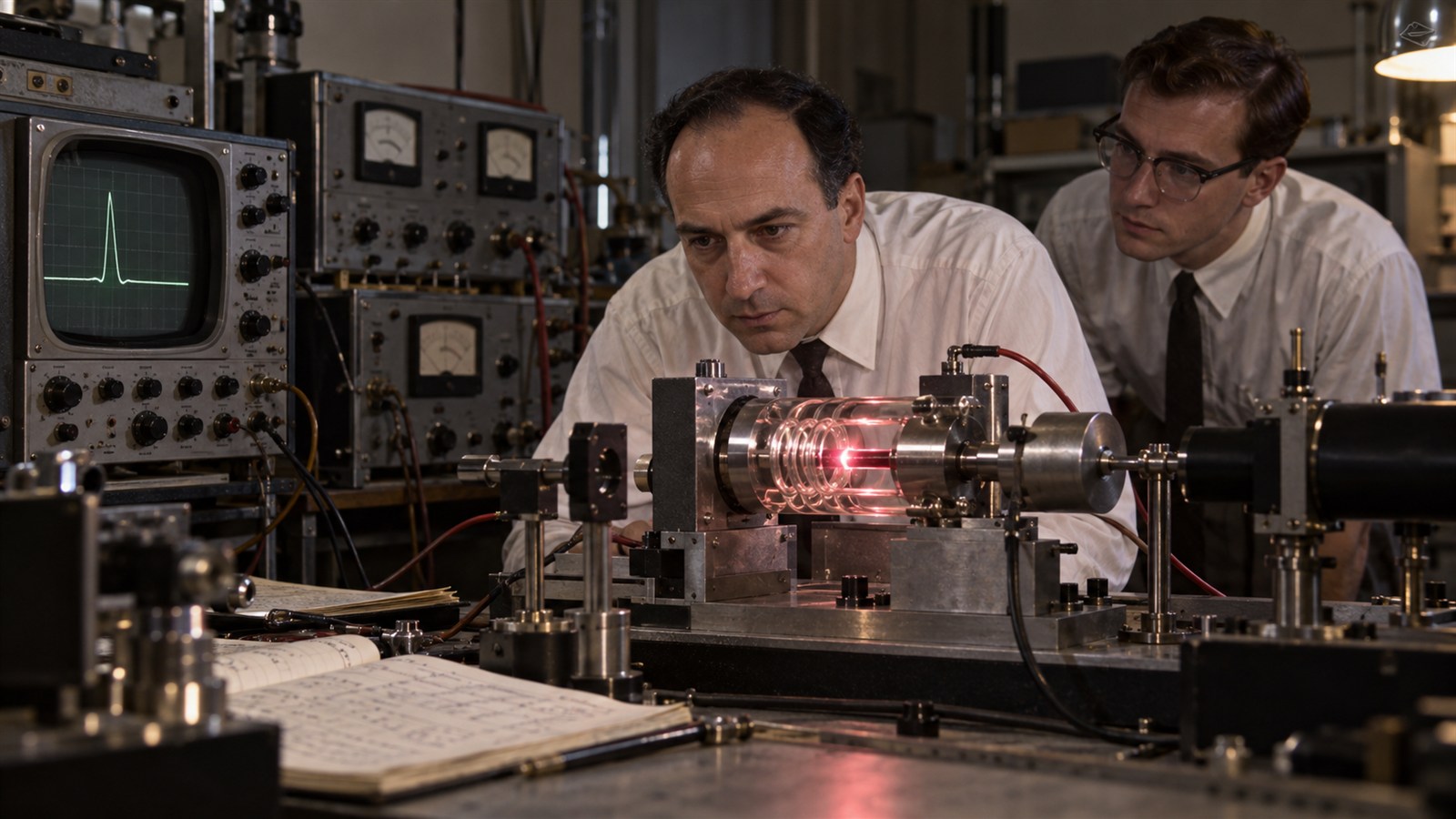
On May 16, 1960, physicist Theodore Maiman operated the first working laser at Hughes Research Laboratories in Malibu, California. His device used a synthetic ruby rod surrounded by a helical flashlamp. When the lamp excited atoms in the ruby, the apparatus produced a brief pulse of coherent red light. Other researchers had developed the theoretical foundations and were racing to build an optical maser, but Maiman chose materials and a compact design that many competitors considered unpromising. The successful demonstration turned a scientific possibility into a physical technology with an unusually broad future.
The initial device did not arrive with a ready market. Lasers were famously described as a solution looking for a problem because their coherent, concentrated light differed from familiar lamps but lacked obvious mass applications. Research organizations nevertheless recognized a platform. Different materials and methods produced continuous beams, new wavelengths, and more efficient operation. Patent disputes and scientific publication shaped who received credit and commercial rights. Companies and universities invested because the underlying capability—precise light that could be controlled, focused, measured, and transmitted—could support many products rather than one fixed use.
Applications accumulated across industry. Lasers cut and welded materials, read barcodes and optical discs, carried information through fiber, measured distance, aligned construction, printed documents, and enabled medical procedures. Semiconductor lasers made the technology compact and inexpensive enough for consumer electronics and communications. Each market required complementary advances in optics, sensors, electronics, standards, and safety. The original ruby apparatus therefore became valuable less as a product than as proof of a principle that entrepreneurs and engineers could adapt to different jobs.
The demonstration matters because general-purpose technologies rarely reveal their full economics at birth. Maiman’s laser created an option: once coherent light existed, organizations could explore where precision justified cost. Early uncertainty was not a sign of uselessness; it reflected the distance between a laboratory effect and reliable systems for customers. Commercial success required reducing size and price, improving durability, and discovering workflows in which the beam solved an expensive problem. The laser’s history encourages patient evaluation of foundational research while preserving competitive urgency. A tiny pulse in one laboratory ultimately became invisible infrastructure for manufacturing, medicine, retail, communications, and digital media. Standards and safety became part of that expansion. A beam useful for cutting or surgery can also damage eyes and skin, so classifications, enclosures, training, and protective equipment allowed workplaces to adopt lasers responsibly. Markets for powerful technology deepen when customers can manage hazards predictably. Safety design is not friction added after innovation; it is infrastructure for wider use.
Scientific work on stimulated emission and masers established the theory behind coherent optical light.
Theodore Maiman selected a synthetic ruby rod and flashlamp in a compact design many rivals doubted.
On May 16, 1960, the device produced the first successful laser pulse at Hughes Research Laboratories.
No single obvious market existed, so laboratories explored materials, wavelengths, patents, and possible applications.
Smaller and more reliable lasers entered communications, medicine, manufacturing, retail, printing, and consumer electronics.
The first laser’s business value lay in opening a platform whose applications could be discovered over decades.
Explore more of "On This Day ..."
Discover more events from the same date across news, politics, technology, sports, and other fields. Each link highlights significant moments that shaped history on different fronts.