

On This Day in Business: May 17, 1792
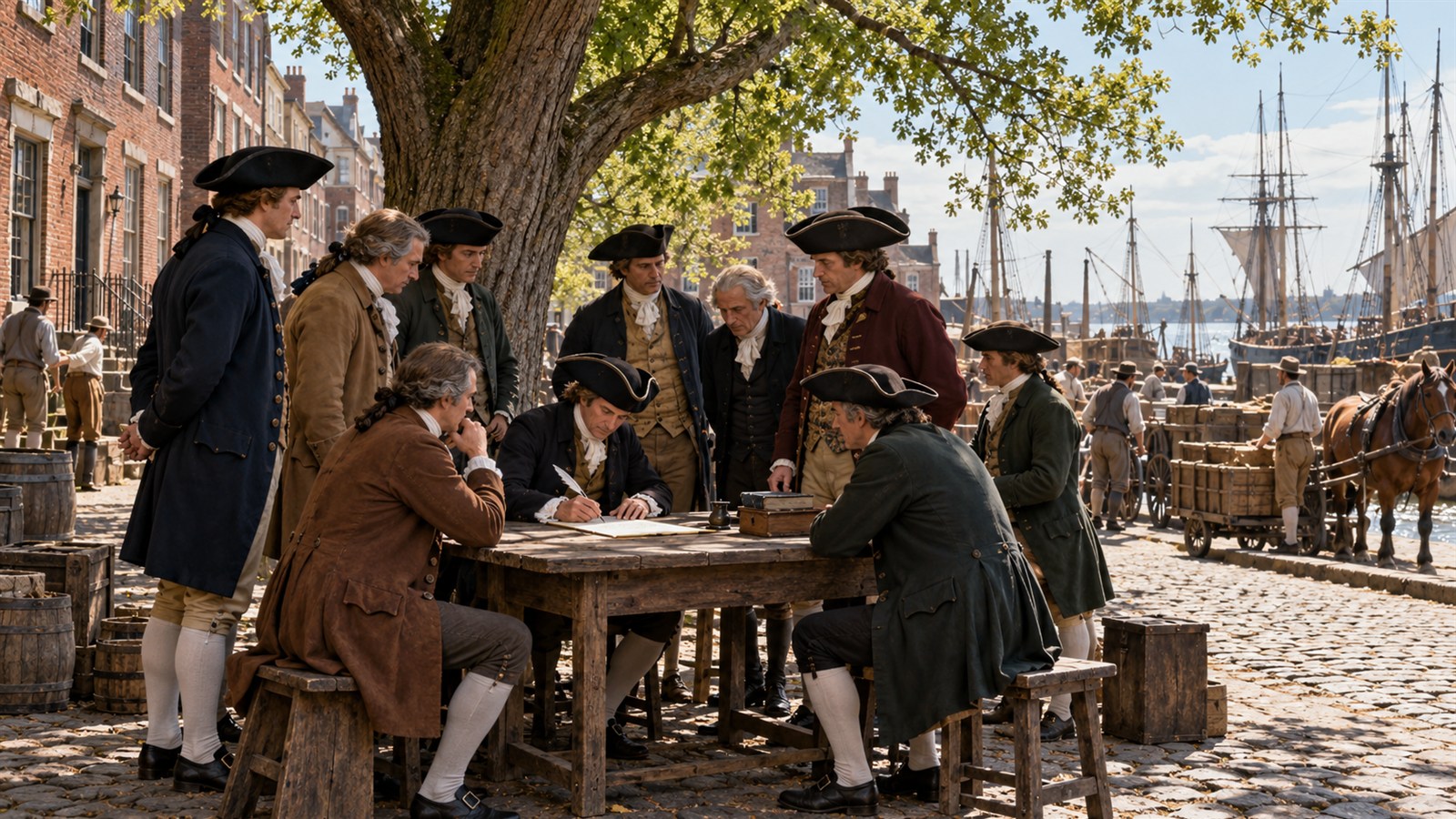
On May 17, 1792, twenty-four New York brokers and merchants signed the Buttonwood Agreement. The short document promised that the signers would give one another preference in securities transactions and would not charge less than a quarter-percent commission. New York’s young market had recently experienced a financial panic, and trading practices lacked stable rules. By forming a private group, the signers created a degree of trust and order among people buying and selling government debt and the limited corporate securities then available. The New York Stock Exchange traces its origins to this compact.
The agreement did not create a modern public exchange overnight. Trading continued through coffeehouses and informal meetings before brokers formed the New York Stock & Exchange Board in 1817 and adopted a more detailed constitution. Even so, the Buttonwood group established two valuable elements of market infrastructure: a network of known counterparties and a common commercial rule. Members gained reliable access to one another’s order flow, while fixed commissions reduced price competition among brokers. The arrangement protected insiders as much as customers, revealing that organized markets can improve confidence while also creating a powerful club.
As securities markets grew, the exchange developed a permanent floor, listing standards, communications technology, clearing processes, and supervision. Telegraphs and ticker tape widened access to prices; later computers transformed execution speed and geographic reach. The institution’s economic role expanded from arranging trades to setting requirements for companies seeking capital and for firms handling investor orders. Market quality came to depend on liquidity, transparent information, enforceable rules, and confidence that completed trades would settle even when prices moved sharply.
The Buttonwood Agreement matters because markets are not simply places where buyers happen to meet sellers. They are rule systems that make strangers willing to transact. Standard commissions and mutual preference were an early solution for a narrow group; later reforms had to address conflicts, access, competition, disclosure, and public protection. The business lesson is that trust can be designed into institutions, but every design distributes power. An exchange becomes more valuable as participants gather around shared standards, creating a network effect that can also entrench the operator. The one-page pact endured in memory because it began the long process of turning scattered bargains into organized financial infrastructure. Information quality became another pillar. Prices are meaningful only when participants receive timely reports and listed companies disclose material facts. Rules against manipulation and insider abuse developed because shared confidence could be damaged by hidden advantages. Modern exchanges therefore sell more than execution speed: they sell a belief that the process is sufficiently fair to attract capital.
A financial panic exposed the fragility of informal securities trading in the young United States.
Twenty-four brokers sought dependable counterparties and common terms in a small New York market.
The May 17, 1792 agreement promised mutual preference and a minimum quarter-percent commission.
Coffeehouse trading later developed into a formal board with membership, rules, and a dedicated marketplace.
Technology and regulation expanded the exchange into infrastructure for price discovery, capital raising, and settlement.
The compact’s lasting lesson is that markets create value through trusted rules as well as through the assets being traded.
Explore more of "On This Day ..."
Discover more events from the same date across news, politics, technology, sports, and other fields. Each link highlights significant moments that shaped history on different fronts.