

On This Day in Business: May 20, 1873
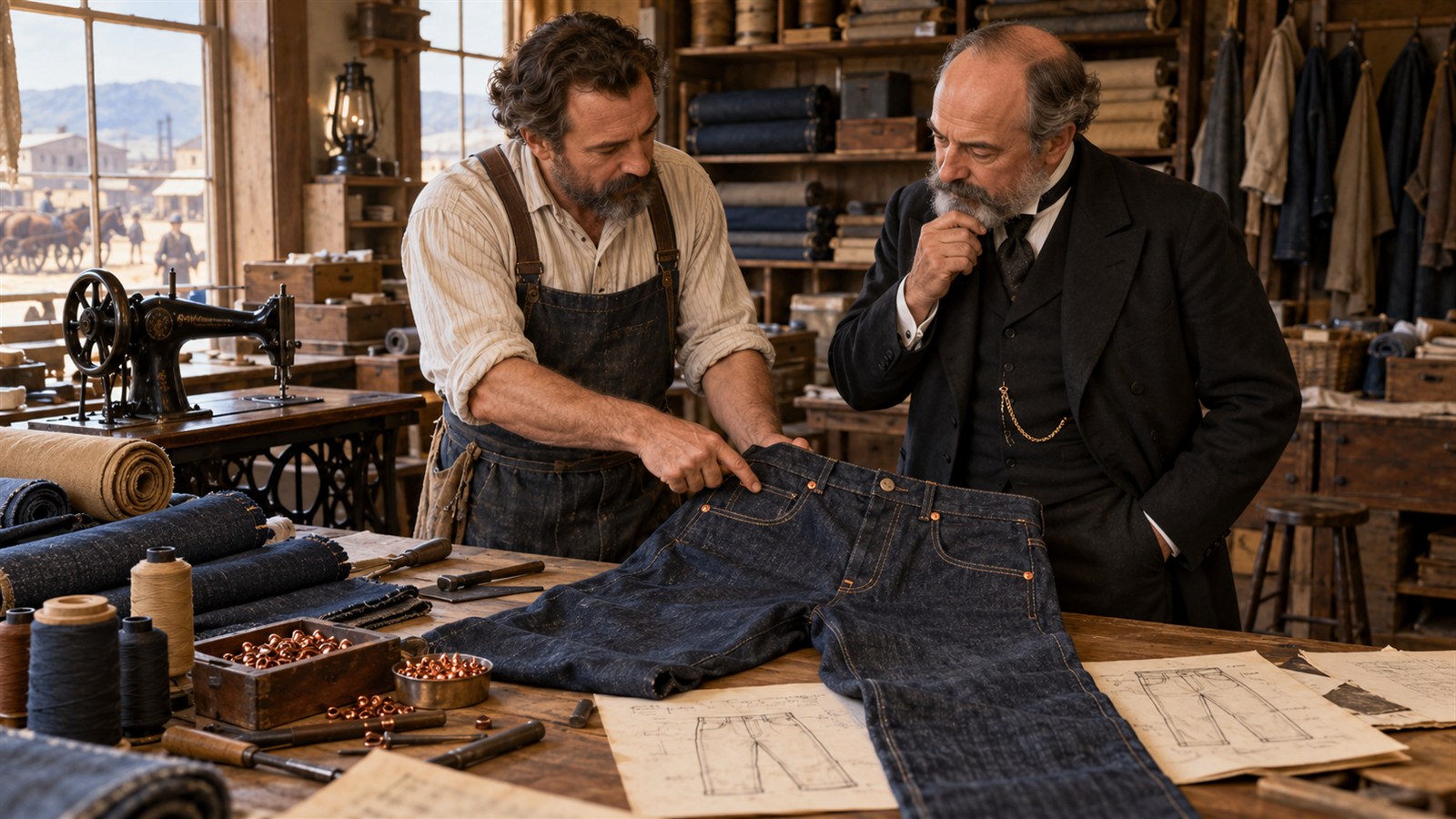
On May 20, 1873, the U.S. Patent Office granted Jacob W. Davis and Levi Strauss & Co. Patent No. 139,121 for an improvement in fastening pocket openings. Davis, a Reno tailor, had reinforced work pants by placing metal rivets at points that tore under strain. He needed financial help to protect the idea and wrote to San Francisco merchant Levi Strauss, whose firm supplied fabric. Strauss agreed to pursue the patent as partner and assignee. The resulting copper-riveted waist overalls created the product category later known worldwide as blue jeans.
The invention was commercially powerful because it solved a clear problem for laborers. Miners and other workers placed heavy tools and objects in their pockets, causing stitched corners to fail. A small metal fastener extended garment life at low additional cost and made the improvement visible. Levi Strauss & Co. combined the patented feature with durable denim, manufacturing, wholesalers, and a trusted regional merchant name. The patent provided a temporary period of exclusivity in which the firm could establish demand and associate riveted construction with its own products.
After patent protection expired, competitors adopted similar methods. Levi Strauss & Co. then relied on trademarks, product details, distribution, and storytelling to distinguish its jeans. The numbered 501 style, leather patch, arcuate pocket stitching, and red tab became forms of identification in a market where the functional concept was widely copied. Jeans also moved far beyond workwear. Western films, youth culture, music, fashion designers, and global manufacturing turned a practical garment into a symbol whose meaning changed across customers and countries.
The patent matters because it illustrates the path from small process improvement to enduring brand. Davis recognized a failure point; Strauss supplied capital, material access, and commercial reach. Intellectual property bought time, but it did not guarantee permanence. The company had to convert a protected construction method into consistent quality and recognizable signals before rivals could freely compete. Blue jeans also show how a utilitarian product can accumulate cultural value that exceeds its physical materials. The rivet created the first differentiation; decades of manufacturing, marketing, and adoption created the asset that survived after the patent no longer did. Supply-chain choices later carried reputational consequences. Global demand made cotton, dyeing, sewing, finishing, and retail a far larger system than the original San Francisco workshop. Durability remained part of the promise, but labor and environmental performance also became measures of quality. An iconic product must manage the conditions under which its familiar materials reach the customer.
Tailor Jacob Davis noticed that workers’ pocket corners failed under repeated strain from tools and heavy objects.
He used metal rivets to reinforce the stress points and sought help from fabric supplier Levi Strauss.
Patent No. 139,121 was granted on May 20, 1873, covering the improvement in fastening pocket openings.
Exclusivity allowed the partners to associate durable riveted work pants with their company.
After the patent expired, trademarks, stitching, product numbers, and distribution carried differentiation forward.
A modest durability improvement became the foundation for a garment with global commercial and cultural value.
Explore more of "On This Day ..."
Discover more events from the same date across news, politics, technology, sports, and other fields. Each link highlights significant moments that shaped history on different fronts.