

On This Day in Business: June 21, 2004
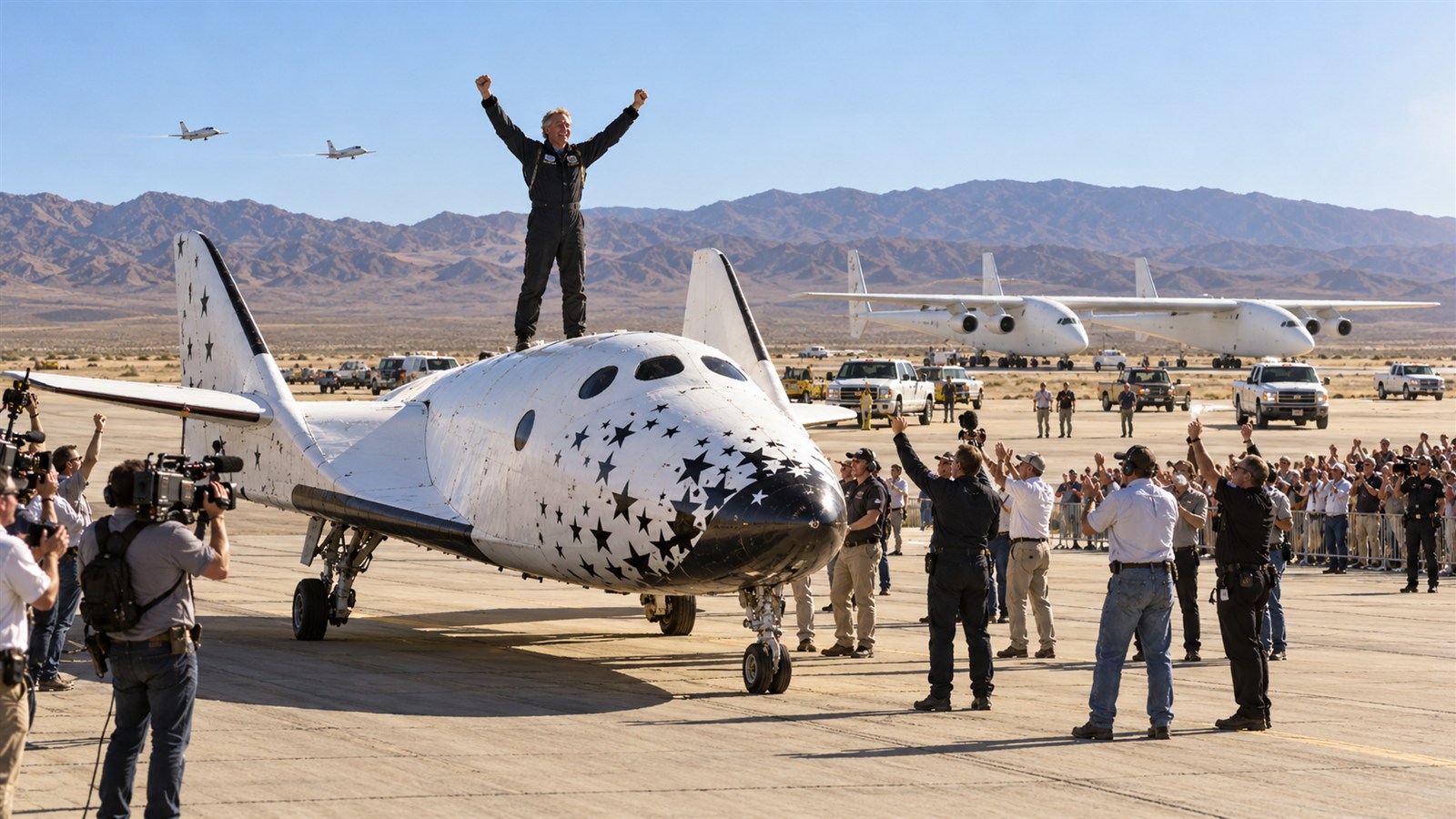
On June 21, 2004, SpaceShipOne flew beyond 100 kilometers above Earth and completed the first privately funded human spaceflight. Test pilot Mike Melvill rode beneath the White Knight carrier aircraft from Mojave, California, separated at altitude, ignited the rocket motor, and climbed to space before gliding back to the runway. Scaled Composites designed and built the vehicle under Burt Rutan, with financing from Microsoft cofounder Paul Allen. The flight earned Melvill commercial astronaut wings and demonstrated that a small nongovernmental team could design, test, launch, and recover a crewed spacecraft.
The program used a distinctive architecture to control cost and risk. A carrier aircraft lifted the spacecraft above the densest atmosphere, reducing the rocket's ground-launch requirements. SpaceShipOne's feathered tail rotated for a stable high-drag reentry, then returned to a normal position for gliding flight. The team built prototypes, conducted captive-carry and glide tests, and gradually expanded the flight envelope before attempting space. Private funding allowed concentrated decision making, but it did not remove the need for disciplined engineering, range coordination, licensing, and careful treatment of pilot safety.
The June flight was a milestone on the path to the Ansari X Prize, which required two qualifying spaceflights within two weeks using the same vehicle. SpaceShipOne completed that challenge later in 2004. Its success attracted attention to commercial suborbital travel and helped inspire investment in Virgin Galactic and other private space companies. Turning a demonstration into a recurring passenger service proved far harder. Vehicles needed higher reliability, scalable operations, training, insurance, regulatory acceptance, and customers willing to pay. The gap between a record and a business remained wide even after the technical barrier had been crossed.
The flight matters because prizes and visible demonstrations can mobilize capital around goals that conventional procurement might approach differently. Paul Allen financed a focused team, while the X Prize supplied a public benchmark and global attention. That structure encouraged competing solutions without prescribing one design. Still, the later history of commercial human spaceflight shows that proof of possibility is only the beginning. A viable service must repeat safely, control cost, and maintain trust over many operations. SpaceShipOne changed expectations by showing what a private team could achieve. Its deeper business lesson is to distinguish a breakthrough experiment from the operating system required to make that breakthrough routine. Knowledge spillovers extended beyond tourism. Suppliers, regulators, engineers, and investors gained experience with composite structures, hybrid propulsion, high-altitude operations, and private launch licensing. Even where a direct business model remained uncertain, the program expanded the pool of people and institutions able to attempt the next one.
White Knight carried SpaceShipOne aloft before Mike Melvill separated, ignited the rocket, and climbed beyond 100 kilometers.
Scaled Composites designed the system under Burt Rutan with private financing from technology entrepreneur Paul Allen.
Air launch and a feathered reentry configuration addressed cost, stability, and recovery in an unconventional integrated design.
Progressive carry, glide, powered, and high-altitude tests expanded the vehicle's operating envelope before the space attempt.
The flight led toward the Ansari X Prize and stimulated commercial interest, but recurring passenger service required far more.
SpaceShipOne separates technical proof from operational scale: a breakthrough becomes a business only when it can be repeated safely.
Explore more of "On This Day ..."
Discover more events from the same date across news, politics, technology, sports, and other fields. Each link highlights significant moments that shaped history on different fronts.