

On This Day in Business: July 18, 1968
On July 18, 1968, Robert Noyce and Gordon Moore incorporated a new semiconductor company in California. Both men had helped build Fairchild Semiconductor and understood the opportunities and organizational strains of the young integrated-circuit industry. With early support from investor Arthur Rock, they raised capital quickly and chose the name Intel, shortened from integrated electronics. Their initial strategy emphasized semiconductor memory, a market in which advances in process technology and chip density could displace magnetic-core systems used by computers.
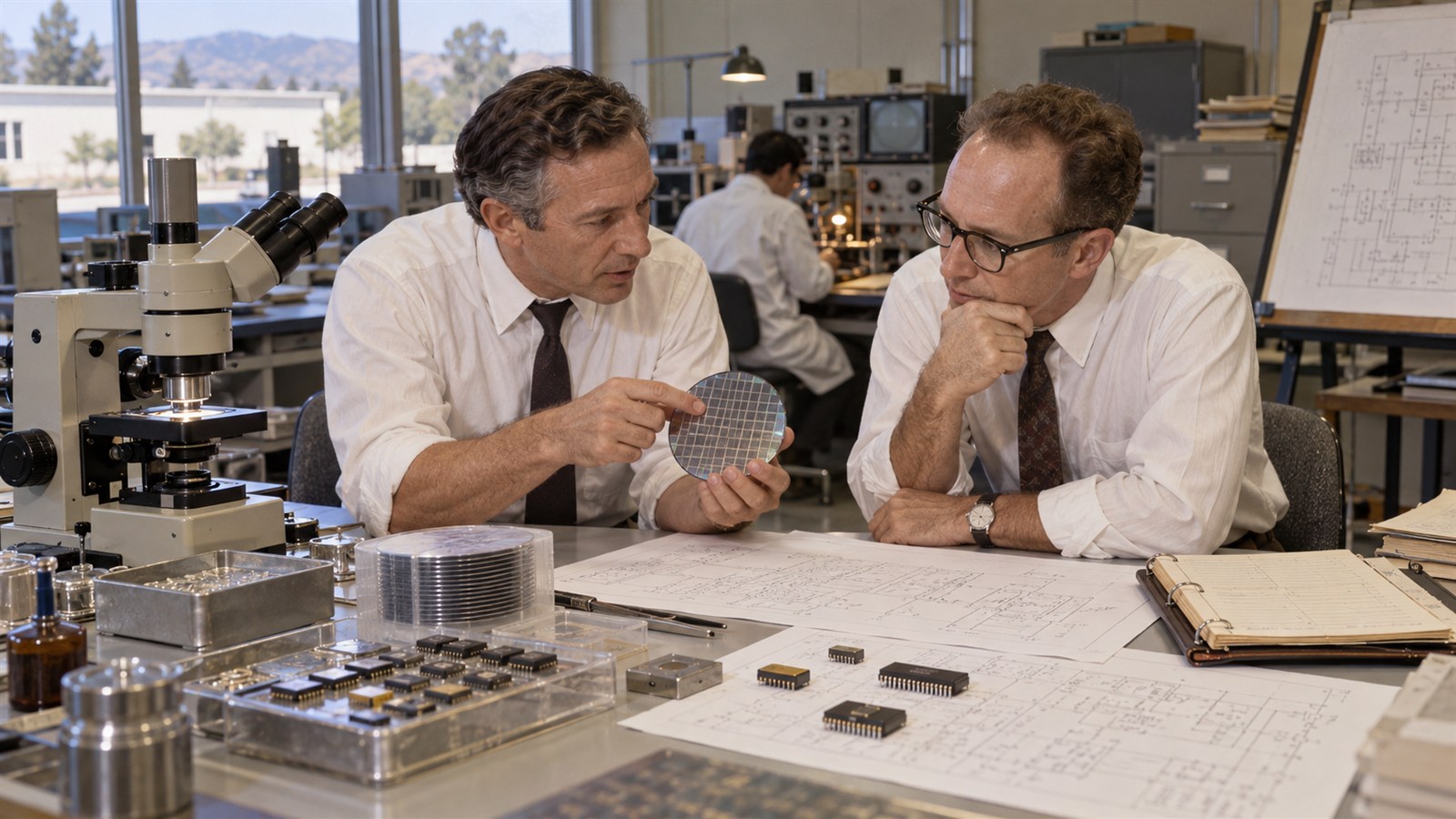
The company had to turn microscopic manufacturing into repeatable output. Chip design was only one part of the challenge; yields, contamination control, materials, equipment, testing, packaging, and trained workers determined how many usable devices emerged from each wafer. Intel introduced products including bipolar and metal-oxide-semiconductor memory. In 1971 it also released the 4004 microprocessor, originally developed for a calculator project. A programmable general-purpose chip opened opportunities that reached far beyond the specific customer that helped fund its development.
Memory competition later became severe, especially from Japanese producers. Intel made a difficult strategic shift toward microprocessors, where the growing personal-computer market created a powerful platform. Design compatibility, manufacturing investment, software support, marketing, and relationships with computer makers reinforced the position. The company experienced repeated cycles of technical leadership, capacity spending, competition, shortages, and missteps as the semiconductor industry grew central to the global economy.
The founding matters because expertise can be reorganized into a new institution. Noyce and Moore did not begin with a household product; they began with a belief about where component value would move and a team capable of learning faster than fabrication technology changed. Intel's later direction was not fixed on day one, but its process discipline and willingness to reallocate attention made adaptation possible. The broader lesson is that in science-based manufacturing, strategy and production cannot be separated. A superior design creates value only when factories can reproduce it at acceptable yield, cost, volume, and speed. Semiconductor economics also reward learning curves. A factory may begin with low yields and high unit costs, then improve as engineers identify defects and stabilize each step. Knowledge accumulates through production itself, so delayed volume can become a competitive disadvantage. Intel's culture of measurement and technical debate reflected an industry in which tiny process gains could change the economics of an entire product line. Capital intensity reinforced the need for focus. New fabrication equipment became obsolete quickly, yet underinvestment could leave a firm unable to make its newest designs competitively. Management had to commit large sums before future demand was certain, balance internal production with outside capacity, and decide which technical advantages customers would value long enough to recover the spending.
Noyce and Moore left Fairchild with deep experience in integrated circuits and the organization of semiconductor work.
They incorporated Intel on July 18, 1968, with early financing arranged by venture investor Arthur Rock.
The initial strategy targeted semiconductor memory as a replacement for bulky magnetic-core computer memory.
Success depended on wafer processes, contamination control, yield, testing, packaging, and manufacturing scale—not design alone.
The 4004 and later processors opened a platform business, while memory competition forced a major strategic shift.
Intel's history shows that technical companies must align invention, fabrication, customer ecosystems, and capital investment.
Explore more of "On This Day ..."
Discover more events from the same date across news, politics, technology, sports, and other fields. Each link highlights significant moments that shaped history on different fronts.