

On This Day in Business: July 24, 1959
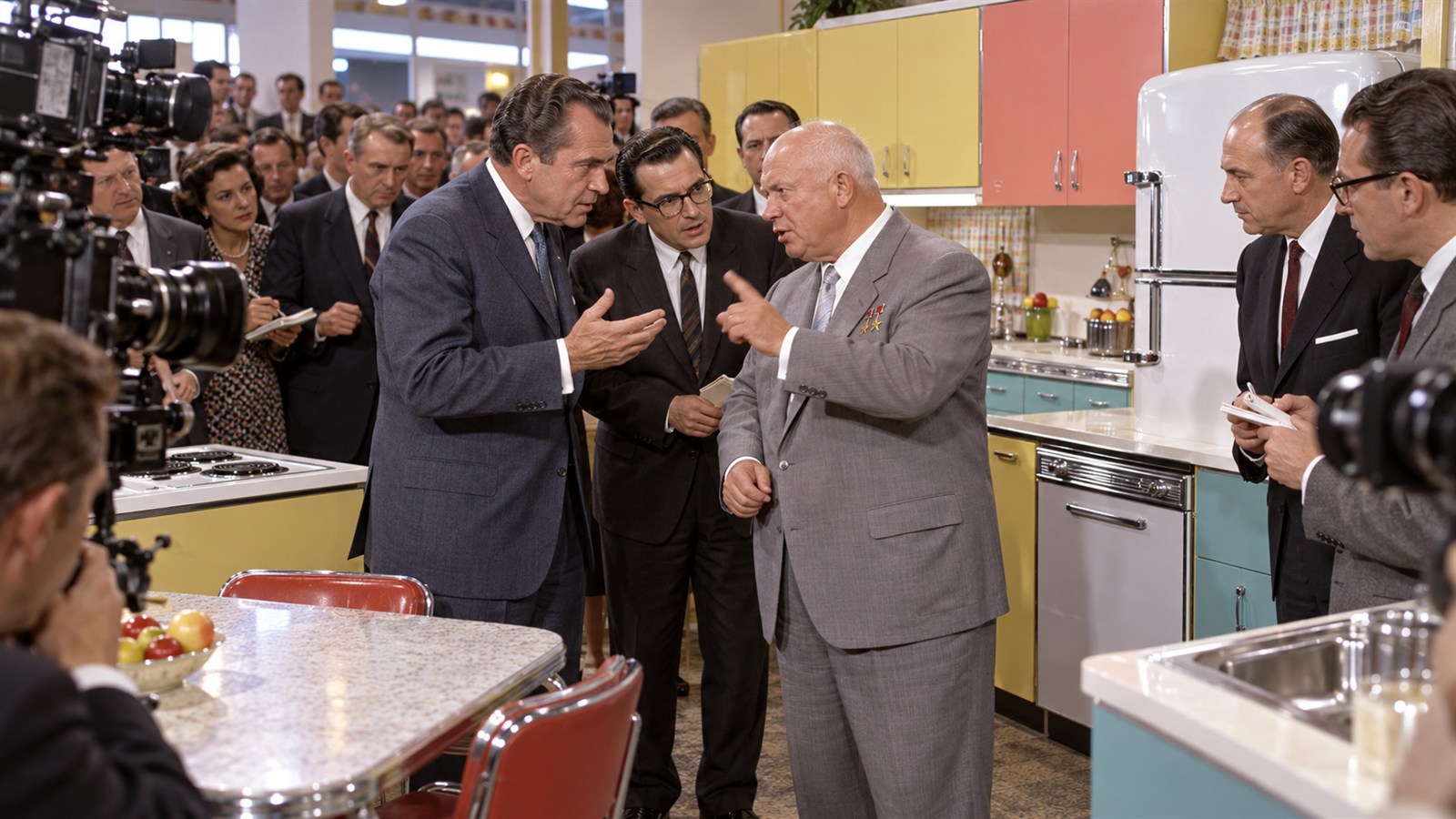
On July 24, 1959, U.S. Vice President Richard Nixon and Soviet Premier Nikita Khrushchev argued inside a model American kitchen at the American National Exhibition in Moscow. Their exchange, later called the Kitchen Debate, moved across politics, technology, living standards, and the merits of capitalism and communism. The setting mattered. Appliances, cabinets, household products, and a suburban home display turned abstract economic claims into visible objects that visitors could inspect. Television cameras and journalists carried the unscripted encounter far beyond the exhibition hall.
The exhibition was part diplomacy and part trade show. American companies displayed consumer goods, automobiles, machinery, art, and culture to Soviet visitors. Organizers presented variety and household convenience as evidence of productive capacity and individual choice. Khrushchev challenged the claims and predicted Soviet achievements would overtake them, while Nixon argued that competing products let consumers decide. Brands gained exposure, but the larger message came from the assortment itself rather than from any single appliance.
The kitchen was not a neutral measure of prosperity. Critics questioned whether the model home's cost and lifestyle represented ordinary American families, and the debate simplified both economies. Yet the event demonstrated how products can serve as political communication. Refrigerators, dishwashers, televisions, and labor-saving devices embodied supply chains, credit, advertising, energy systems, housing patterns, and household expectations. The consumer market became part of Cold War competition alongside missiles and industrial output.
The debate matters because material culture can make an argument more persuasive than statistics alone. Visitors could picture daily routines around the displayed goods, while cameras transformed the encounter into media content. For businesses, exhibitions offer a stage where products acquire meanings beyond function: modernity, freedom, status, efficiency, or national identity. Those meanings can create demand, but they also invite scrutiny about affordability and who benefits. The model kitchen sold a vision of choice, showing that markets compete through stories about life as well as through price and performance. For appliance makers, the exhibition connected domestic design with export ambition. A refrigerator or mixer had to fit different voltages, kitchens, incomes, and cultural routines before publicity could become overseas sales. The political spectacle attracted attention, but localization determined practical demand. Global marketing still faces that gap between a universally appealing promise and the local systems required to use a product. Television multiplied that effect. Viewers who would never enter the exhibition still saw the kitchen as a compressed image of abundance and rivalry. The value of the display therefore depended partly on media distribution outside the hall. A physical demonstration became more powerful when broadcasters converted it into repeatable national and international content.
The American National Exhibition presented consumer goods and culture to Soviet visitors during the Cold War.
Nixon and Khrushchev debated inside a model kitchen on July 24, 1959, before journalists and television cameras.
Appliances made claims about productivity, convenience, variety, and living standards visible in an everyday setting.
The exchange challenged whether the display represented ordinary households or an idealized version of American consumption.
Manufactured goods became diplomatic symbols linked to housing, energy, credit, advertising, and national identity.
The debate showed how products can carry powerful stories about an economic system while inviting questions about access.
Explore more of "On This Day ..."
Discover more events from the same date across news, politics, technology, sports, and other fields. Each link highlights significant moments that shaped history on different fronts.