

On This Day in Business: July 23, 1829
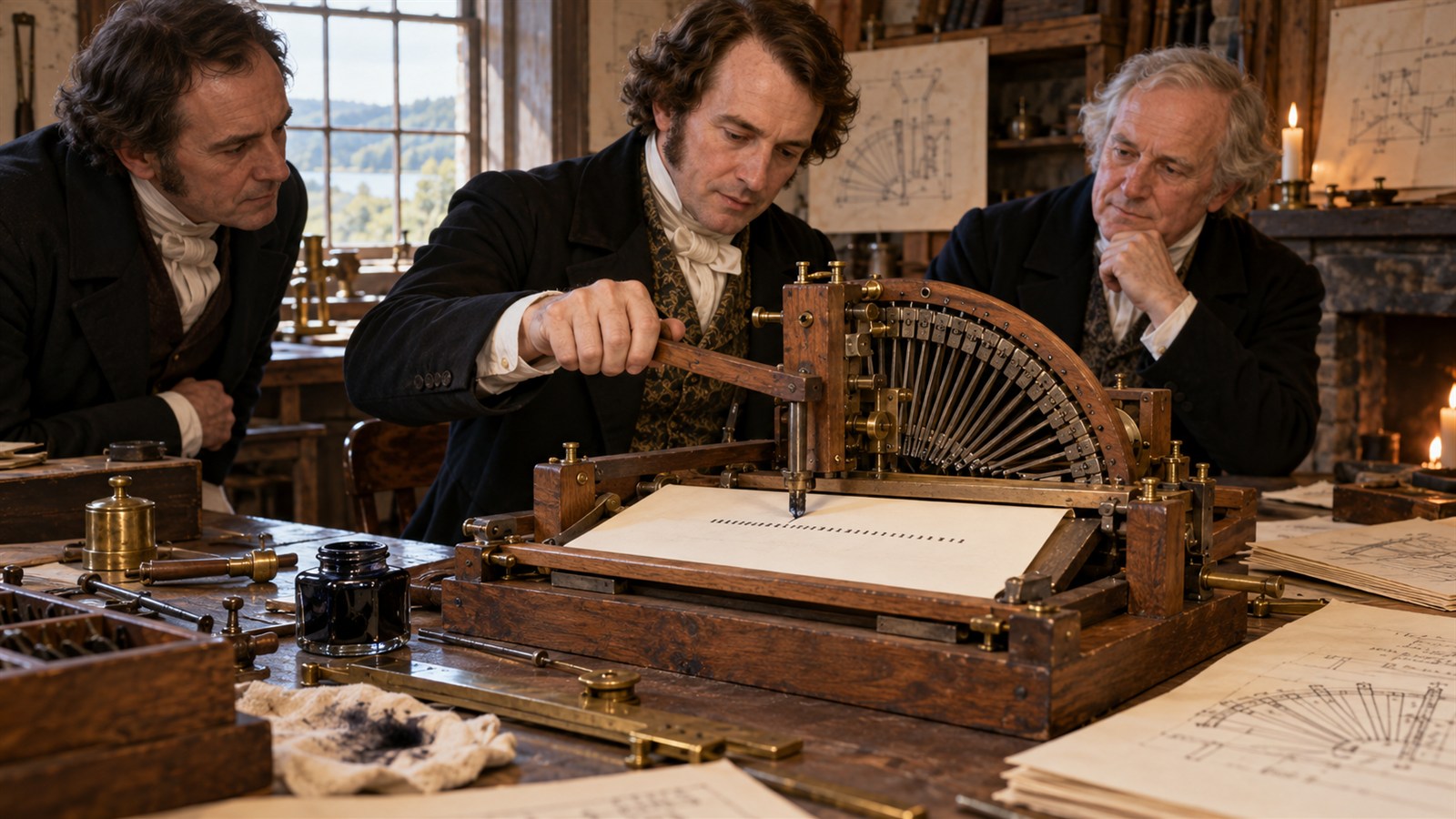
On July 23, 1829, American inventor William Austin Burt received a patent for a writing machine he called the Typographer. The hand-built device used a selector mechanism to choose characters and a lever to press inked type onto paper. It was slow by later standards and did not resemble the keyboard typewriters that eventually dominated offices. The original patent model was lost in the 1836 Patent Office fire, leaving later reconstructions and descriptions to show how it worked. Even so, the patent represents an early effort to make mechanical writing practical.
Handwriting was flexible but varied in legibility and speed. A machine promised uniform characters that strangers could read, yet it had to solve alignment, spacing, inking, paper movement, character selection, and correction. Burt's mechanism did not combine those functions efficiently enough to create a broad market. Manufacturing precision and office demand were also limited. An invention can establish that a task is mechanizable without providing the cost, convenience, or production system required for adoption.
Later inventors developed keyboard arrangements, type bars, carriages, ribbons, and mass-manufacturing methods. Commercial typewriters spread in the late nineteenth century, changing office organization and expanding paid clerical work, especially for women. Standardized documents improved copying, filing, contracts, correspondence, and administration. Manufacturers sold machines while training, supplies, repair, typing schools, and office furniture formed complementary businesses. The category succeeded when the total workflow became faster and more dependable than handwriting for a growing volume of information.
Burt's patent matters because unsuccessful products can still mark an important direction. The Typographer identified uniform mechanical writing as a problem worth solving, but later businesses needed different designs and a market ready to reorganize work around them. Patent priority alone did not secure commercial leadership. The enduring lesson is that inventions compete as parts of workflows. Customers evaluate not only whether a machine can perform a task, but whether people can learn it, manufacturers can build it, offices can maintain it, and the output fits existing systems. Adoption later depended on job design. Employers had to decide which documents justified typing, who would operate the machine, and how work would be checked and stored. Typing speed became a measurable skill, creating training and hiring markets. The device's commercial effect came not only from faster marks on paper, but from reorganizing responsibility inside offices. Standard keyboard layouts later produced their own network effect. Once schools taught a layout and employers hired people trained on it, alternative arrangements faced higher adoption barriers even if they promised advantages. A product standard can persist because the surrounding skill base, documentation, and workplace habits become more costly to replace than the machine itself.
William Austin Burt built a mechanical writing device that selected characters and pressed them onto paper.
He received a U.S. patent for the Typographer on July 23, 1829, decades before keyboard typewriters spread.
The machine addressed legibility but remained slow and awkward, with no manufacturing system to support wide adoption.
Later designs combined keyboards, type bars, carriages, ribbons, repair, training, and office demand into a viable category.
Typewriters standardized documents and helped reorganize correspondence, filing, administration, and clerical employment.
The patent shows that proving a task can be mechanized is different from delivering a complete, adoptable workflow.
Explore more of "On This Day ..."
Discover more events from the same date across news, politics, technology, sports, and other fields. Each link highlights significant moments that shaped history on different fronts.