

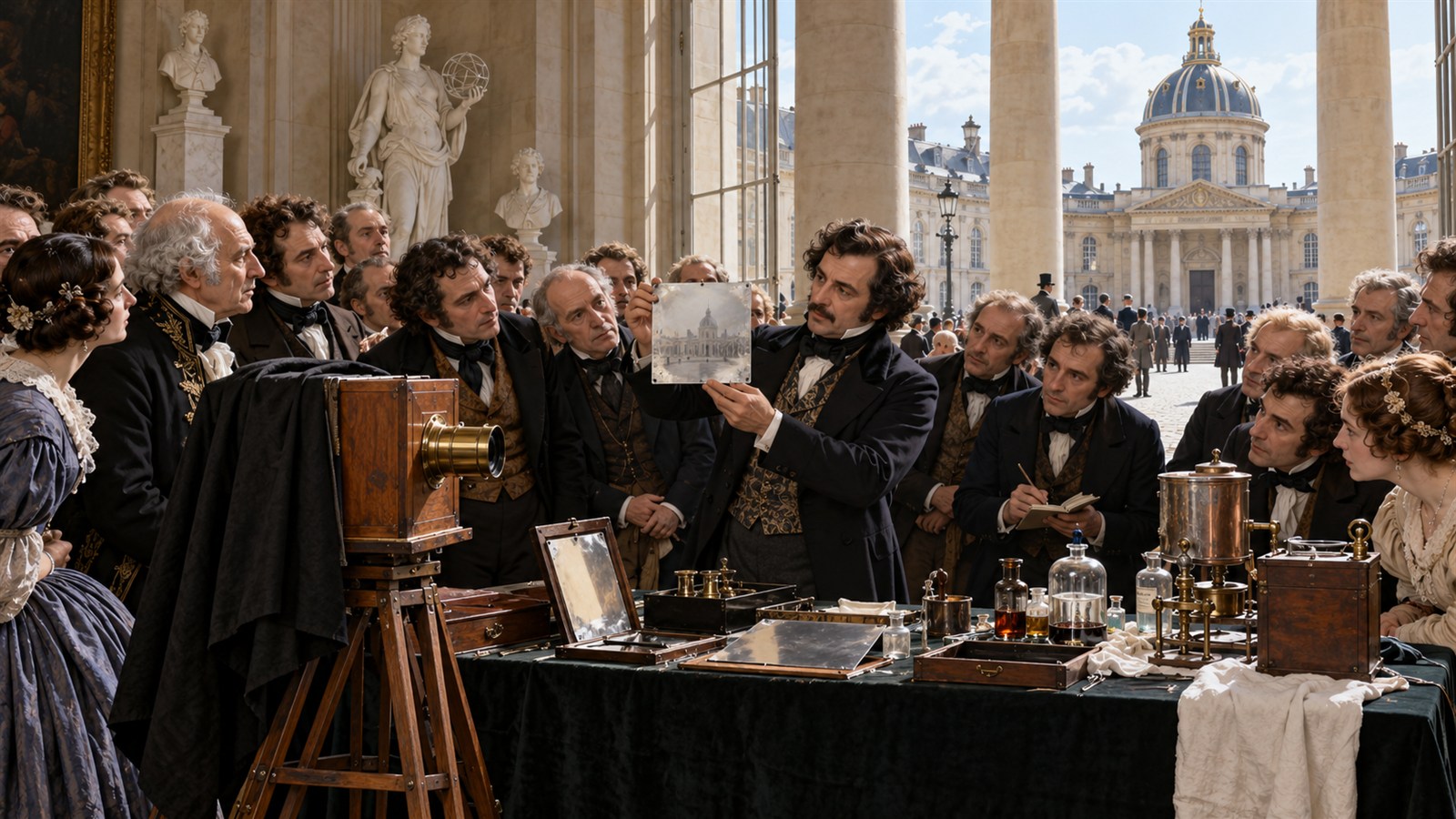
On This Day in Business: August 19, 1839
On August 19, 1839, François Arago explained Louis Daguerre's photographic process to a joint meeting of France's academies of sciences and fine arts in Paris. The French government had arranged pensions for Daguerre and the son of his late partner, Nicéphore Niépce, in exchange for disclosing the method. The daguerreotype produced a highly detailed, one-of-a-kind image on a silver-plated copper sheet. Once the steps were public, opticians, chemists, artists, and entrepreneurs across Europe and the United States could begin practicing and improving the new art without paying a license for the process in most countries.
The method was demanding. Plates had to be polished, sensitized with chemical vapors, exposed in a camera, developed over mercury fumes, and fixed. Early exposure times limited portraiture, but commercial pressure drove rapid improvements in lenses, chemistry, lighting, and studio equipment. Within a few years, photographic portrait studios appeared in major cities. Customers who could not afford painted portraits gained a new way to preserve an image of themselves or their families. A scientific disclosure quickly generated a market for cameras, plates, chemicals, cases, studio rentals, training, and professional services.
Daguerre retained interests in equipment, and different patent arrangements applied in Britain, so the story was not a pure gift without commercial strategy. Still, broad access accelerated experimentation and diffusion. The daguerreotype also had limitations: each plate was unique and could not be reproduced from a negative. Later processes solved that problem and supported mass printing. Even as the technology changed, early studios established business practices around appointments, posing, image finishing, protective cases, and local reputation. Photography became both a creative profession and an information industry.
Today images can be captured, copied, and distributed globally at almost no marginal cost. The public explanation in 1839 began that long transformation by converting a guarded technique into shared technical knowledge. Its economic significance lies in the speed with which supporting businesses formed around an open method. When know-how becomes widely available, competition often moves to execution, service, quality, and complementary products. Photography's public birthday therefore marks more than an artistic milestone; it is an example of disclosure creating an ecosystem large enough to outgrow the original invention. Because each early plate was unique, studios also learned to sell scarcity and ceremony. Protective cases, careful posing, hand coloring, and the studio visit itself made the object feel valuable, demonstrating how service design can compensate for technical inconvenience during a market's early years.
Daguerre's process was explained publicly in Paris on August 19, 1839.
The French government compensated the inventors' interests in exchange for disclosure.
A daguerreotype created a detailed, unique image on a silver-plated copper sheet.
Open access encouraged rapid improvements in chemistry, lenses, lighting, and studio practice.
Portrait studios created demand for equipment, supplies, training, cases, and professional services.
Photography became an early example of public technical knowledge generating a broad commercial ecosystem.
Explore more of "On This Day ..."
Discover more events from the same date across news, politics, technology, sports, and other fields. Each link highlights significant moments that shaped history on different fronts.