

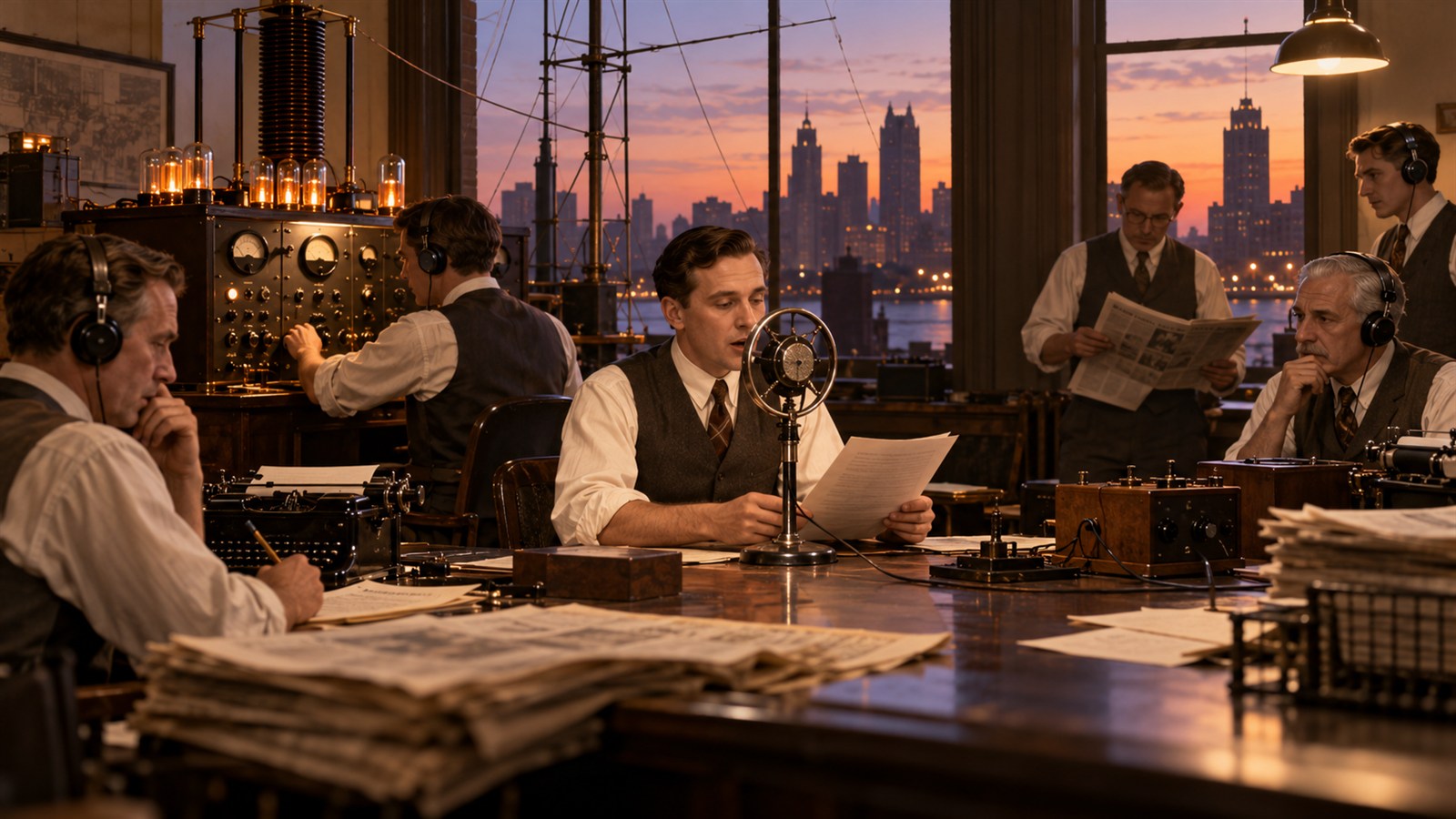
On This Day in Business: August 20, 1920
On August 20, 1920, Detroit station 8MK began a schedule of news and entertainment broadcasts from the offices of the Detroit News. The station later became WWJ. Wireless experimenters had transmitted voice and music before, and historians debate several claims to being first, but 8MK's regular newspaper-backed programming marked an important step toward broadcasting as an organized service. Instead of sending a message to one known recipient, the station offered content to anyone with a receiver in range. That one-to-many model would support a new industry linking media companies, equipment makers, performers, advertisers, and audiences.
The Detroit News saw broadcasting as an extension of its information business. Radio could deliver election returns, news bulletins, music, and religious programming faster than print and with a sense of live presence. Early audiences were small and reception was uncertain, but scheduled programs gave people a reason to buy or build receivers. More receivers made stations more valuable, and more stations increased the appeal of receivers. This reinforcing cycle helped transform radio from a hobbyist technology into a mass consumer market during the 1920s.
A sustainable model was not obvious at first. Stations required transmitters, studios, talent, licenses, and reliable programming, while listeners expected content after purchasing their sets. Advertising eventually became a primary source of revenue, allowing programs to be offered without a direct charge to each listener. Networks linked stations and spread production costs across larger audiences. Newspapers, department stores, manufacturers, and universities all experimented with ownership. The market evolved through competing ideas about who should pay and how scarce frequencies should be assigned.
Radio reshaped politics, entertainment, sports, retail advertising, and the music business. It created national audiences while preserving local stations and demonstrated the enormous economic power of real-time shared attention. The 8MK broadcasts matter because regularity turned transmission into habit. A technical signal becomes a media business only when audiences know when to listen and providers can keep delivering. That principle survives in television, streaming, podcasts, and live digital platforms. Scheduling, content, distribution, and monetization remain interdependent parts of the broadcast model first assembled during radio's formative years. Measurement followed monetization. Stations and sponsors needed to know who was listening, when audiences gathered, and which programs influenced purchases. Ratings, program schedules, and advertising agencies emerged as business infrastructure around a signal that early hobbyists had treated mainly as a technical achievement. Once attention could be measured, it could be priced, compared, and sold.
Detroit station 8MK began scheduled broadcasting on August 20, 1920.
The station operated from the Detroit News and later became WWJ.
Newspaper-backed programming included news, music, and other recurring content.
Regular broadcasts encouraged consumers to buy receivers, expanding the addressable audience.
Advertising and network distribution later supplied scalable ways to finance programming.
Radio established the commercial power of real-time, one-to-many media.
Explore more of "On This Day ..."
Discover more events from the same date across news, politics, technology, sports, and other fields. Each link highlights significant moments that shaped history on different fronts.