

On This Day in Business: August 22, 1902
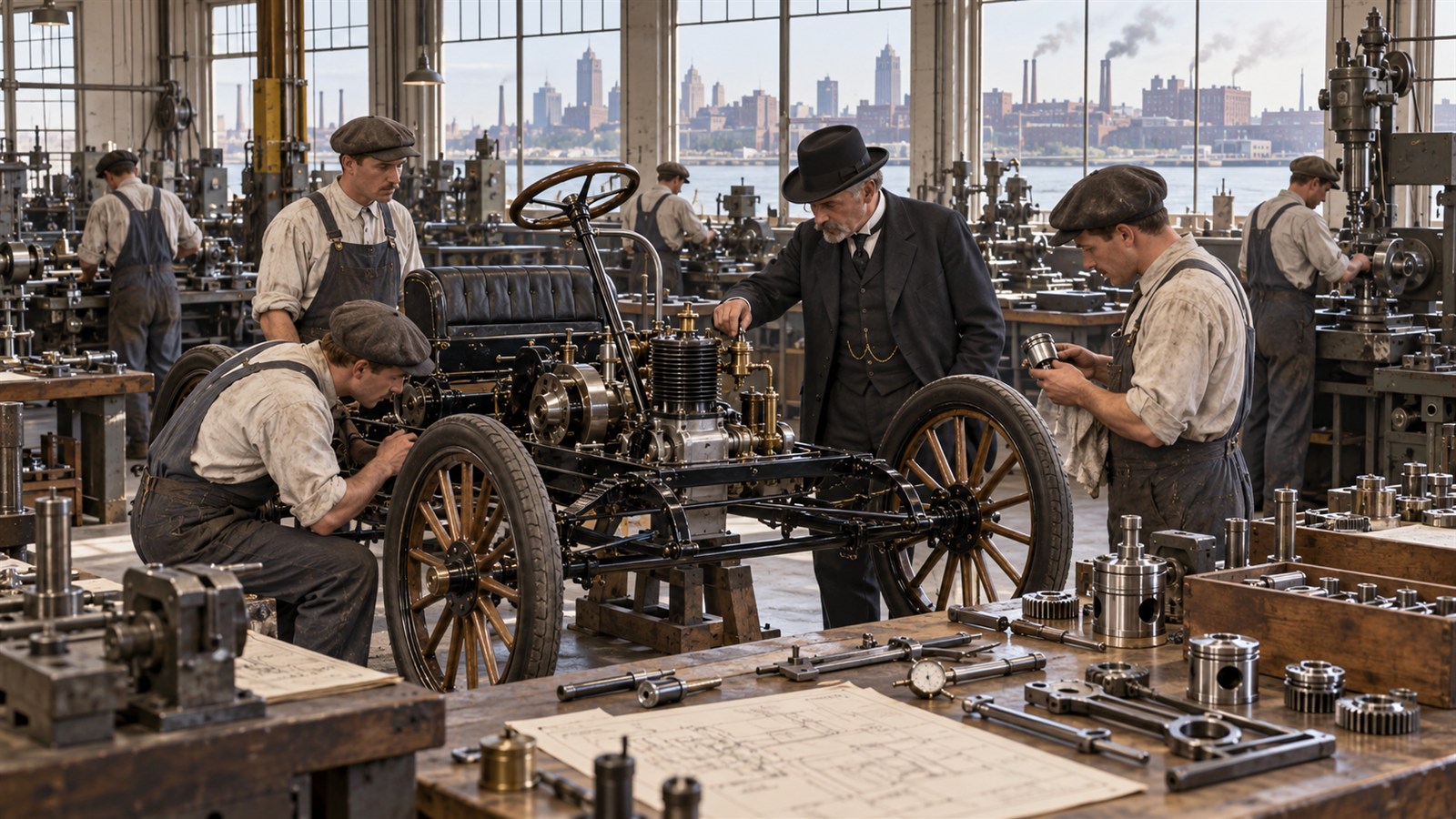
Cadillac traces its founding to August 22, 1902, when Henry M. Leland and his associates reorganized the remnants of the Henry Ford Company as the Cadillac Automobile Company. Investors had brought Leland in to appraise the failed venture's assets. Instead of recommending liquidation, the precision manufacturer proposed building automobiles around an engine developed by his firm. The new company took the name of Antoine de la Mothe Cadillac, founder of Detroit. What began as a salvage assignment became a fresh enterprise centered on accurate manufacturing and dependable machinery.
Leland's background in machine tools shaped Cadillac's strategy. Early automobile production often relied on skilled fitting because nominally identical parts varied from one vehicle to another. Cadillac emphasized measurement, gauges, and interchangeability. Standard parts reduced assembly and repair complexity and made quality less dependent on the intuition of a particular craftsman. In 1908, the company won the Royal Automobile Club's Dewar Trophy after cars were disassembled, their parts mixed, and then successfully reassembled. The demonstration turned manufacturing discipline into a marketable promise.
Cadillac used engineering features and premium positioning to distinguish itself in a crowded field of young automakers. General Motors acquired the company in 1909, giving GM a luxury division and Cadillac access to a larger corporate system. The brand later introduced or popularized electric starting, advanced engines, and other features that made automobiles easier and more desirable to use. Its development shows how a product category becomes segmented: customers do not buy only transportation, but also reliability, status, comfort, design, and confidence in service.
The company's founding is notable because it emerged from a business that investors were ready to close. Leland recognized that assets, skills, and supplier relationships could be recombined around a stronger operating idea. Turnarounds rarely preserve everything; they select what still has value and impose new standards. Cadillac's early success rested less on inventing the automobile than on making precision and interchangeability central to its identity. That focus helped industrialize car production and gave a rescued factory a durable position in the developing American auto market. Precision also improved the economics of service after a sale. Dealers could stock replacement parts with greater confidence, mechanics could complete repairs more quickly, and customers faced less risk that one damaged component would disable an otherwise valuable car for an extended period. Those savings strengthened resale value and made ownership easier to predict, two advantages that helped automobiles move from experimental purchases toward dependable household assets.
Cadillac's founding is dated to August 22, 1902.
Henry Leland proposed reorganizing a troubled Detroit automaker rather than liquidating it.
The new company centered its strategy on precision manufacturing and dependable engines.
Interchangeable parts reduced fitting, repair complexity, and variation among vehicles.
General Motors acquired Cadillac in 1909 and positioned it as a premium division.
Cadillac's origin shows how assets from a failed venture can be recombined around a stronger operating model.
Explore more of "On This Day ..."
Discover more events from the same date across news, politics, technology, sports, and other fields. Each link highlights significant moments that shaped history on different fronts.