

On This Day in Business: August 30, 1956
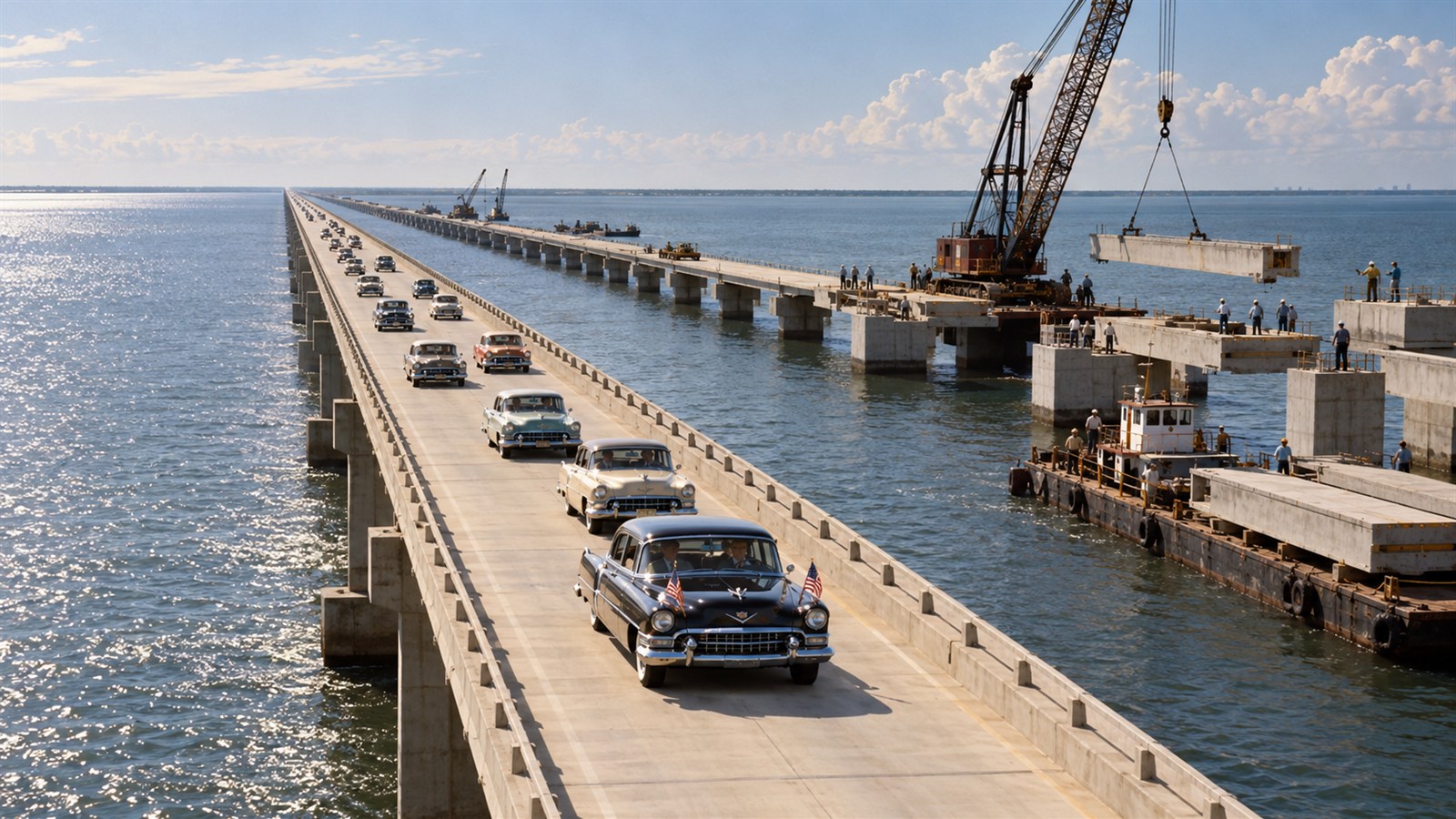
The original Lake Pontchartrain Causeway opened to traffic on August 30, 1956, connecting Metairie on the south shore with Mandeville on the north. At nearly 24 miles, the bridge created a direct route across the lake and was then the world's longest bridge over water. More than 600 vehicles joined opening-day celebrations. The project reduced a long drive around the lake and made daily movement between the New Orleans metropolitan area and north-shore communities practical, changing commuting, land values, development, and access to regional markets.
The bridge was also a manufacturing achievement. Engineers used hundreds of repeated prestressed-concrete piles, caps, and deck sections. Components were cast at an onshore plant, loaded onto barges, and assembled across the lake in a production-line process. Standardization reduced cost and construction time; the first span was completed in about fourteen months after pile driving began. The approach treated infrastructure less like a one-off monument and more like a product assembled from interchangeable units, transferring factory logic onto open water.
Financing and operation mattered after construction. Tolls helped support the facility, while the Greater New Orleans Expressway Commission managed traffic, maintenance, and later expansion. Demand eventually justified a parallel span, opened in 1969, so each bridge could carry one-way traffic. The causeway became both transportation infrastructure and a development corridor. Shorter travel times encouraged residential and commercial growth on the north shore, demonstrating how a road investment can redistribute economic activity rather than merely speed existing trips.
The causeway remains exposed to weather, corrosion, collisions, and the continuing cost of inspection and repair. Its history shows that the opening ceremony is only the beginning of an infrastructure business. Value depends on decades of safe operation, predictable tolling, emergency response, and reinvestment. The 1956 span is notable for both its scale and its method: mass production made an extraordinary crossing feasible. By turning repetitive engineering into a coordinated construction system, the project showed how standardization can lower the cost of building connections that permanently reshape a region. Standard components also simplified later inspection and replacement. Repetition gave maintenance teams familiar details to examine and made engineering knowledge transferable along the span. The same decision that accelerated construction therefore continued to shape operating cost long after the opening-day motorcade disappeared. The causeway became a recurring service obligation as well as a finished asset, requiring toll collection, patrols, emergency procedures, weather monitoring, and capital reserves for repairs. Its business model had to finance that continuing promise of safe passage.
The first Lake Pontchartrain Causeway span opened on August 30, 1956.
The nearly 24-mile route linked metropolitan New Orleans with north-shore communities.
Engineers mass-produced repeated piles, caps, and deck sections at an onshore plant.
Barge delivery and standardized assembly shortened construction and controlled cost.
Tolls and a dedicated commission supported continuing operation and later expansion.
The bridge altered commuting, land development, and the economic geography around the lake.
Explore more of "On This Day ..."
Discover more events from the same date across news, politics, technology, sports, and other fields. Each link highlights significant moments that shaped history on different fronts.