

On This Day in Business: August 29, 1885
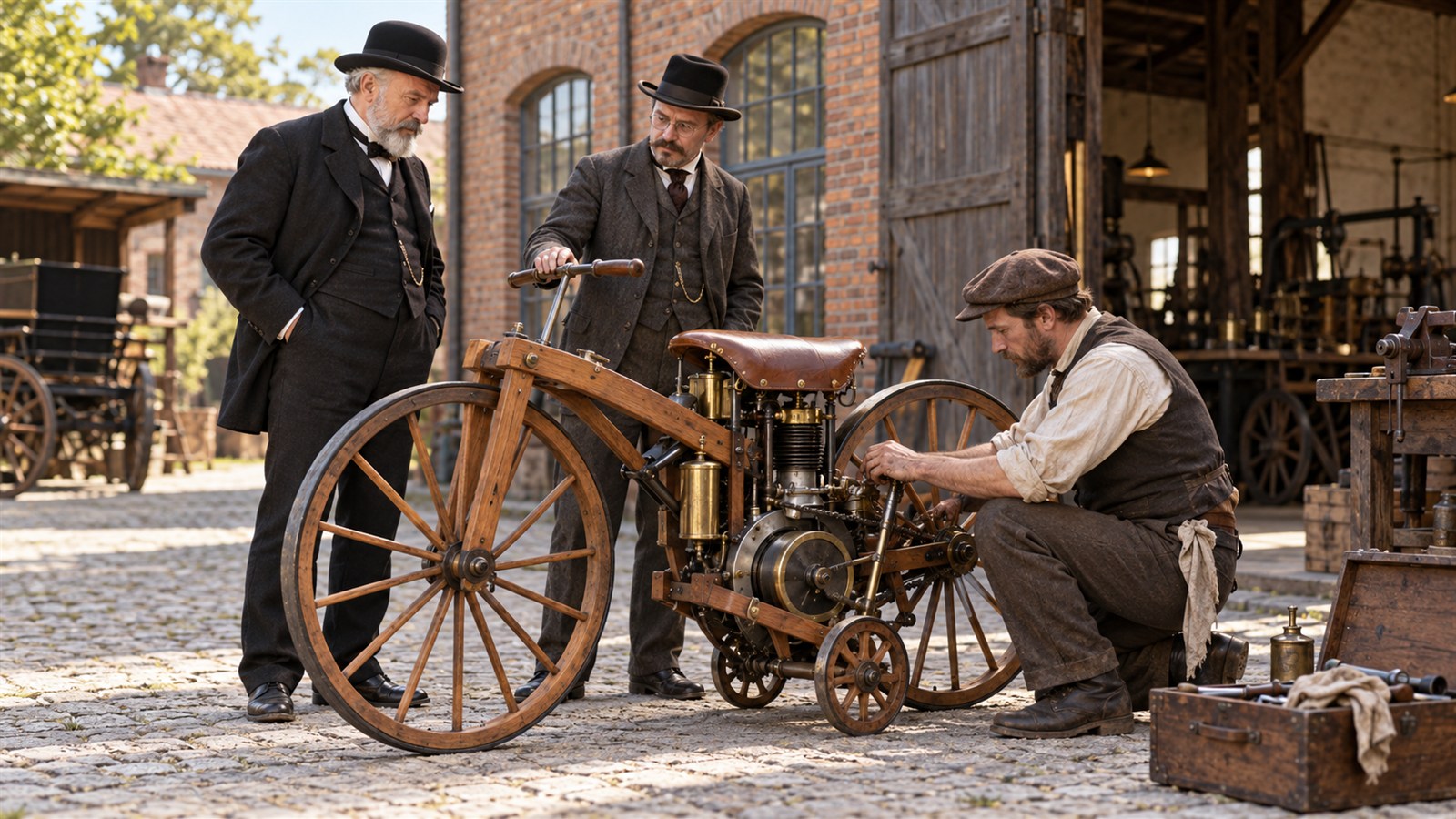
On August 29, 1885, Gottlieb Daimler filed a German patent for a vehicle using a gas or petroleum engine. The wooden two-wheeler, developed with Wilhelm Maybach and later called the Reitwagen, placed their compact high-speed internal-combustion engine into a road-going test vehicle. Small stabilizing wheels made it unlike a modern motorcycle in handling, but it is widely recognized as the first functioning motorcycle powered by an internal-combustion engine. The machine's larger purpose was to prove that the new engine could propel a vehicle independently of rails.
Daimler and Maybach focused on making the four-stroke engine smaller, lighter, and faster-running than stationary designs. Portability mattered because a power source that could fit into different vehicles opened multiple markets. The Reitwagen was therefore a prototype and a technology demonstrator, not a mass consumer product. After testing on two wheels, the engine concept moved into carriages and boats. This sequence reflects a common innovation strategy: use a simple platform to validate the risky component, then transfer the component into applications with greater commercial potential.
Motorcycles later developed through contributions from many inventors and manufacturers. They offered lower purchase costs, lighter weight, and greater maneuverability than cars, supporting personal transport, delivery work, military use, policing, sport, and recreation. A specialized supply chain emerged for engines, frames, tires, protective gear, repair, and racing. The category also carried safety and environmental costs that prompted licensing, road rules, emissions standards, and design improvements. What began as an engine test became a global industry with distinct brands and customer communities.
The patent's business importance lies in technological transfer. Daimler and Maybach were not only building one vehicle; they were developing a compact power unit that could be reused across products. Reusable core technology can support an entire portfolio and attract partners who see applications the original inventors did not pursue. The Reitwagen made the engine visible in motion and reduced uncertainty about its potential. That demonstration helped move internal combustion from workshop apparatus toward a commercial platform for mobility, with consequences that would transform cities, manufacturing, energy demand, and personal travel. The prototype also created a visual argument that specifications alone could not provide. Investors, engineers, and potential partners could watch the engine carry a rider over a road, making portability concrete and exposing vibration, cooling, control, and durability problems that bench testing might conceal. Each visible failure became design information, and each successful run reduced the perceived risk of applying the engine to a more valuable vehicle.
Daimler filed the Reitwagen patent on August 29, 1885.
The wooden two-wheeler tested a compact, high-speed internal-combustion engine on the road.
Stabilizing wheels and prototype construction distinguished it from later motorcycles.
The same engine concept could be transferred to carriages, boats, and other vehicles.
Motorcycles later created markets for affordable transport, delivery, sport, equipment, and repair.
The Reitwagen demonstrated the portfolio value of a reusable core technology.
Explore more of "On This Day ..."
Discover more events from the same date across news, politics, technology, sports, and other fields. Each link highlights significant moments that shaped history on different fronts.