

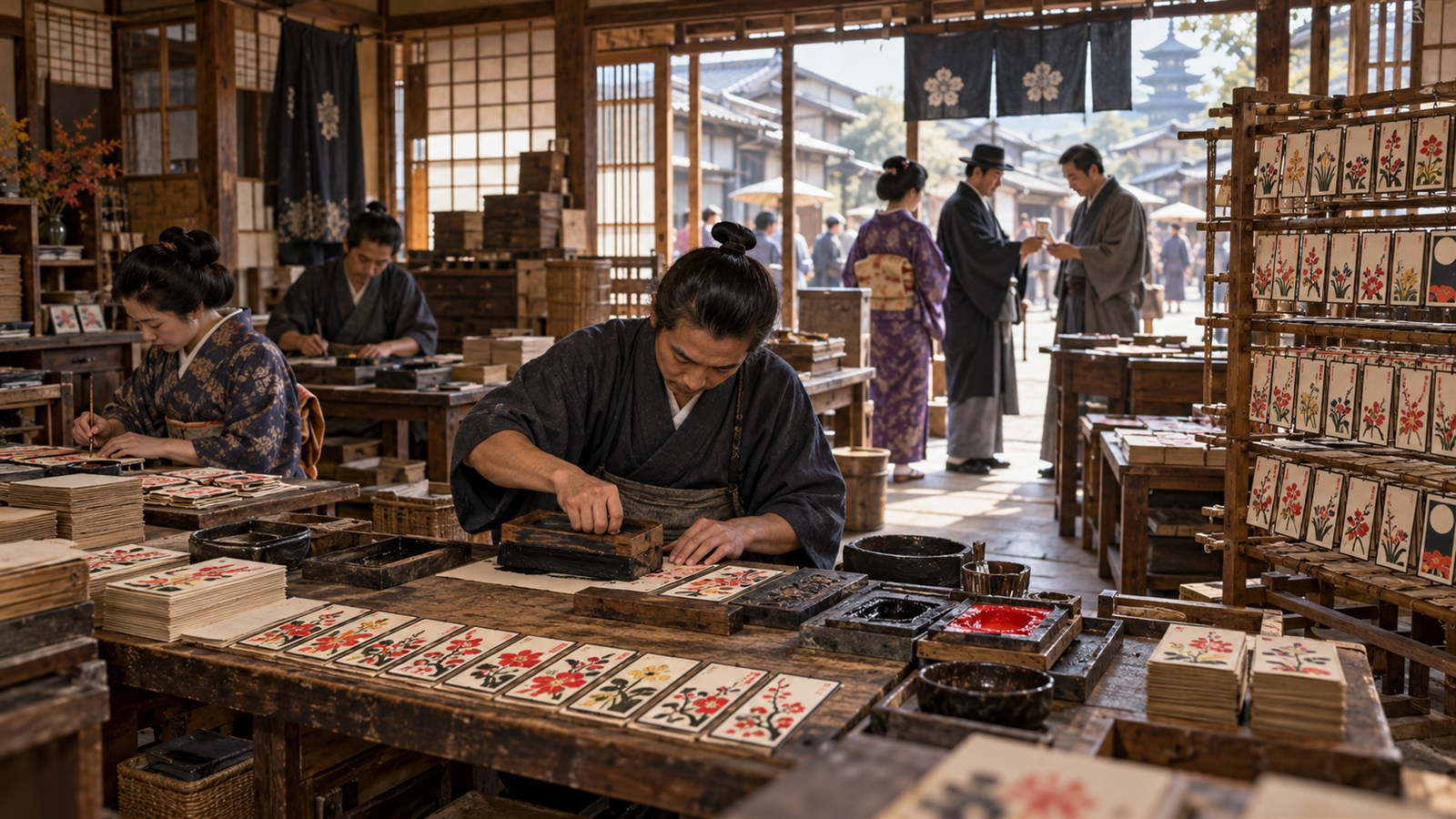
On This Day in Business: September 23, 1889
Nintendo traces its founding to September 23, 1889, when Fusajiro Yamauchi began producing hanafuda playing cards in Kyoto, Japan. Hanafuda used illustrated flower designs rather than conventional numbers and suits, and skilled makers printed and assembled the cards by hand. Yamauchi's small business served an established leisure market with a product whose value depended on durable materials, recognizable artwork, and trust in the maker. Long before electronic entertainment, Nintendo was already in the business of creating repeatable rules, social play, and physical objects people gathered around.
The card trade required careful distribution. Retailers and specialized dealers connected the workshop with players, while design and quality distinguished legitimate products from cheaper alternatives. Nintendo expanded into Western-style cards and later experimented with many businesses as Japanese consumer markets changed. Some ventures failed, but the company retained expertise in play, manufacturing, and mass-market distribution. That continuity mattered more than any single product line. It provided a platform from which management could explore toys and, eventually, electronic games.
During the twentieth century, Nintendo developed mechanical toys, light-gun games, arcade machines, and handheld electronic products before entering home consoles. The company repeatedly combined hardware with characters and rules that made technology understandable. Its card heritage remained visible in that approach: a device mattered because it enabled a designed form of play. Strong intellectual property and quality control later helped Nintendo recover the home video-game market in North America, while franchises such as Mario and Zelda turned individual releases into durable entertainment ecosystems.
Nintendo's history is often used to illustrate reinvention, but it also demonstrates the value of a stable underlying purpose. The company changed materials, technologies, and distribution many times while remaining focused on structured amusement. That focus helped it evaluate opportunities outside the boundaries of a particular product. The September 1889 founding therefore connects hand-crafted cards with global interactive entertainment without pretending the path was predetermined. Most long-lived firms survive through experiments, failures, and shifts in leadership. Nintendo's advantage was the ability to carry design knowledge, customer trust, and a culture of play from one format to the next. Its first business was small, but its core question—how to create an experience people want to share and repeat—proved remarkably scalable. The card business also taught the importance of controlled randomness, clear symbols, and social rules—principles that transfer naturally into game design. Nintendo did not simply abandon one industry for another; it carried a vocabulary of play into every new technical format it explored.
Nintendo's official records date its founding to September 23, 1889.
Fusajiro Yamauchi began making hanafuda playing cards in Kyoto.
Craft quality, illustration, distribution, and trust shaped the early card business.
Nintendo later experimented with cards, toys, arcades, handhelds, and home consoles.
Hardware became valuable when paired with accessible rules, characters, and repeatable play.
The company's longevity reflects a stable entertainment purpose expressed through changing technology.
Explore more of "On This Day ..."
Discover more events from the same date across news, politics, technology, sports, and other fields. Each link highlights significant moments that shaped history on different fronts.