

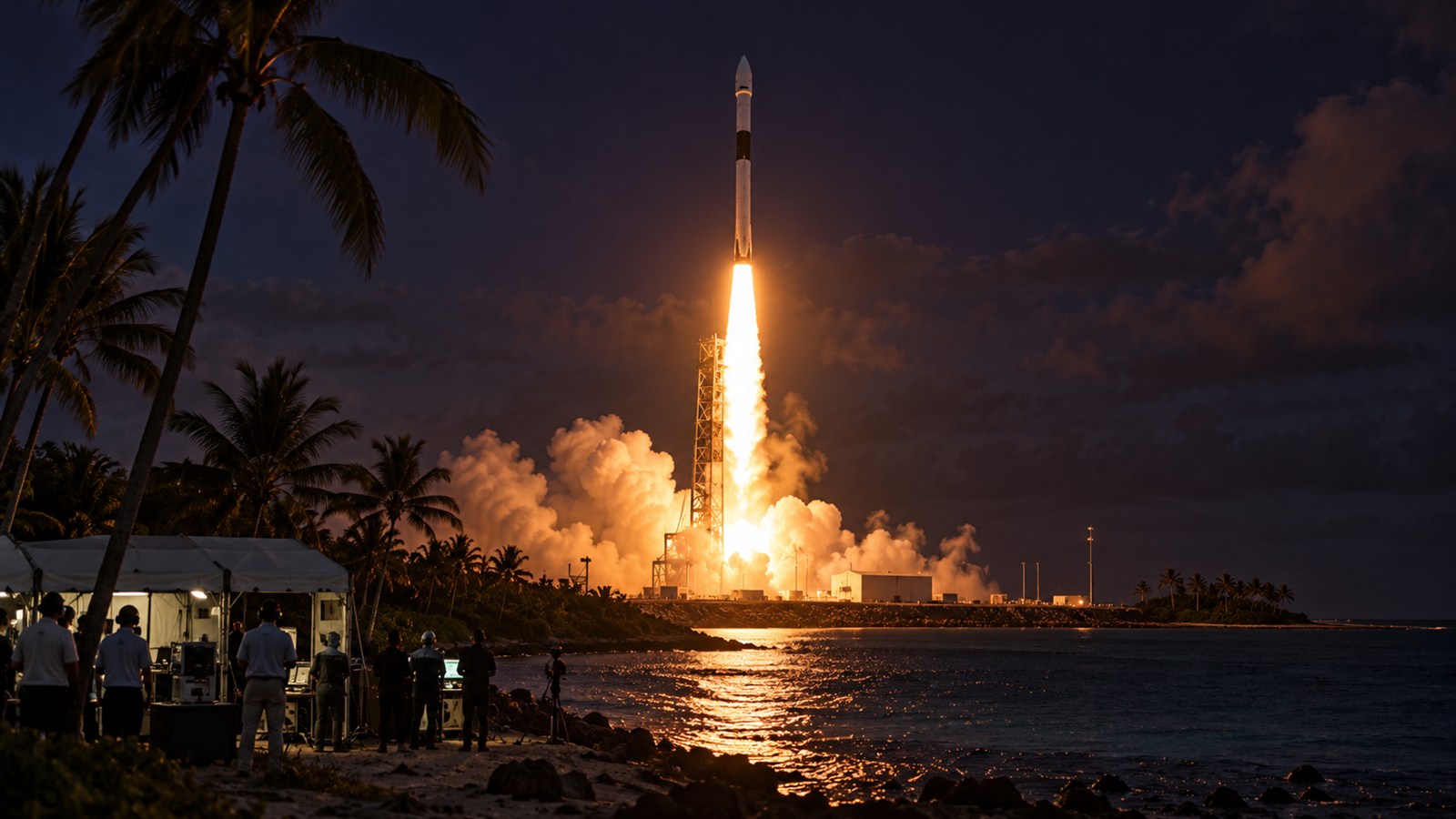
On This Day in Business: September 28, 2008
On September 28, 2008, SpaceX successfully launched Falcon 1 from Omelek Island in the Kwajalein Atoll. The two-stage, liquid-fueled rocket placed a demonstration payload into orbit, becoming the first privately developed and funded liquid-propellant launch vehicle to achieve that milestone. Success came on the fourth attempt. Three earlier flights had failed for different reasons, and the third loss had occurred less than two months before. With limited cash remaining, the fourth mission was both an engineering test and an existential business event for the young company.
Falcon 1 was designed to offer lower-cost access to orbit for smaller payloads. SpaceX attempted to reduce expense through in-house development, a compact workforce, reusable design ambitions, and vertical control over engines and structures. Those choices increased learning but also concentrated risk inside the company. Each failed flight consumed hardware, time, reputation, and investor confidence. Engineers had to diagnose causes, modify systems, manufacture replacements, and preserve team focus under a schedule that conventional aerospace organizations might have considered impossible.
The fourth flight carried an inert payload rather than a paying satellite, allowing the company to prove ascent, stage separation, engine performance, guidance, and orbital insertion. Reaching orbit validated core technology and changed how customers and government partners could evaluate SpaceX. The achievement strengthened the case for Falcon 9 and Dragon, systems later used for commercial satellites, International Space Station cargo, crew transportation, and large constellations. One small rocket did not create those markets alone, but it moved the firm from promise to demonstrated capability.
Falcon 1's success became a turning point in commercial space. It showed that a privately financed entrant could develop orbital launch hardware outside the traditional prime-contractor structure, while SpaceX's later NASA partnerships demonstrated the importance of public demand and technical oversight in scaling that capability. The September 28 flight also offers a clear innovation lesson: failure can generate valuable evidence only if an organization has enough capital, discipline, and time to act on it. Persistence by itself is not a strategy; persistence joined with rapid diagnosis and design change can be. Orbit transformed those accumulated lessons into credibility, financing options, contracts, and a foundation for a much larger launch business. The isolated launch site added another layer of execution. Hardware, fuel, instruments, and specialists had to reach a small Pacific island, where weather and limited facilities constrained every attempt. Logistics became part of the vehicle program, reinforcing the principle that advanced products succeed only through equally capable operations.
Falcon 1 reached orbit from Omelek Island on September 28, 2008.
It became the first privately developed and funded liquid-fueled rocket to achieve orbit.
The success followed three failed flights and arrived during severe financial pressure.
The demonstration mission validated engines, staging, guidance, and orbital insertion.
Credibility from Falcon 1 supported development of Falcon 9, Dragon, and later commercial services.
The milestone showed how rapid learning, capital endurance, and public-private demand can reshape an industry.
Explore more of "On This Day ..."
Discover more events from the same date across news, politics, technology, sports, and other fields. Each link highlights significant moments that shaped history on different fronts.