

On This Day in Business: October 11, 1887
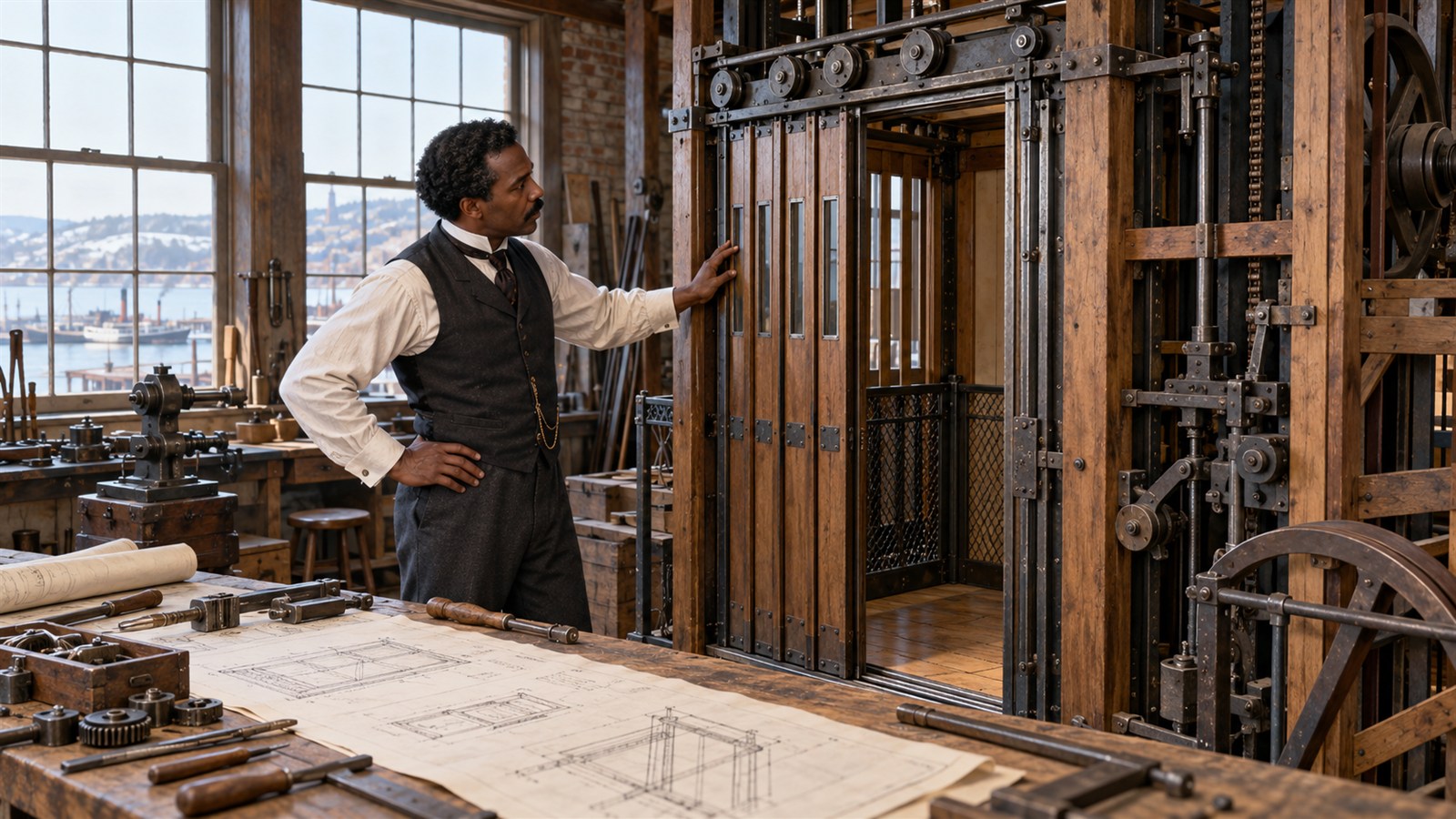
On October 11, 1887, the United States Patent Office issued Patent No. 371,207 to Alexander Miles of Duluth, Minnesota, for improvements to elevator doors. Elevator passengers and operators could encounter dangerous open shafts when landing doors were left unsecured. Miles proposed mechanisms linked to the movement of the car that would close shaft openings and operate sliding cage doors as the elevator approached or departed a floor. He did not invent the elevator or every form of automatic door, but his patent addressed a practical safety problem at a moment when taller commercial buildings were making vertical transport central to urban life.
The specification described a flexible belt covering shaft openings except at the car's current floor, along with levers, rollers, tracks, and segmented sliding doors. The system attempted to make safe behavior part of the machinery rather than depend entirely on a human operator remembering each step. That principle has enduring business value. When equipment prevents a predictable mistake, it can reduce injuries, downtime, insurance losses, and the training burden while increasing customer confidence. Patents offered inventors a temporary right to exclude others from the claimed invention in exchange for public disclosure, creating both an asset and a record that competitors could study.
Miles was a Black entrepreneur who had worked as a barber and operated businesses in Duluth, where he and his family were prominent members of the community. His patent belongs within the broader history of Black innovation during an era of severe legal and commercial discrimination. Access to capital, manufacturing, distribution, and enforcement could determine whether a patented idea became a profitable product. The document proves inventive contribution, but it does not by itself reveal a mass-production business. That distinction is important: invention, commercialization, and industry standardization are separate achievements that often involve different participants.
Automatic interlocks, sensors, and powered doors later became fundamental to safe elevator operation, helping make upper floors practical for offices, apartments, hotels, and stores. Vertical mobility changed urban land values by turning height into usable and rentable space. The 1887 patent therefore connects a compact mechanical improvement with the economics of the modern city. Miles's work shows how safety innovation can unlock adoption: customers are more willing to enter a system when routine hazards are designed out of it. It also demonstrates why business history should look beyond famous founders to the inventors whose components make entire markets more dependable. For building owners, reliability transformed the elevator from an occasional machine into expected infrastructure. That expectation supported taller structures, concentrated more tenants on valuable land, and created continuing markets for inspection, repair, modernization, and liability management.
Alexander Miles received U.S. Patent No. 371,207 on October 11, 1887.
The patent described mechanisms for closing shaft openings and operating elevator-car doors.
Its design sought to replace a dangerous manual dependency with motion-linked safeguards.
Miles was a Black inventor and entrepreneur working within a discriminatory commercial environment.
A patent records and protects an invention, but manufacturing and market adoption require additional capital and partners.
Safer elevators helped turn upper floors into practical, valuable commercial real estate.
Explore more of "On This Day ..."
Discover more events from the same date across news, politics, technology, sports, and other fields. Each link highlights significant moments that shaped history on different fronts.