

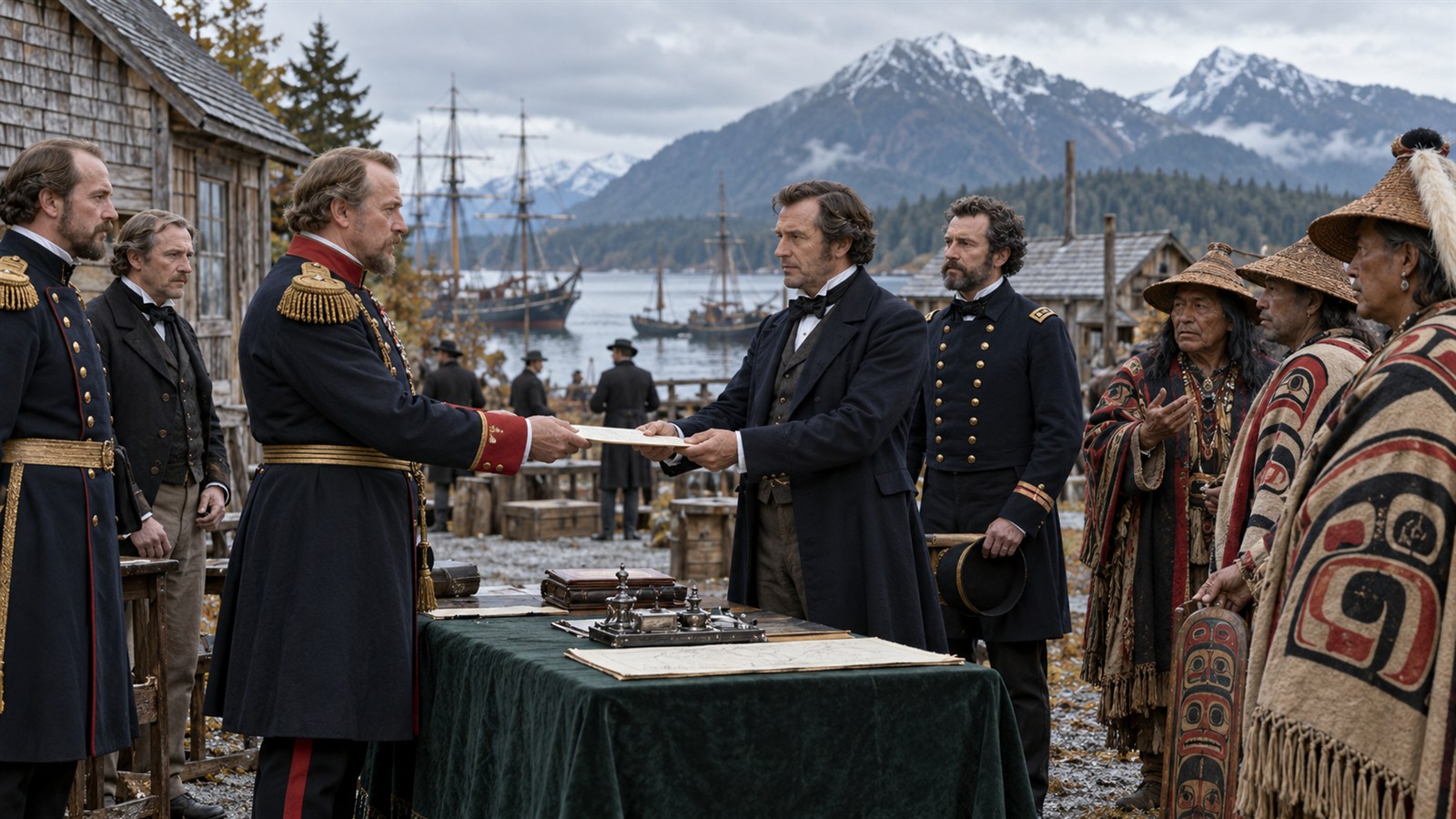
On This Day in Business: October 18, 1867
On October 18, 1867, representatives of Russia and the United States completed the formal transfer of Alaska at Sitka. The United States had agreed in March to pay $7.2 million for roughly 586,000 square miles, following negotiations led by Secretary of State William H. Seward and Russian minister Edouard de Stoeckl. Russia sought funds and considered the distant colony difficult to defend; the United States gained territory on the Pacific rim. The transaction is often told as a bargain validated by later discoveries, but it transferred sovereignty over lands already inhabited by diverse Alaska Native peoples who were not parties to the sale.
Commercial motives were present from the beginning. Russian expansion had centered on the maritime fur trade, particularly sea otter pelts, and American merchants were active across the North Pacific. Supporters imagined access to fisheries, timber, minerals, Asian trade, and strategic ports. For decades, however, federal governance and private investment remained limited. Military, Treasury, and naval authorities administered the territory in succession, while Indigenous communities confronted new laws, missions, commercial practices, and continued encroachment after earlier exploitation by Russian companies.
The Klondike gold rush in the late 1890s drew capital and migrants through Alaska, and later mining, commercial fishing, timber, military construction, aviation, and petroleum reshaped the economy. The discovery of major North Slope oil and completion of the Trans-Alaska Pipeline created enormous revenue but also environmental risk and dependence on a volatile commodity. Statehood in 1959 and the Alaska Native Claims Settlement Act of 1971 changed land ownership and created Native corporations, a distinctive structure combining settlement, business organization, and community interests.
October 18 belongs in business history because it shows the limits of describing territory as an asset on a balance sheet. The purchase price captured an agreement between empires, not the full value of land, ecosystems, culture, or sovereignty. Later profits required infrastructure, labor, public spending, technology, and legal frameworks that arrived over many decades. Alaska's experience also demonstrates how resource wealth can finance services while exposing communities to price cycles and extraction costs. The transfer created strategic and commercial options for the United States, but a complete accounting must include the Indigenous peoples whose rights and economies endured through a transaction made without their consent. Public revenue from resource development later supported a permanent fund that distributes annual dividends to eligible residents. That model turned a portion of exhaustible oil income into financial assets, illustrating one attempt to share benefits across people and time rather than consume them immediately.
Russia formally transferred Alaska to the United States at Sitka on October 18, 1867.
The purchase price was $7.2 million for a vast territory on the North Pacific.
Alaska Native peoples were not parties to the sale of lands they already inhabited.
Furs, fisheries, minerals, timber, transport, military activity, and oil later shaped the economy.
Infrastructure and law, not the purchase alone, determined when resources became commercially valuable.
The history links strategic acquisition with Indigenous sovereignty, environmental cost, and commodity dependence.
Explore more of "On This Day ..."
Discover more events from the same date across news, politics, technology, sports, and other fields. Each link highlights significant moments that shaped history on different fronts.