

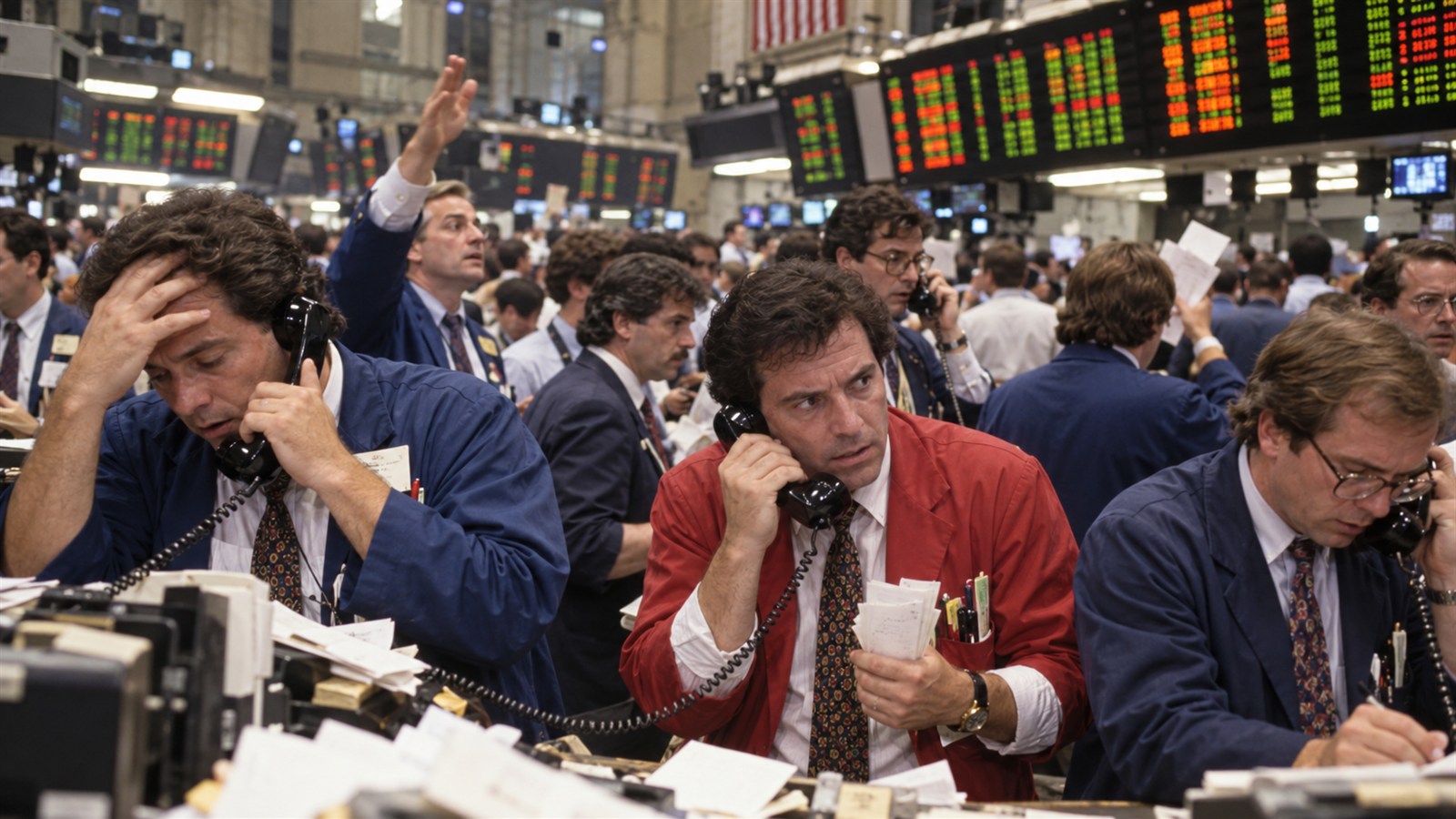
On This Day in Business: October 19, 1987
On October 19, 1987, a worldwide stock sell-off reached the United States with extraordinary force. The Dow Jones Industrial Average fell 508 points, or 22.6 percent, in a single session—the largest one-day percentage decline in its history. Markets in Asia and Europe had already dropped, and selling orders overwhelmed available buyers as New York opened. Investors, brokers, exchanges, banks, and clearing organizations confronted a crisis moving faster through electronic links and derivative markets than earlier systems had been designed to handle. The day became known as Black Monday.
No single cause explains the collapse. Share prices had risen rapidly earlier in the year, while concern grew about interest rates, the U.S. trade deficit, and the dollar. Portfolio-insurance strategies used futures selling in an effort to limit losses, but as prices fell, the strategies called for more selling. Stock, options, and futures markets operated with different trading and settlement arrangements, adding uncertainty about positions and payments. Computerized order systems accelerated volume, but human fear and a sudden absence of willing buyers were equally important. A risk method that appeared protective for one institution could amplify danger when many institutions acted together.
The Federal Reserve stated the next morning that it was ready to provide liquidity to support the financial and economic system. It encouraged banks to continue lending to securities firms, helping markets meet payment obligations. Exchanges and regulators later strengthened coordination, clearing procedures, and circuit breakers designed to pause trading during extreme declines. Firms revised models to account for sharper price moves, changing correlations, and liquidity that could disappear under stress. The crash did not produce a major U.S. recession or banking panic, and markets recovered much of the loss relatively quickly, but the near breakdown exposed structural weaknesses.
Black Monday remains a warning about feedback loops. A tool can reduce risk for one portfolio while worsening system-wide conditions when used at scale. Modern markets are faster and more automated, making safeguards, capital, testing, and cross-market communication even more important. October 19 also changed expectations about central-bank crisis response, establishing a prominent example of public liquidity supporting private market function. That support can limit contagion, but it raises questions about moral hazard and future risk taking. The business lesson is not that technology caused the crash; it is that strategy, incentives, infrastructure, and crowd behavior interact, often in ways that historical data cannot fully predict. Continuity also depended on back-office institutions that the public rarely saw. Clearing, settlement, credit lines, and operational communications had to function after prices collapsed. Market resilience required those systems to process yesterday's obligations while participants were reassessing tomorrow's risks.
The Dow Jones Industrial Average fell 22.6 percent on October 19, 1987.
The decline followed losses abroad and became the first modern global market crash.
Portfolio insurance and market-structure mismatches amplified selling and settlement pressure.
The Federal Reserve supplied confidence and encouraged banks to support securities firms with liquidity.
Exchanges later adopted stronger coordination, clearing practices, and circuit breakers.
Black Monday shows how individually rational risk controls can create dangerous system-wide feedback loops.
Explore more of "On This Day ..."
Discover more events from the same date across news, politics, technology, sports, and other fields. Each link highlights significant moments that shaped history on different fronts.