

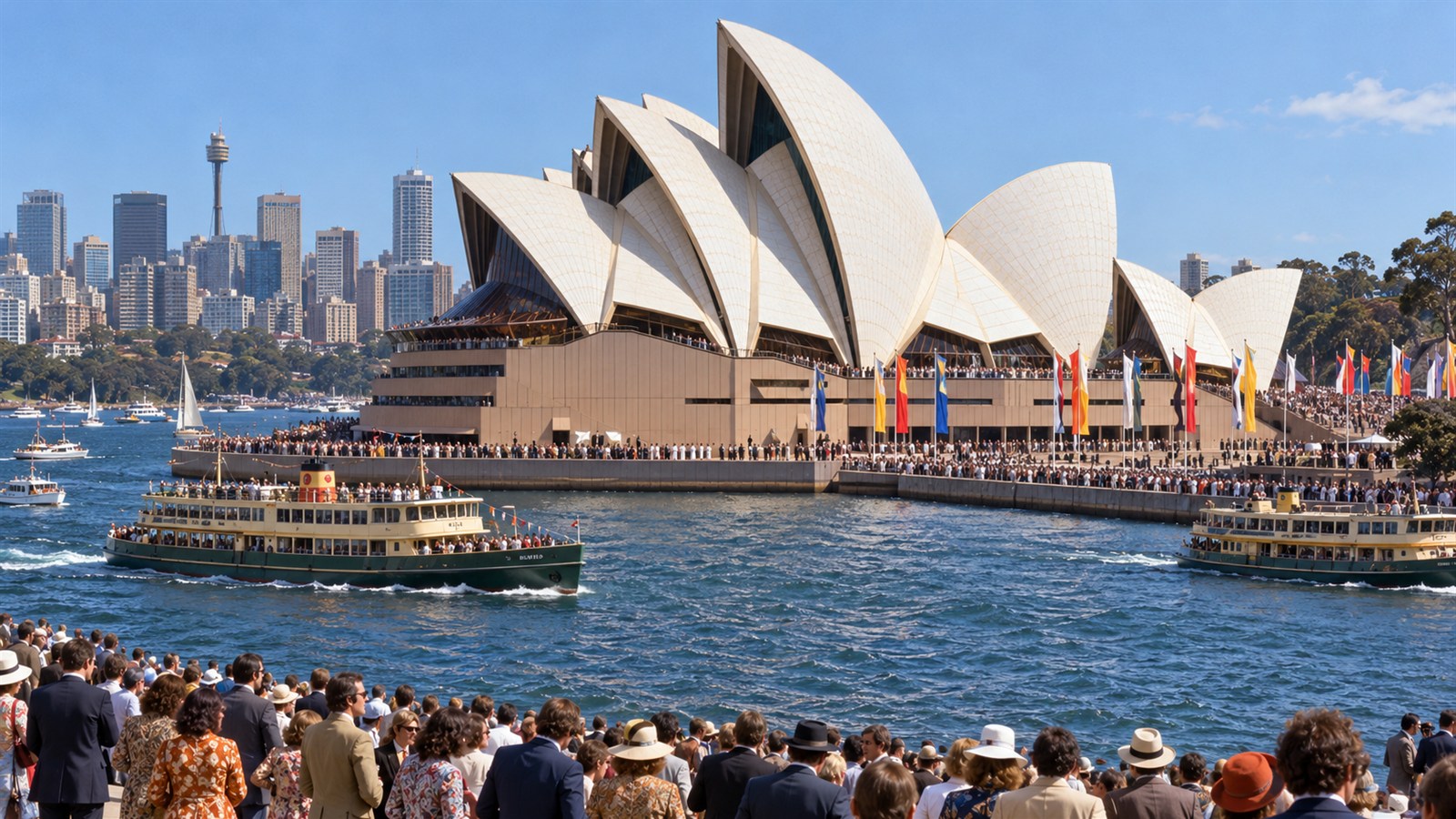
On This Day in Business: October 20, 1973
On October 20, 1973, Queen Elizabeth II formally opened the Sydney Opera House on Bennelong Point. The building's sail-like shells gave Australia an instantly recognizable symbol, but the route to completion was contentious. Danish architect Jørn Utzon won an international competition in 1957 with a design whose roof geometry had not yet been solved. Construction began before every technical question was settled, and the project moved through redesigns, political conflict, cost escalation, and Utzon's resignation in 1966. The final complex opened about a decade later than originally expected and at a cost far above the early estimate.
The project required engineers, builders, manufacturers, acousticians, stage specialists, and public administrators to invent methods as work progressed. Ove Arup's engineering team and Utzon eventually developed the shell forms as sections of a sphere, allowing repeated components to replace a collection of unrelated curves. That solution illustrates the business value of modular thinking: a bold design became buildable when unique-looking surfaces could be produced through a common geometric system. At the same time, incomplete scope and changing requirements exposed the danger of beginning a megaproject before design, budget, governance, and political sponsorship are aligned.
Operationally, the building combined several performance venues, rehearsal areas, restaurants, tours, and public spaces. Its value was never limited to ticket revenue. The image of the Opera House promoted Sydney internationally, drew visitors, supported nearby hospitality, and strengthened Australia's cultural brand. Public architecture could therefore function as economic infrastructure and intellectual property at city scale. The benefits accumulated over decades, while the construction cost was concentrated and politically visible in advance—a familiar challenge for long-lived civic investments.
The Opera House later underwent renovations and a gradual reconciliation with Utzon, whose design principles guided subsequent work. It became a UNESCO World Heritage Site and one of the world's busiest performing-arts centers. October 20 shows that a troubled project can still create exceptional long-term value, but that outcome should not excuse weak management or damage to creative partnerships. The building's legacy joins two lessons: ambitious design can generate commercial and civic returns far beyond ordinary real estate, and delivering that design requires clear governance, realistic sequencing, technical experimentation, and respect between the people financing, managing, and creating the work. Managers can learn from the gap between the icon and the process. A finished landmark compresses years of conflict into one image, but future sponsors should preserve records of decisions, make accountability clear, and test whether cost and schedule assumptions match the maturity of the design.
The Sydney Opera House formally opened on October 20, 1973.
Jørn Utzon's competition-winning design required major engineering development before it could be built.
A spherical geometry allowed apparently unique shells to use related, repeatable components.
Early construction, changing scope, political conflict, and cost escalation disrupted the project.
The completed building created tourism, cultural, hospitality, and city-brand value beyond ticket sales.
Its history combines the rewards of ambitious design with the governance risks of megaprojects.
Explore more of "On This Day ..."
Discover more events from the same date across news, politics, technology, sports, and other fields. Each link highlights significant moments that shaped history on different fronts.